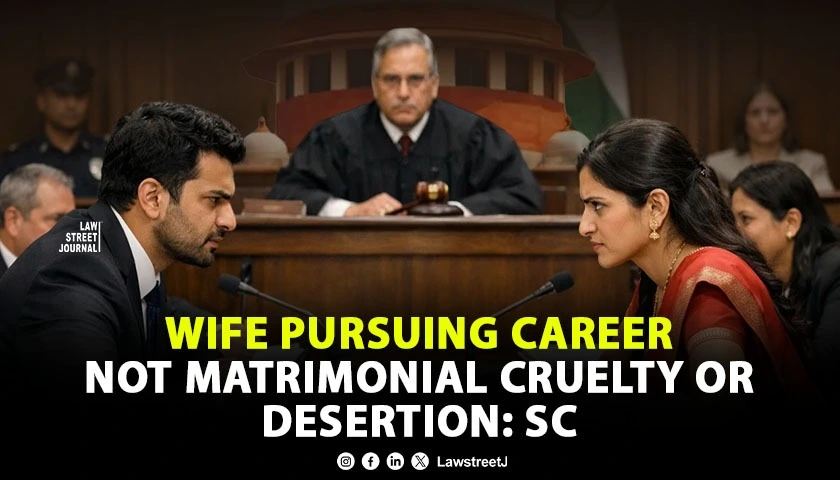
New Delhi: In a strongly worded ruling reaffirming gender equality within marriage, the Supreme Court of India observed that treating a wife’s pursuit of professional aspirations as matrimonial cruelty merely because it may offend the sensitivities of her husband or in-laws reflects a regressive mindset that is fundamentally at odds with contemporary constitutional values.
The Division Bench of Justice Vikram Nath and Justice Sandeep Mehta allowed a civil appeal filed by the wife, expunging the findings of cruelty and desertion recorded against her by the Family Court, which were later affirmed by the Gujarat High Court, while upholding the decree of divorce on the ground of irretrievable breakdown of marriage.
The parties married in September 2009 under Hindu and Christian rites and later registered their marriage under the Special Marriage Act. The wife, a dentist, gave up her dental practice in Pune to join her husband, an Indian Army officer, during his posting in Kargil. During her pregnancy, she returned to Ahmedabad due to inadequate medical facilities in Kargil and later gave birth to their daughter in April 2012.
After their daughter developed serious health issues in Kargil, the parties returned to Ahmedabad for treatment. Amid rising marital disputes, the wife sought maintenance, and the Family Court granted Rs. 55,000 per month, later modified by the High Court to Rs. 25,000 for the wife and Rs. 20,000 for the daughter.
The husband had also filed a suit seeking dissolution of marriage. The Family Court, by its judgment dated 30 September 2022, decreed divorce on the grounds of cruelty and desertion attributed to the wife. Upon scrutiny, the Supreme Court found the Family Court’s observations to be appalling and totally unacceptable.
The Family Court had held that the wife’s decision to open her dental clinic in Ahmedabad without informing the husband or his family amounted to cruelty, as it was expected of a wife that any such step be taken with the knowledge of the husband’s family. The wife’s request to stay at her parental home during visits to Ahmedabad was similarly treated as cruelty, since a married woman was expected to reside at the matrimonial home. The Family Court had further observed that it was the bounden duty of a wife to reside with her husband wherever he chose to reside, and that the wife’s attempts to run her own clinic were indicative of an intent not to reside with the husband at his place of posting, thereby constituting desertion.
The allegation that the wife had once not permitted the husband’s mother to hold the minor daughter, allegedly fearing infection, was also treated as cruelty. The High Court affirmed all these findings.
Examining this approach, the Supreme Court described the reasoning of the Family Court as pedantic and regressive. It observed that the endeavour of the appellant to establish her own dental clinic at Ahmedabad, rather than allowing a professional qualification earned through years of effort to lie dormant and go to waste, had been viewed with disapproval merely because her stance did not conform to the expectation of the husband and in-laws that she must abandon her aspirations and reside with her husband at a remote location on account of his posting.
The Court held that such assumptions, rooted in a conservative patriarchal understanding of marital roles, are wholly incompatible with the progressive evolution of society where dignity, autonomy, and equal participation of women in all spheres are recognised as fundamental to social advancement.
The Court emphasised that a well-educated and professionally qualified woman cannot be expected to be confined within the rigid boundaries of matrimonial obligations alone. Marriage does not eclipse her individuality, nor does it subjugate her identity under that of her spouse. It is for both the husband and the wife to balance their marital ties in a manner that respects mutual aspirations, and not for one to unilaterally dictate the life choices of the other. A woman can no longer be treated as a mere appendage to the household of the husband, and her independent intellectual and professional identity must receive due credence and respect.
The Court further held that what was portrayed as defiance in the impugned judgments was, in truth, an assertion of independence, and what was labelled as desertion was, on closer scrutiny, a consequence of circumstances shaped by professional commitments, the welfare of the minor child, and the realities of life. To characterise such conduct as cruelty or desertion was to effectively penalise the wife for exercising choices integral to her dignity and personhood.
The expectation that a woman must invariably sacrifice her career and conform to traditional notions of an obedient wife, irrespective of her own aspirations or the welfare of the child, reflects a line of reasoning that is archaic, ultra-conservative, and cannot be countenanced at a time when women are leading various professional fields from the forefront.
On the specific finding regarding the inauguration of the dental clinic without informing the husband or in-laws, the Court observed that the husband’s attitude throughout the proceedings was that of male chauvinism, claiming an exalted status on account of Army service and never supporting the career of his own wife. Under such circumstances, the wife’s decision to open the clinic without disclosure must have been taken out of sheer compulsion to deter the husband from obstructing her rightful professional pursuit.
The Court further observed, in a significant passage, that it was convinced that the Family Court would never have taken the same view had there been a role reversal. If the wife were serving in the Army while the husband was a medical professional, then the husband would never be expected to sacrifice his career merely to remain by her side, and his failure to do so would certainly not have been branded as cruelty and desertion.
The Court also addressed the allegation that the wife had sought to coerce the husband to convert to Christianity, observing that the material on record disclosed no clear or credible evidence substantiating such allegations, which appeared to arise in the backdrop of competing claims during intense matrimonial discord. The only consistent circumstance was that the husband had accompanied the wife to a church in Tamil Nadu, which by itself would not constitute coercion or cruelty. This had to be seen in the context that the marriage was a love marriage solemnised in accordance with the customs of both faiths.
The Court observed that, having considered the husband’s attitude during hearings and his thrust in seeking the prosecution of the wife, it was convinced that he had an attitude of domineering control, which was likely the cause for the wife taking steps toward independence and pursuing her career. The steps taken by her were characterised as absolutely justified in view of the prevailing facts and circumstances.
Since the wife had expressed through counsel that she was no longer hopeful of resuming the marriage, and since the husband had reportedly remarried, the Supreme Court declined to disturb the divorce decree. However, it expressly expunged and set aside all observations and findings regarding cruelty and desertion and directed that the decree of divorce shall be deemed to have been passed on the ground of irretrievable breakdown of marriage. The civil appeal was accordingly partly allowed.
In the connected special leave petition, the husband had challenged the rejection of his application seeking prosecution of the wife for perjury, alleging that she had made false statements on oath in the maintenance proceedings. The Court dismissed this petition, observing that the allegations appeared to be instigated by personal vendetta and a spiteful approach fuelled by anger and pent-up frustration owing to multiple cases filed against him.
The Court held that the allegations did not disclose the necessary ingredients of the offence of perjury or giving false evidence, and that the grievances appeared to stem from a hyper-technical dissection of material in the backdrop of escalated matrimonial acrimony.
Case Title: Ann Saurabh Dutt v. Lieutenant Colonel Saurabh Iqbal Bahadur Dutt, Civil Appeal arising out of SLP(Civil) No. 25076 of 2024 with SLP(Civil) No. 28451 of 2024