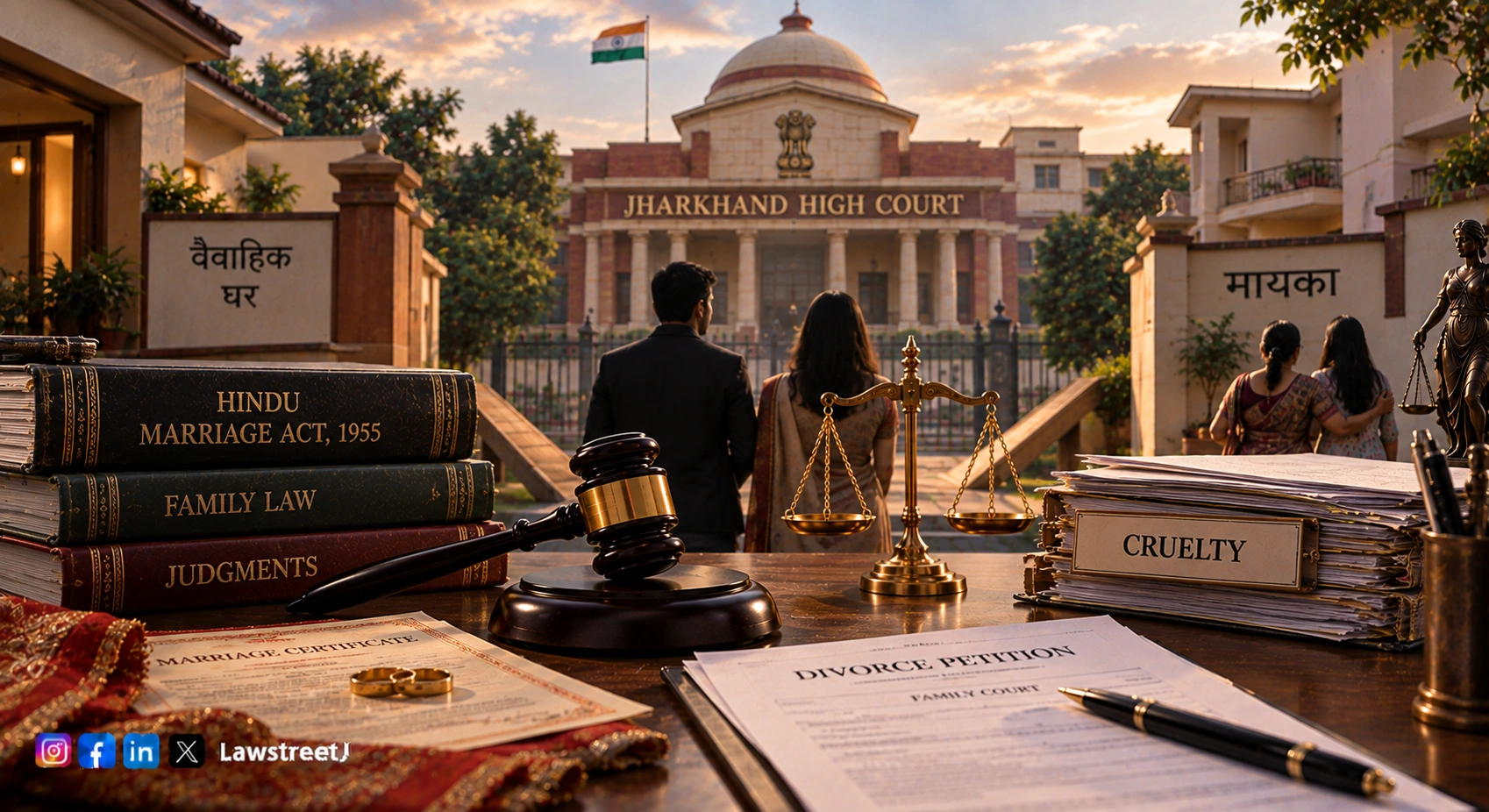
Ranchi: The Jharkhand High Court has dismissed a husband's first appeal against a Family Court judgment that had refused him a decree of divorce on the ground of cruelty under Section 13(1)(i-a) of the Hindu Marriage Act, 1955, holding that a wife's frequent visits to her parental home are as good as a bride's right, and that her family's wish that the husband live as a Gharjamai, without any compulsion, does not constitute cruelty.
A Division Bench of Justices Sujit Narayan Prasad and Sanjay Prasad was hearing F.A. No. 86 of 2022, challenging the judgment and decree passed by the Principal Judge, Family Court, Hazaribagh, dismissing Original Suit No. 148 of 2019.
The appellant's case was that he married the respondent in 2008 at Patna according to Hindu rites, and that a daughter was born to them in 2011. He alleged that soon after marriage the respondent began visiting her parental home in Patna frequently and eventually stopped returning, her parents wanting him to leave his own elderly, ailing parents and live with them as a Gharjamai, a proposal he refused. The respondent, now employed and settled in Patna, allegedly remained unwilling to resume matrimonial life, causing the appellant mental distress and social stigma, on the basis of which he sought divorce on the ground of cruelty. Despite service of notice, including publication in a Hindi daily, the respondent did not appear before the Family Court, and the suit proceeded ex parte, with the appellant examining himself and one other witness. The Family Court held that the appellant had failed to prove cruelty and dismissed the suit, leading to the present appeal, in which the respondent, again not appearing, was represented through an amicus curiae appointed by the Court.
Counsel for the appellant submitted that the Family Court's judgment was perverse and unsustainable, having failed to frame or properly appreciate the issue of desertion despite the respondent having left the matrimonial home since 2013 and never returning despite repeated attempts at reconciliation. It was submitted that compelling the appellant to abandon his dependent, ailing parents and settle as a Gharjamai amounted to mental cruelty, and that the respondent's persistent refusal to cohabit, coupled with her failure to contest the suit even after notice and paper publication, showed a clear intention to desert him. Relying on Narendra v. K. Meena, it was argued that persistent efforts by a wife to force separation from the husband's family constitute cruelty. It was further submitted that the marriage, subsisting for about nine years without any prospect of reconciliation, had irretrievably broken down, and that following Naveen Kohli v. Neeta Kohli and Samar Ghosh v. Jaya Ghosh, courts should not preserve an unworkable marriage merely to uphold its legal form once breakdown is complete, since doing so causes greater misery to the parties than granting divorce.
The amicus curiae appearing for the respondent submitted that it was in fact the appellant and his father who had subjected her to cruelty, including verbal abuse while drunk, in the presence of her daughter, and that she had endured physical, mental and economic torture silently in the hope of a peaceful married life, which was why she had not earlier approached any court. It was submitted that during the pendency of the suit, she learnt that the appellant intended to solemnise a second marriage and had promptly filed a police complaint asserting her status as his legally wedded wife to prevent the ceremony. It was contended that the respondent did not seek dissolution of the marriage at all and wished to resume married life with the appellant, and that the Family Court had rightly held that no cruelty of a serious nature justifying divorce had been established, the present suit having been filed by the appellant, who himself wished to remarry, under the guise of a cruelty claim.
The Court noted that, exercising appellate jurisdiction under Section 19 of the Family Courts Act, which is parallel to Section 96 of the Code of Civil Procedure, it was entitled to re-appreciate the entire evidence on facts and law and arrive at its own conclusion, as held in Jagdish Singh v. Madhuri Devi. It examined the settled principles on cruelty under matrimonial law, drawing on Dr. N.G. Dastane v. Mrs. S. Dastane, Shobha Rani v. Madhukar Reddi, V. Bhagat v. D. Bhagat, Vijaykumar Ramchandra Bhate v. Neela Vijaykumar Bhate, Joydeep Majumdar v. Bharti Jaiswal Majumdar and Vishwanath Agrawal v. Sarla Vishwanath Agrawal, holding that cruelty must be grave and weighty conduct rendering it unreasonable to expect the spouses to live together, going beyond the ordinary wear and tear of married life, and that its assessment depends on the social and economic background and values of the parties concerned.
Applying these principles to the facts, the Court held that the respondent's frequent visits to her parental home were as good as a bride's right and could not, by any stretch, be termed cruelty for the purpose of divorce. On the Gharjamai issue, it held that while the practice is an old social custom, it remains entirely the groom's choice to accept or decline, and since there was no case that the appellant had been compelled or forced to live as a Gharjamai, the respondent's mere wish that he do so did not constitute cruelty under the Hindu Marriage Act. The Court found that the Family Court had duly appreciated the evidence on record in rejecting the cruelty claim, and that its finding was not perverse.
Accordingly, the Court held that the appellant had failed to substantiate the alleged cruelty and that the Family Court's judgment dismissing the divorce suit required no interference.
The appeal was dismissed, along with any pending interlocutory applications. The Court placed on record the able assistance rendered by the amicus curiae and directed the Secretary, High Court Legal Services Committee, Ranchi, to make payment of the prescribed remuneration to him.
Appearances:
For the Appellant: Mr. Shekhar Prasad Gupta, Advocate.
For the Respondent: Mr. Atanu Banerjee, Amicus Curiae.
Case Title: Rahul Choubey vs. Poonam Pathak, F.A. No. 86 of 2022


![Supreme Court Collegium approves new Chief Justices for five key High Courts in India [Read Recommendations]](/secure/uploads/2023/12/lj_8000_380d1135-6f3a-4988-a00a-4d5cd5901815.jpg)
!['Arbitrary, impermissible,' SC quashes HC's resolution raising aggregate cut off marks on district judges appointment [Read Judgment]](/secure/uploads/2024/02/lj_3605_Rule-for-Judge-Selection.webp)