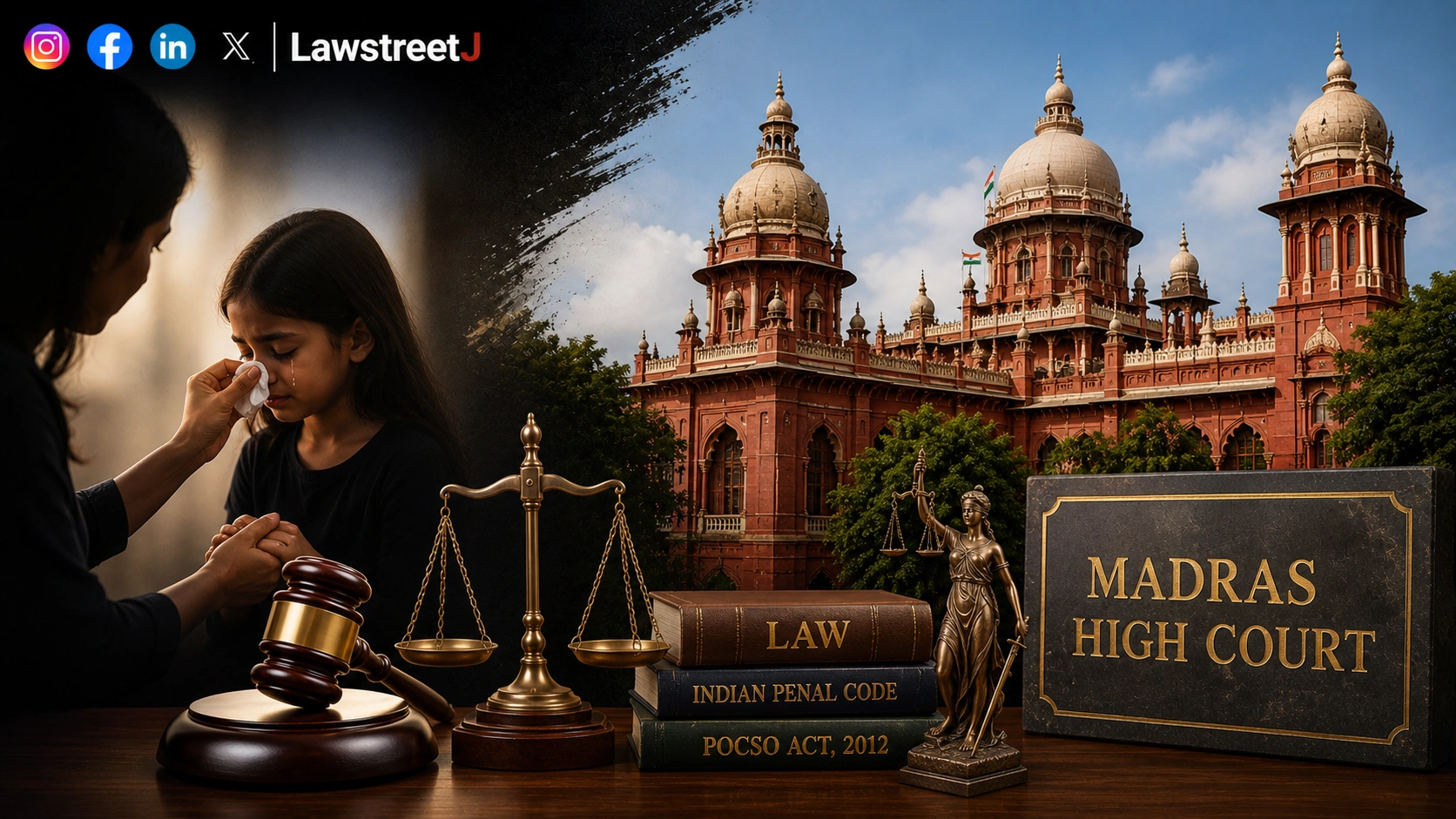
Madurai: The Madurai Bench of the Madras High Court has quashed criminal proceedings against a Grade-II police constable accused of aggravated sexual assault under the POCSO Act, holding that the allegations in the charge sheet did not disclose the essential ingredient of sexual intent. The Court found that the alleged acts of holding the minor victim’s hand and wiping her tears, viewed in the circumstances in which they occurred, could not by themselves be treated as acts of sexual assault merely because they involved physical contact.
Background
The Court has quashed a final report filed against a Grade-II police constable accused of offences under Sections 7, 8, 9(b)(iii) and 10 of the Protection of Children from Sexual Offences Act, 2012, holding that the material on record did not disclose the essential ingredient of sexual intent required to constitute the alleged offences.
Justice R. Vijayakumar was hearing a Criminal Original Petition filed by the sole accused, a constable attached to Battalion-III, Armed Reserve, Tirunelveli District, seeking quashment of the charge sheet pending before the Principal District Court, Tenkasi.
According to the final report, the petitioner and the victim, then a minor student of the 11th standard from the same locality, had been in an acquaintance that developed into a romantic association over about two years. After her parents learned of it, the girl was reprimanded and a complaint was lodged, resulting in an entry in the local Community Service Register. It was further alleged that on 10 September 2025, while the victim was on her way to school, the petitioner arrived in a car, asked for a few minutes of her time, and after she got into the rear seat and began to cry, stopped the vehicle near the school, held her hand, apologised for the difficulties caused to her, assured her that he would marry her once she completed Class XII and attained majority, and wiped the tears from her cheek.
Arguments
Counsel for the petitioner contended that the allegations, even taken at face value, amounted to nothing more than an assurance of marriage and the wiping away of tears, and did not answer the description of any offence under the Act. It was submitted that although wiping the tears involved bodily contact, the circumstances narrated in the final report itself ruled out any sexual intent, so that Sections 7 and 8 were not attracted. It was further argued that once Section 7 failed, Section 9(b), which deals with aggravated sexual assault by a member of the armed forces, could not apply, and Section 10, being the penal provision for that offence, would fall as well.
Counsel for the second respondent, the de facto complainant, argued that the petitioner having touched the victim's cheek, Sections 7 to 10 were squarely attracted, particularly since the victim lived within the area of the petitioner's deployment, and that he had continued to follow her even after the earlier complaint and Community Service Register entry. The learned Government Advocate, appearing for the police, submitted that the presence or absence of sexual intent was a question of fact to be decided only at trial, relying on the Explanation to Section 11 of the Act.
Analysis
The Court explained that Section 7 of the Act penalises touching of specified body parts, or any other act involving physical contact without penetration, but only when done with sexual intent, and that this mental element is the foundation of the offence rather than an incidental feature. Since the expression sexual intent is left undefined, the Court held that it must be gathered from the attendant circumstances under the Explanation to Section 11, a principle capable of establishing intent where circumstances point to it, and equally capable of ruling it out where they do not.
Examining the specific facts, the Court noted that the only act of physical contact attributed to the petitioner was the wiping of the victim's tears along with the holding of her hand, on a public road near the school in broad daylight, with the victim entering the vehicle voluntarily by her own admission, the petitioner seated in front while she occupied the rear seat, and the words attributed to him being ones of apology and assurance rather than anything of a sexual nature.
“the contact thus arose out of, and was wholly explicable by, an act of contrition and consolation.”
The Court held that reading sexual intent into such conduct would amount to assuming the very ingredient that the Explanation to Section 11 forbids courts from assuming. It further held that while sexual intent is ordinarily a question of fact for trial, that principle does not apply where the material, taken at its highest, does not disclose the ingredients of the offence at all. Once Section 7 failed, Section 9(b)(iii) could not independently apply merely because of the petitioner's status as a police constable, since that status could only aggravate an existing offence and could not supply the missing intent, and Sections 8 and 10, being penal provisions consequential upon Sections 7 and 9, would fall along with them. The Court also noted that the victim's own statements under Section 180(3) of the BNSS and Section 164 of the Cr.P.C. confirmed that she had entered the vehicle voluntarily and was not coerced.
Conclusion
Holding that the ingredients of Sections 7, 8, 9 and 10 of the POCSO Act were not made out and that permitting the prosecution to continue would amount to an abuse of the process of law, the High Court quashed the charge sheet pending before the Principal District Court, Tenkasi, allowed the Criminal Original Petition, and closed the connected miscellaneous petitions.
Appearances:
For the Petitioner: Mr. R. Pon Karthikeyan, Advocate.
For the 1st Respondent: Mr. P. Samuel Gunasingh, Government Advocate (Criminal Side).
For the 2nd Respondent: Mr. N. Gurusamy, Advocate.
Case Title: Maheshkumar v. State of Tamil Nadu and Anr., Crl.OP(MD) No. 1465 of 2026



![Madras High Court Directs Tamil Nadu Government to Ensure Quota for Transgenders in Local Body Elections [Read Order]](/secure/uploads/2023/08/lj_2507_7a03d113-08b1-4670-b6fb-9058aee481d0.jpg)