


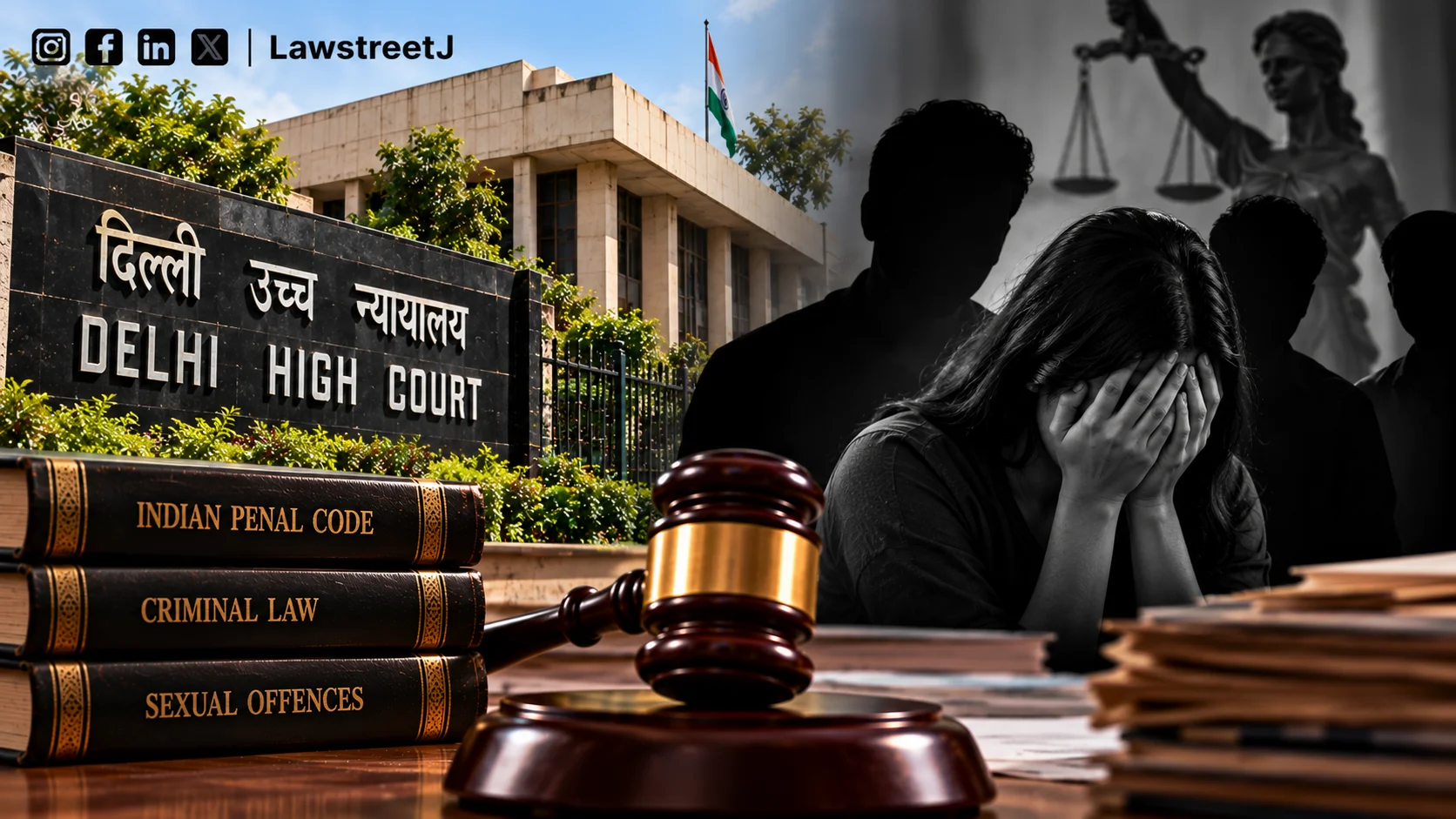
New Delhi: The Delhi High Court has held that a woman can also be charged with the offence of gang rape under Section 376D of the Indian Penal Code and Section 70 of the Bharatiya Nyaya Sanhita, 2023, clarifying however that a woman alone cannot be charged with that offence, and has dismissed a criminal revision petition challenging an order on charge in a POCSO case.
Justice A. J. Bhambhani was hearing a petition under Sections 438, 442 and 528 of the Bharatiya Nagarik Suraksha Sanhita, 2023, read with Article 227 of the Constitution, challenging the order on charge dated 17.01.2025 of the Additional Sessions Judge (POCSO), North District, Rohini Courts. The petitioners were charged under Sections 70(2), 351(3) and 64(2)(m) of the BNS and Section 6 of the POCSO Act, but pressed their challenge only on the ground that petitioner No. 1, a woman, cannot be charged with gang rape. The Court framed the question as whether a woman can be charged with gang rape under Section 376D IPC or Section 70 BNS.
The FIR was registered on 09.07.2024 at the instance of petitioner No. 1, the mother of the minor victim, initially alleging that the minor was kidnapped. After the victim reappeared on 01.10.2024, she stated in her statement under Section 183 BNSS that petitioner No. 1 threatened to kill her unless she submitted to sexual relations with petitioner No. 2, and remained present in the room during the incidents between December 2023 and July 2024. The Court appointed Mr. Rohan J. Alva as Amicus Curiae.
Appearing for the petitioners, Ms. Tanya Agarwal argued that under Section 63 BNS only a “man” can commit rape, so the reference to a “group of persons” in Section 70 can only mean a group of men. She relied on the Supreme Court's rulings in Priya Patel v. State of M.P. and State of Rajasthan v. Hemraj, which held that a woman cannot be prosecuted for gang rape. She also argued that the Legislature consciously did not replace the word “man” with “person” in 2013, and that the deeming fiction in Section 70 cannot be stretched beyond its purpose.
The Amicus, whose submissions were adopted by the State, submitted that Priya Patel and Hemraj were decided on the pre-2013 law, when gang rape was only an aggravated form of rape under Section 376(2)(g) IPC, tied to an Explanation. Since the 2013 amendment, he argued, Section 376D IPC, now Section 70 BNS, is an independent offence, and its phrasing about “one or more persons constituting a group or acting in furtherance of a common intention” is gender-neutral. He also relied on the Allahabad High Court's ruling in Suneeta Pandey v. State of U.P., which held that a woman who facilitates rape by a group may be prosecuted for gang rape.
Accepting this view, the Court traced the legislative history and noted that the 2013 amendment made gang rape a separate, substantive offence and expanded the definition of rape to include non-penile acts, a position retained in Sections 63 and 70 BNS. It held that Section 70 therefore need not be confined to the definition of rape in Section 63. The Court stressed that it was not deciding whether a woman can commit rape or interpreting the word “man” in Section 63, but only giving the offence of gang rape its ordinary and strict meaning, which refers to “persons” and not to men alone.
The Court found no reason to restrict “persons” to men, or to limit “common intention” to the intention of men. It observed that the phrases “one or more persons constituting a group” and “acting in furtherance of a common intention” are separated by the disjunctive “or”, so a person acting in furtherance of a common intention need not be among those who physically commit the offence. For instance, a woman who is not part of the group committing the act may yet have acted in furtherance of a common intention to have rape committed on the victim.
The Court further held that the phrase “deemed to have committed the offence of rape” shows that each person constituting the group or acting in furtherance of the common intention need not have individually committed rape. It concluded that such persons are liable to be charged with gang rape regardless of gender, and held that “there is no basis to hold that a woman cannot be charged” with that offence.
The Court added a caveat, stating that a woman alone cannot be charged with gang rape, as that would prima facie not conform to the statutory definition of rape in Section 375 IPC and Section 63 BNS as currently construed. It noted that this question may have to be revisited in an appropriate case, given the additional acts criminalised in the expanded definition, which can equally be committed by a non-male offender, and left open whether “man” in Section 63 is gender-neutral.
The Court also held that the charge under Section 6 of the POCSO Act was in any case sustained on the strength of its earlier ruling in Sundari Gautam v. State of NCT of Delhi, which held Section 3 of the POCSO Act to be gender-neutral. The order on charge dated 17.01.2025 was upheld and the petition was dismissed, with pending applications disposed of. The interim stay granted on 30.01.2025 had earlier halted the trial.
Appearances:
For the Petitioners: Ms. Tanya Agarwal, Ms. Ritu, Mr. Akshay Singhal and Mr. Vishal M., Advocates.
Amicus Curiae: Mr. Rohan J. Alva, with Mr. Anant Sanghi, Advocate.
For the State: Mr. Digam Singh Dagar, APP, with SI Naresh Kumar, P.S. Bhalswa Dairy.
Case Title: ANSXXX and Anr. vs. State of NCT of Delhi and Anr., CRL.REV.P. 37/2025



![Delhi High Court Sets Aside Arbitral Tribunal's Award Against NHAI in Highway Project Delay Case [Read Judgment]](/secure/uploads/2023/07/lj_9605_23374c2e-392c-4491-a2fe-f2f12fc5272f.jpg)
![Delhi Court Rejects Stay Request in Defamation Case Against Rajasthan CM Ashok Gehlot [Read Order]](/secure/uploads/2023/08/lj_5208_80de1ddc-d76a-4f7f-b180-408e3ae14fb4.jpg)

.jpeg)

.jpeg)

