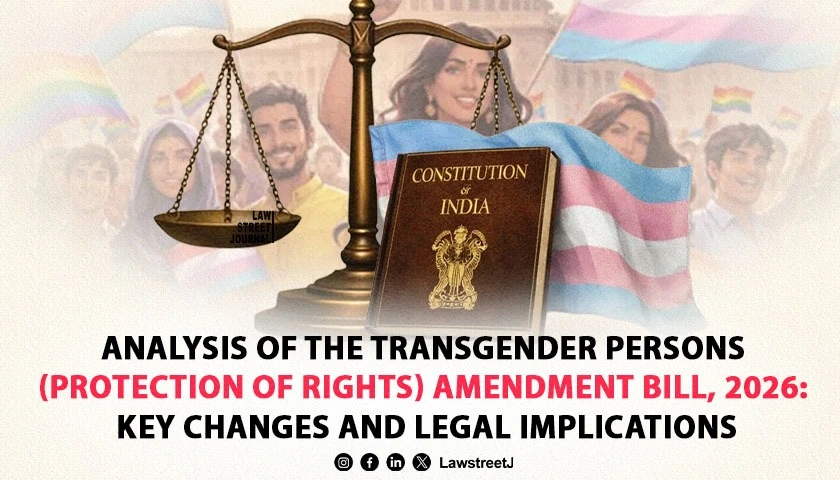
The Transgender Persons (Protection of Rights) Amendment Bill, 2026, was introduced in the Lok Sabha on March 13, 2026, by the Union Minister of Social Justice and Empowerment, Dr. Virendra Kumar. This amendment seeks to fundamentally modify the Transgender Persons (Protection of Rights) Act, 2019, which was originally enacted to provide legal recognition and welfare for the transgender community following judicial directions in NALSA judgement. The government’s primary stated objective in introducing these amendments is to provide a more “precise definition” for the identification of transgender persons, arguing that the 2019 definition was “vague” and led to significant implementation difficulties. According to the Bill’s Statement of Objects and Reasons, the legislative intent is to protect a specific class of persons who face severe social exclusion due to “biological reasons” through “no fault of their own and no choice of their own,” rather than protecting every individual with various gender identities or fluidities.
The 2026 Bill proposes a fundamental shift in the definition of a “transgender person,” replacing the broad categorization found in the 2019 Act. Under the 2019 legislation, a transgender person was defined as someone whose gender did not match the gender assigned at birth, inclusively covering trans men, trans women, intersex persons, and genderqueer individuals, regardless of medical interventions. In contrast, the 2026 Amendment Bill narrows this scope to primarily recognize individuals belonging to specific socio-cultural communities, namely kinner, hijra, aravani, jogta, or eunuchs. Additionally, it includes persons with specified congenital biological variations, such as chromosomal patterns, gonadal development, external genitalia, primary sexual characteristics, and endogenous hormone production or response. Crucially, the Bill explicitly states that the definition of a transgender person “shall not include, nor shall ever have been so included, persons with different sexual orientations and self-perceived sexual identities”.
To align with this definition, the Bill proposes the removal of Section 4(2) of the 2019 Act, which currently enshrines the right of transgender persons to a selfperceived gender identity. The government contends that the existing broad definition made it impossible to identify “genuinely oppressed” beneficiaries and rendered several penal, civil, and personal laws “unworkable”. This shift effectively seeks to replace the principle of self-identification with a more regulated medical and socio-cultural classification system. The Bill introduces a mandatory medical certification process for obtaining a certificate of identity, creating a Medical Board referred to as the “authority”. This board, headed by a Chief Medical Officer or a Deputy Chief Medical Officer, must examine the applicant and provide a recommendation to the District Magistrate. The District Magistrate must consider this recommendation before issuing a certificate and is further empowered to seek assistance from other medical experts if necessary.
The Bill also seeks to introduce new requirements regarding the change of name and gender in official records. While it affirms that recognized transgender persons are entitled to change their first name on birth certificates and other identity documents, this right is contingent upon meeting the new, stricter statutory definition. Furthermore, the Bill mandates that any transgender person who undergoes surgery to change their gender “shall” apply for a revised certificate of identity, changing the 2019 Act’s more optional “may” language. Medical institutions performing these surgeries are now required to furnish details of the procedure and the person involved to the relevant District Magistrate and medical authority in a prescribed manner.
Significant changes are proposed regarding offences and penalties, introducing a distinct criminal category aimed at addressing the “coerced” assumption of a transgender identity. It penalizes acts of compelling individuals, through force, deceit, or allurement, to undergo procedures like mutilation, emasculation, castration, or hormonal changes to assume a transgender identity. The penalties for such acts are notably severe; for instance, kidnapping or abducting an adult with the intent to cause such harm carries a minimum sentence of ten years of rigorous imprisonment, which may extend to life, and a minimum fine of two lakh rupees. If the victim is a child, the penalty is rigorous imprisonment for life and a minimum fine of five lakh rupees. Furthermore, the Bill seeks to increase punishments for the economic exploitation of persons forced into a transgender identity. Compelling an adult to dress as a transgender person and engage in begging or bonded labor is punishable with five to ten years of rigorous
imprisonment and a fine of at least one lakh rupees. If a child is subjected to the same treatment, the punishment increases to ten to fourteen years of rigorous imprisonment and a fine of at least three lakh rupees. These penalties are significantly higher than the general punishments outlined in the 2019 Act, which ranged from six months to two years.
The introduction of the 2026 Bill has generated considerable debate regarding its alignment with the landmark Supreme Court judgment in National Legal Services Authority (NALSA) V. Union Of India (Writ Petition (Civil) No.400 Of 2012). In this judgement, the apex court recognized transgender persons as a “third gender” and affirmed that the right to self-perceived gender identity is a fundamental right rooted in personal autonomy, dignity, and expression. The court also held that gender identity does not need to be proven through external, especially medical, means. The Court further characterized gender identity as a deeply felt internal and individual experience which may or may not correspond with the sex assigned at birth. This judgment was hailed for recognizing that the “moral failure lies in the society’s unwillingness to contain or embrace different gender identities”.
Critics, however, argue that the 2026 Bill violates and strikes at the very foundation of the NALSA judgment, as well as Articles 14, 15, 19(1)(a), and 21 of the Indian Constitution. It is contended that the Bill’s narrowed definition of transgender persons undermines Article 14 by arbitrarily excluding non-binary and gender-fluid individuals from its protective ambit, thereby denying them equal protection of the law. Further, Article 15 is implicated, as the Supreme Court in National Legal Services Authority v. Union of India (NALSA) recognized that discrimination on the ground of “sex” includes discrimination based on gender identity. The Bill is also said to infringe Article 19(1)(a), since the expression of one’s self-identified gender through dress, speech, and conduct constitutes a core aspect of personal autonomy and freedom of expression. Most significantly, critics contend that the Bill violates Article 21 by eroding the right to life and personal liberty, particularly the principle of self-determination of gender, which the Court in NALSA affirmed as intrinsic to dignity. The reintroduction of mandatory medical certification and institutional “gatekeeping,” it is argued, represents a regression from the constitutional vision of autonomy and dignity articulated in the judgment.
Further concerns have also been raised regarding the Bill’s retrospective tone, stating that the definition “shall never have been so included” persons with selfperceived identities. Additionally, this could also jeopardize more than 30,000 transgender certificates already issued under the 2019 Act, as it remains unclear if these individuals will be required to “re-prove” their identity under the new medical criteria. Additionally, the “forced identity” clauses are feared to be broad enough to target trans-led communities, non-governmental organizations, or families supporting a minor's gender transition by labeling support as “allurement”. Activists also claim the Bill was introduced without meaningful consultation with the transgender community, ignoring their demands related to sexual violence and marriage equality.
In conclusion, the Transgender Persons (Protection of Rights) Amendment Bill, 2026, represents a major shift in India’s legal framework governing gender identity. By narrowing the definition of a transgender person, removing the right to self-identification, and introducing mandatory medical board oversight, the Bill moves toward a regulated, medicalized model of gender recognition. While the government emphasizes the need for administrative clarity and targeted welfare delivery, critics remain focused on the Bill’s potential to conflict with the constitutional principles of dignity, autonomy, and expression affirmed by the Supreme Court in the NALSA judgment