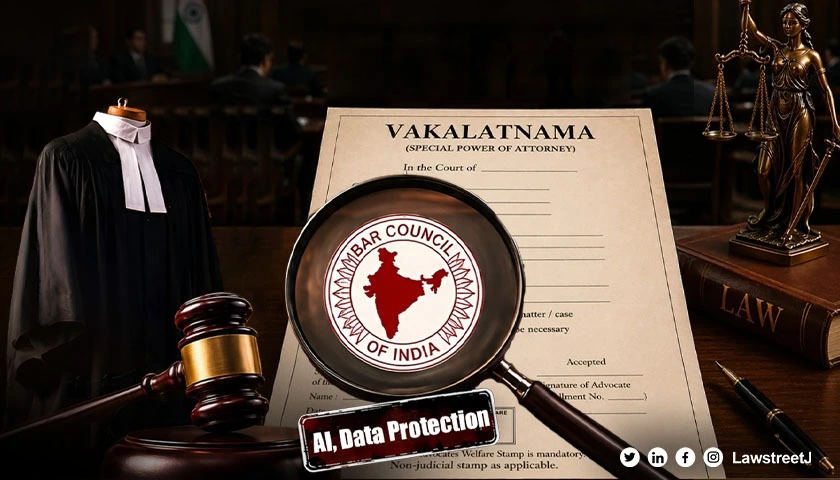
New Delhi: A representation has been submitted to the Bar Council of India urging it to amend the standard Vakalatnama format by incorporating an express client-consent clause authorising Advocates and law firms to process personal data through digital platforms and Artificial Intelligence tools, in compliance with the Digital Personal Data Protection Act, 2023.
The representation, addressed to the Chairman, Bar Council of India, has been submitted by Mr. Nitesh Mehra, an Advocate enrolled with the Bar Council of Delhi for the last sixteen years and Member Executive of the Delhi High Court Bar Association. It states that the representation is submitted in the larger interest of Advocates practising throughout India, with the aim of protecting the legal profession from legal and professional risk in an era where legal practice is being rapidly transformed by digital case-management systems, e-filing portals, cloud storage and Artificial Intelligence-assisted research and drafting tools.
Tracing the history and significance of the Vakalatnama, the representation notes that under Section 2(u) of the Advocates' Welfare Fund Act, 2001, a Vakalatnama includes a memorandum of appearance or any other document by which an Advocate is empowered to appear or plead before a court, tribunal or other authority, and is filed on the record of the Court as proof of the Advocate's authority to act on behalf of the party. It describes the Vakalatnama as the foundational document creating the advocate-client relationship, a document of record without which an Advocate has no locus to act for a party, and the only standard document executed between an Advocate and a client at the inception of every engagement, making it the most appropriate instrument to record client consent for the handling of personal data. The representation submits, however, that the Vakalatnama, though it authorises an Advocate to act, plead and receive process, is presently silent on the processing of personal or professional data through digital modes.
The representation states that an Advocate who uploads a client's documents to a cloud platform, shares them with a legal-tech vendor, or processes them through an AI research tool is, in law, undertaking processing of personal data as defined under Section 2(x) of the DPDP Act, 2023, and that the absence of an express consent clause in the Vakalatnama leaves both the client's data without a documented lawful basis and the Advocate personally exposed to allegations of breach of confidentiality or non-compliance with the DPDP Act.
Examining the existing legal framework, the representation refers to the rule-making power of the Bar Council of India under Section 49 of the Advocates Act, 1961, the confidentiality obligation under Rule 17 of the Bar Council of India Rules and the legal professional privilege provisions of the Indian Evidence Act, 1872, now re-enacted in the Bharatiya Sakshya Adhiniyam, 2023, and submits that these provisions, being pre-digital in origin, do not contemplate or regulate the digital processing of client data. It also refers to Section 6 of the DPDP Act, 2023, which requires processing of personal data to be based on free, specific, informed, unconditional and unambiguous consent, and notes that while the consent requirements under Section 6 are yet to be brought fully into force under the Digital Personal Data Protection Rules, 2025, the representation is intended as a pre-emptive and preparatory measure ahead of the provisions becoming operational. It further flags potential exposure under Section 72A of the Information Technology Act, 2000, the right to privacy under Article 21 of the Constitution, and the Supreme Court's draft Regulations for Use of Artificial Intelligence in Courts, 2026.
Placing reliance on the nine-Judge Bench decision in Justice K.S. Puttaswamy (Retd.) v. Union of India, reported in (2017) 10 SCC 1, the representation notes that the right to privacy has been held to be a fundamental right protected under Article 21 of the Constitution, and refers to the Report of the Committee of Experts headed by Justice B.N. Srikrishna, “A Free and Fair Digital Economy” (2018), which emphasised consent as the cornerstone of lawful data processing. It also refers to the Supreme Court of India's AI Committee, headed by Justice P.S. Narasimha, which released the draft Regulations for Use of Artificial Intelligence in Courts, 2026 for public consultation on June 3, 2026, requiring disclosure of AI-assisted material to courts, and submits that while the draft Regulations govern disclosure of AI use to the Court, they do not address the Advocate's authority, as between the Advocate and the client, to use AI tools while handling the client's personal data.
The representation proposes that the Bar Council of India, in exercise of its rule-making power under Section 49 of the Advocates Act, 1961, and in coordination with the State Bar Councils and the High Courts, recommend or mandate insertion of the following consent clause as a standard part of every Vakalatnama executed across the country:
“I/We hereby expressly give consent to authorize the Advocate(s)/Law Firm to collect, process, store, use, disclose, and transfer my/our Personal data through secure digital platforms, including court e-filing systems, cloud storage, legal technology applications, AI-assisted legal tools, and secure communication platforms, solely for the purposes of legal representation, legal research, drafting, court proceedings, and compliance with applicable law. Such processing shall be limited to what is necessary and shall be carried out in accordance with the Digital Personal Data Protection Act, 2023, including Section 16 thereof and any rules, notifications, or directions issued thereunder from time to time by Central Government.”
The representation suggests that the consent be made subject to safeguards including notice under Section 5 of the DPDP Act, a right of withdrawal of consent under Section 6(4), and provision for consent to be given by a parent or lawful guardian where the Vakalatnama is executed on behalf of a minor or person under legal disability, in line with Section 9 of the Act. It further suggests that the clause be placed immediately below the operative authorisation portion of the Vakalatnama and above the executant's signature, that it be drafted in the vernacular Vakalatnama formats prescribed by respective High Courts, and that the Bar Council of India issue an accompanying practice note clarifying the scope of the authorisation.
Concluding that the insertion of such a clause would benefit clients through genuine transparency, Advocates through a documented and contemporaneous authorisation reducing their exposure to allegations of breach of confidentiality, and the Bar as an institution by demonstrating that the legal profession is proactively adapting its foundational documents to the digitisation of the justice system, the representation prays that the Bar Council of India examine the desirability of amending the standard Vakalatnama format, issue appropriate guidelines or a model clause to the State Bar Councils for incorporation into their respective formats, and take such other steps as may be necessary to protect the professional interests of Advocates practising throughout India.


![Supreme Court upholds order to bar Advocate from practice for running taxi service [Read Order]](/secure/uploads/2023/09/lj_8175_practicing_law_as_an_advocate_texi.jpg)