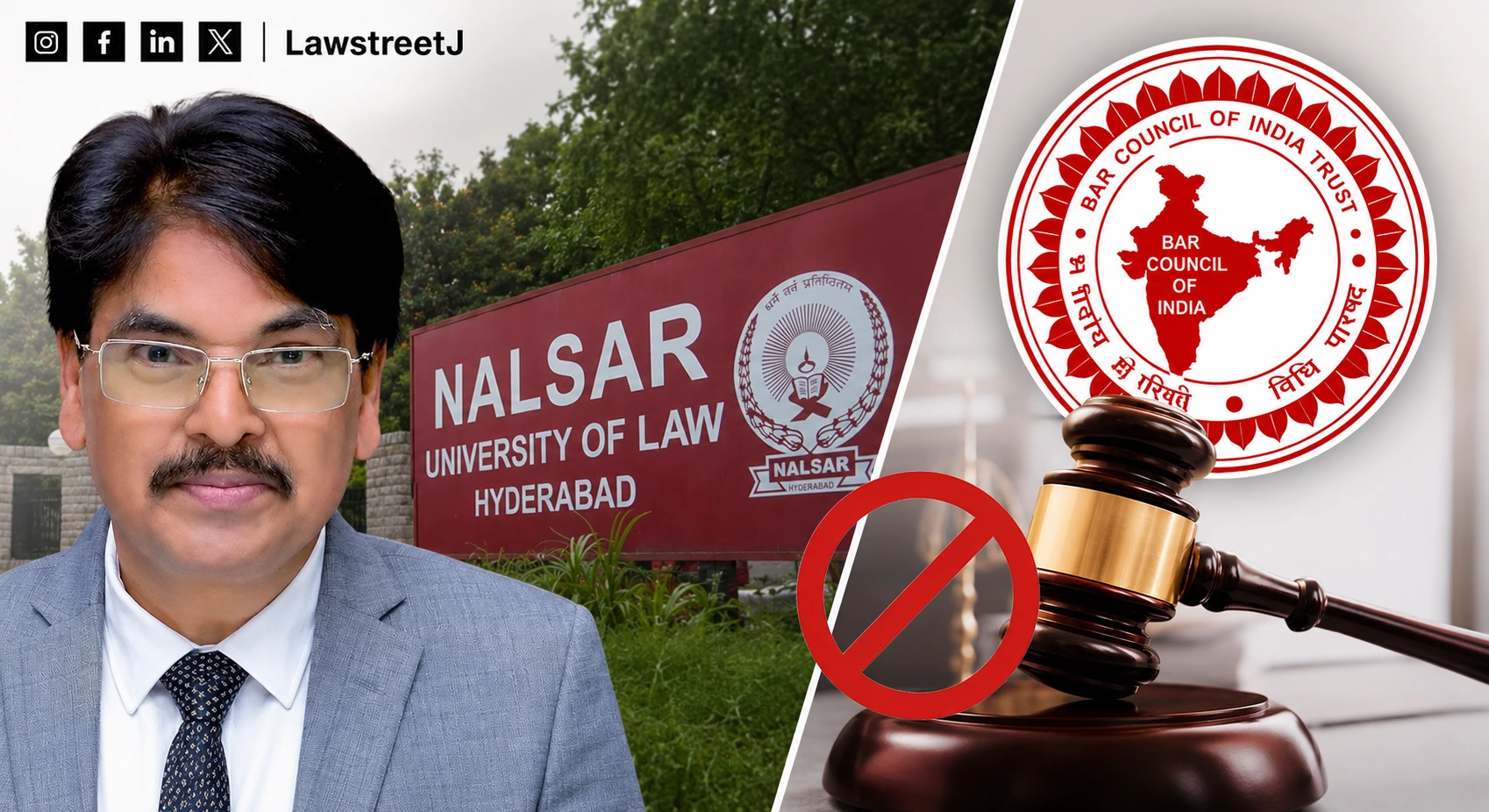
New Delhi: The Bar Council of India has directed that no State Bar Council shall enrol any student of NALSAR University of Law, Hyderabad, who obtained a law degree in 2026, as an advocate till further orders, in a communication issued by its Chairman, Senior Advocate Manan Kumar Mishra, to the Vice-Chancellor of NALSAR and the Secretaries of all State Bar Councils on 13th August, 2026.
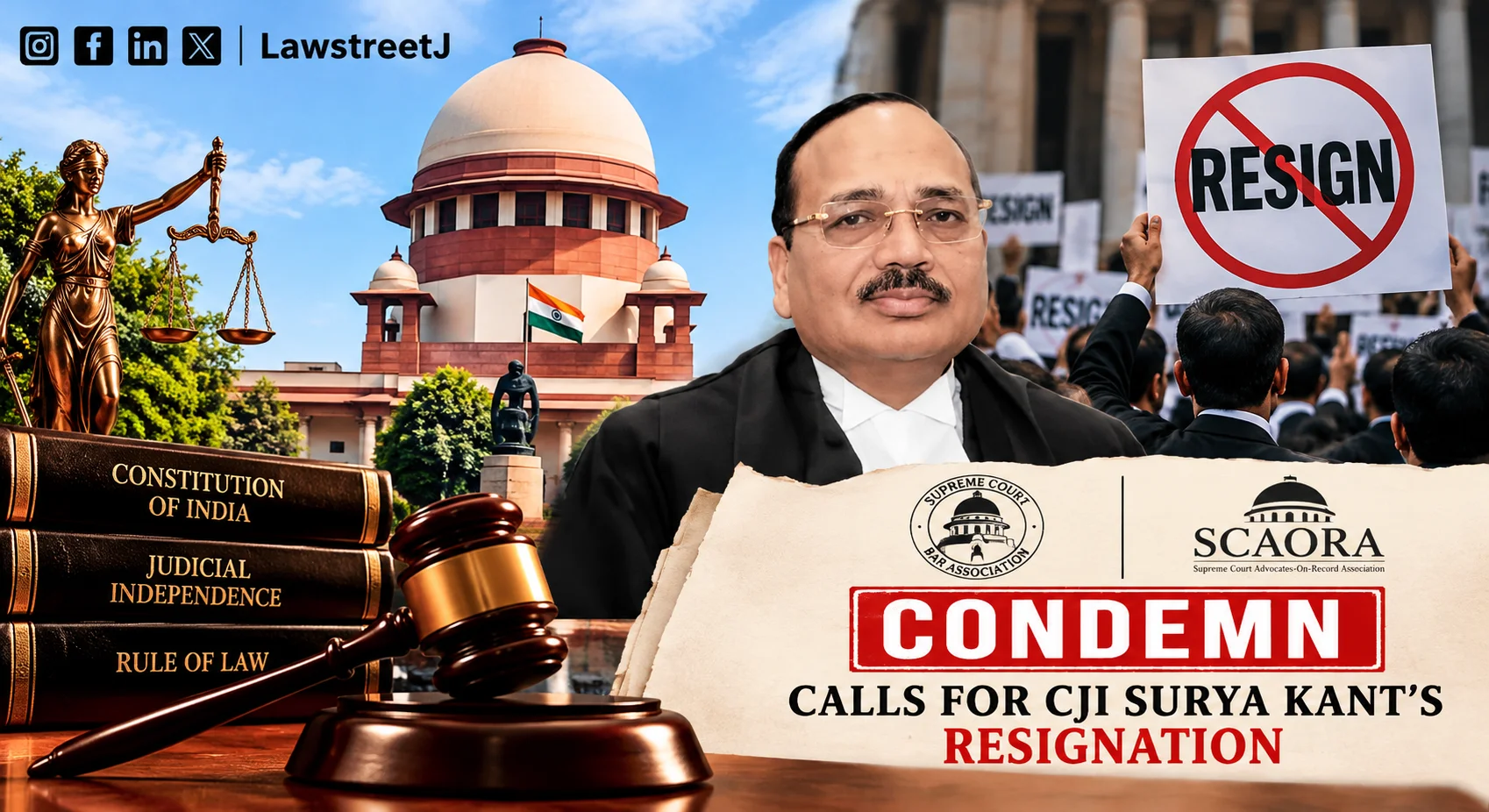
The communication states that the Bar Council has taken note of reports and material in the public domain concerning an organised campaign at NALSAR University relating to the proposed participation or invitation of Hon'ble Mr. Justice Surya Kant, Chief Justice of India, in connection with the University's Convocation. It states that the Bar Council considers it necessary to ascertain the true factual position directly from the University rather than draw conclusions merely from media reports, social media posts, or other secondary material.
The letter asserts that "a student of Law, having no regard or respect for the highest Judicial Office of the country, is not expected to be a responsible or sensible Advocate, Teacher or a Judge," and states that such persons shall always be a liability on the profession, and that such conduct reflects adversely on a person's suitability for entry into or association with the legal profession.
It further states that, as per what it describes as reliable sources, there exists groupism and dirty politics among some of the academic staff who have played an active role in misleading, instigating and misguiding the students, and that the Bar Council, as the regulator of legal education, cannot be a mute spectator to such a situation.
Citing its statutory mandate under the Advocates Act, 1961, the communication notes that Section 7(1)(b) entrusts the Bar Council of India with laying down standards of professional conduct and etiquette for advocates, Section 7(1)(g) with general supervision and control over State Bar Councils, Sections 7(1)(h) and 7(1)(i) with the promotion and standards of legal education, and Section 49 with the power to frame rules on professional conduct, etiquette and standards of legal education. It refers to the Supreme Court's decision in Ex-Capt. Harish Uppal v. Union of India, (2003) 2 SCC 45, on the professional obligations attaching to calls for strikes and boycotts by advocates.
The communication further states that there is a material distinction between legitimate expression and conduct involving organised intimidation, coercion, personal vilification, disruption, obstruction or an organised call for boycott directed against a constitutional functionary or an institutional programme. It has directed the Vice-Chancellor of NALSAR to examine the matter and furnish an authenticated report within three days, including a complete copy of any representation, petition or memorandum submitted to the University concerning the proposed participation of the Chief Justice of India, along with the full list of signatories available in official University records.
The University has further been directed to separately identify, on the basis of verifiable material, those principally instrumental in initiating, drafting, or circulating the campaign, organising meetings connected with it, coordinating or mobilising participation, communicating with the press or media on its behalf, administering any official or organised electronic or social-media coordination group, or proposing or mobilising any call for boycott, obstruction, disruption or organised non-participation in the Convocation. The report is also required to identify office-bearers of the Student Bar Council, Students' Union or other recognised student body involved, and to state the nature of involvement of any faculty member, research scholar, alumnus or outside person.
The communication clarifies that the Bar Council does not, at this stage, record that any person stands disqualified from enrolment under Section 24A merely on account of participation in the representation or campaign. However, it states that where material concerning the conduct of a particular applicant is under active statutory examination and may have a bearing on regulatory considerations governing entry into the profession, completion of enrolment during the pendency of such examination may create a fait accompli and render the statutory examination ineffective.
It directs that upon receipt and preliminary examination of the University's report, the Bar Council shall separately communicate to the State Bar Councils the names of persons whose individual role requires further statutory consideration, and that where such a name is communicated, no order granting enrolment shall be passed and the name shall not be entered on the State Roll; if an enrolment application is already pending, the final decision shall remain deferred during the period of inquiry. Names communicated at the preliminary stage are to be treated confidentially, since such communication does not itself constitute a finding of misconduct or disqualification.
The communication states that any final adverse consideration shall be undertaken only in accordance with the Advocates Act, 1961, the rules framed thereunder, and the principles of natural justice, and that the interim arrangement shall continue only until the individual issue is disposed of by the Bar Council or until further directions are issued.
The Bar Council has directed NALSAR University of Law to furnish the authenticated factual report at the earliest and has requested all State Bar Councils to place the communication before their Chairman, Vice-Chairman, Secretary and Enrolment Committee for compliance. It states that a final decision in the matter would be taken on 19th August, 2026, after receipt of the report from the Vice-Chancellor.


![Supreme Court upholds order to bar Advocate from practice for running taxi service [Read Order]](/secure/uploads/2023/09/lj_8175_practicing_law_as_an_advocate_texi.jpg)