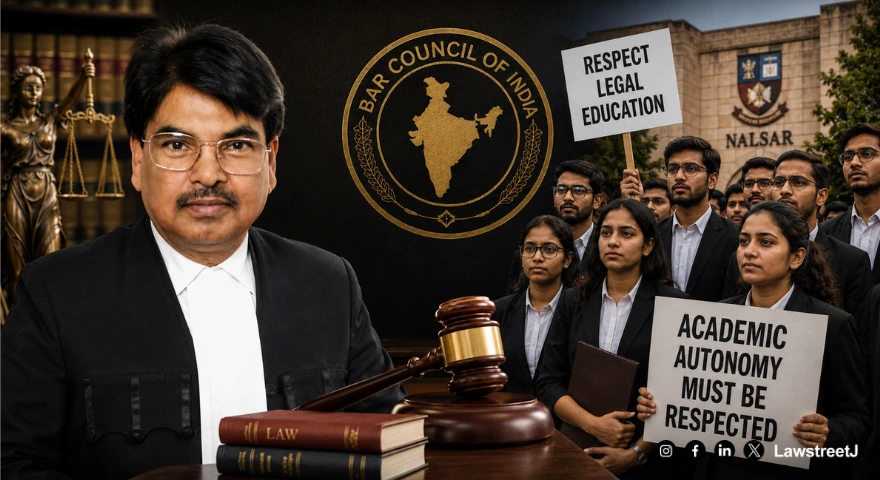
New Delhi: Bar Council of India Chairman Manan Kumar Mishra has written an open letter to law students across the country on the occasion of Independence Day, offering a conditional apology for any hurt caused by his words or letters in connection with the recent controversy involving NALSAR University of Law, Hyderabad.
In the letter, addressed to “My Dear young friends,” Mishra states that the developments of the last few days have caused concern and anguish among a section of the student community, and that whenever students feel hurt or aggrieved, their concerns deserve to be heard with patience, sensitivity and respect. He states that if anything connected with the controversy, including any of his words or letters, has hurt the feelings of law students, he sincerely regrets and apologises for the same, adding that an expression of regret is not a matter of prestige or ego but an acknowledgment that students' feelings and concerns matter.
Mishra describes students of the National Law Universities and other leading Centres of Legal Education as among the most informed and discerning young citizens of the country, who study the Constitution, the Rule of Law and the importance of hearing all sides before reaching a conclusion, and who are fully capable of applying their own independent minds without pressure or influence from any quarter. He states that the conduct and choices of students at leading law universities are noticed across the legal education system and often influence how students elsewhere view similar issues, since many among them will go on to become advocates, senior advocates, teachers, scholars and judges.
The letter states that peaceful disagreement, questioning and protest are important features of a constitutional democracy, and that students must always remain free to express their views, while also observing that when further facts or clarifications emerge, every issue should be reconsidered objectively and with an open mind. Mishra states that there is no inconsistency between expressing a genuine grievance and thereafter fairly considering a clarification.
On the question of convocation participation, the letter states that the decision whether to participate must ultimately rest with the students themselves, that no student should be compelled to attend or feel compelled to abstain, and that his only appeal is that the decision be taken independently after considering the matter in its entirety. He states that the relationship between the judiciary, the Bar, universities and law students is deeper and more enduring than any temporary controversy, and that differences should ultimately be capable of resolution through dialogue, clarification and mutual respect.
Mishra states that the Bar Council of India regards law students as the future of the legal profession, whose dignity, independence of thought and legitimate concerns must always be respected, while dialogue, mutual respect and constitutional values remain equally important for the profession they are preparing to enter. He expresses hope that the issue will be considered with fairness and a spirit of reconciliation, and states that it should not be allowed to acquire a political or extraneous colour through outside influence, urging that students be allowed to examine the matter themselves and that institutions respect their independence of thought.
The letter concludes with Independence Day greetings to law students, teachers, members of the Bar and fellow citizens, and is signed by Mishra in his capacity as Senior Advocate, Supreme Court of India, and Chairman, Bar Council of India.


![Supreme Court upholds order to bar Advocate from practice for running taxi service [Read Order]](/secure/uploads/2023/09/lj_8175_practicing_law_as_an_advocate_texi.jpg)