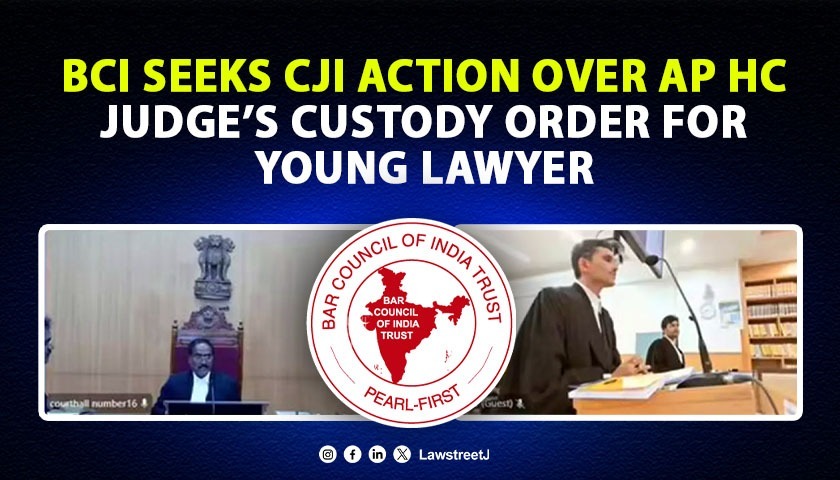
New Delhi: The Bar Council of India (BCI) has approached the Chief Justice of India, seeking urgent intervention following a controversial courtroom exchange at the Andhra Pradesh High Court. The incident, which occurred during a hearing on May 4, 2026, involved Justice Tarlada Rajasekhar Rao and a young legal practitioner. The confrontation, portions of which were captured in a viral video, has sparked significant debate regarding judicial temperament, courtroom decorum, and the treatment of junior members of the Bar.
The tension began during the proceedings of a writ petition where the petitioner was challenging a Look Out Circular (LOC) and the impounding of his passport. As the hearing progressed, Justice Rao indicated an inclination to adjourn the matter to review a precedent established in a similar previous case. The situation escalated when the judge expressed sharp displeasure with the conduct of the petitioner’s counsel.
According to reports and the widely circulated footage, Justice Rao questioned the advocate’s professional standing and suggested that the practitioner was behaving with undue arrogance. In a remarkable turn of events, the judge was heard asking the counsel if he believed himself to be a “great Senior Advocate” before directing police personnel to take him into custody. The judge specifically directed that the advocate be held in police custody for 24 hours.
During the exchange, Justice Rao characterized the advocate’s behavior as “indolent.” In an effort to document the incident for the official judicial record, the court requested other lawyers present in the room to identify themselves so they could be listed as witnesses to the conduct mentioned by the Bench. The exact remark or action from the advocate that triggered this severe reaction remains unclear from the available records.
Despite the judge’s firm stance, the young advocate was seen pleading for leniency with folded hands. The practitioner reportedly informed the court that he was experiencing physical distress and pain, repeatedly begging for grace from the Bench. Justice Rao, however, initially remained unmoved, remarking that the counsel was free to organize a protest with the local Bar association if he felt aggrieved by the directive. “Call the police. You go and file appeal,” the judge was heard stating in the recording.
The order for police custody was never officially signed or executed. Following the immediate intervention of the Andhra Pradesh High Court Bar Association, Justice Rao relented and recalled the detention order.
The Bar Council of India took a stern view of the episode after the video gained traction on social media and WhatsApp. In a letter dated May 6, 2026, the BCI described the incident as “deeply disturbing” and noted that it had caused serious concern across the legal fraternity. The BCI also asserted in its letter that the episode raises grave questions regarding judicial temperament, proportionality, fairness, and the inherent dignity of the Bar.
The BCI’s letter emphasized that while advocates can and should be corrected or cautioned in accordance with the law when facts justify it, the act of ordering a young lawyer into custody for a procedural lapse appears “grossly inappropriate.” The Council warned that such interactions create a hostile environment and could have a “chilling effect” on junior members of the profession, instilling fear rather than fostering a learning environment.
Furthermore, the BCI stated that the dignity of a constitutional court is not enhanced when a legal professional is made to “beg for grace” in open court only to be threatened with incarceration. The letter also notes that a young lawyer is an officer of the court and a student of the profession, entitled to correction without being subjected to public humiliation. The Council argued that any authority of the court must be exercised with restraint, compassion, and institutional grace.
In light of these events, the BCI has requested that the Chief Justice of India take immediate cognizance of the matter. The Council proposed several administrative measures, including the withdrawal of judicial work from Justice Rao pending a formal review. Additionally, the BCI proposed the judge’s immediate transfer to a distant High Court and recommended that he be nominated for judicial training focused on court management, judicial temperament, and the nuances of Bar-Bench relations.
The incident has highlighted the delicate balance between maintaining courtroom discipline and ensuring the fair treatment of practitioners. While the judge did not follow through with the arrest, the BCI maintains that the verbal treatment and threat of incarceration themselves constitute a significant breach of judicial decorum necessitating administrative intervention to preserve the confidence of the Bar in the institution.