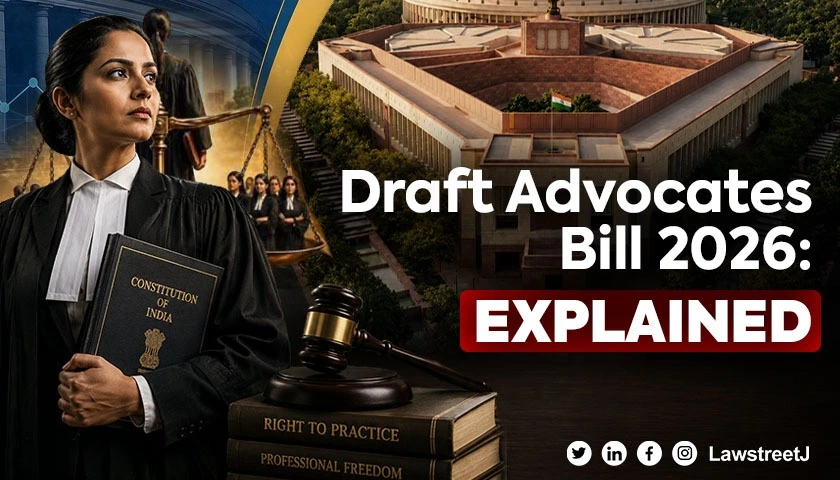
New Delhi: The Union Ministry of Law and Justice, in coordination with the Bar Council of India (BCI), has released the Draft Advocates (Amendment) Bill, 2026 for public and stakeholder consultation. The Draft was first published on the BCI's official website on 18 July 2026, accompanied by a covering letter from BCI Chairman Manan Kumar Mishra, Senior Advocate, Supreme Court of India, and was placed before the wider legal fraternity by the Ministry on 20 July 2026.
Comments and suggestions are invited from advocates, Bar Associations, State Bar Councils, law universities, centres of legal education, law firms and the general public until 31 July 2026, 3:00 PM, to be sent to draftadvact2026bill@gmail.com.
The Ministry has described the exercise as part of a transparent, participative legislative process intended to modernise the legal profession in line with the goals of Viksit Bharat @2047. Being a Draft issued for public consultation, its provisions will acquire statutory force only upon completion of the legislative process and commencement of the enacted law.
According to the BCI's covering note, the Draft is the product of extensive consultation with State Bar Councils, senior advocates practising before the Supreme Court, various High Courts and District Courts, academicians, Vice-Chancellors and Deans of law universities, and the Ministry of Law and Justice. It represents, in the words of the Council, the most comprehensive attempt to modernise the statutory framework governing the Indian legal profession since the original Advocates Act was enacted in 1961.
Controversial 2025 proposals dropped
The BCI has flagged that several contentious features of an earlier 2025 draft, which had drawn sharp resistance from the Bar, do not appear in the 2026 version. These include the proposed heavy punishment or disciplinary proceedings for participation in strikes, provisions enabling disciplinary action against office-bearers of Bar Associations, and a clause imposing a fine of up to Rs. 5 lakh on advocates in serious disciplinary matters.
Also removed is the earlier proposal for inclusion of Government nominees in the Bar Council of India and State Bar Councils. The Council has stated that these omissions followed constructive deliberations with the Union Law Minister and the Government, after concerns raised by the BCI and a coordination committee of Bar Associations from Delhi, Uttar Pradesh, Himachal Pradesh and other States, and are intended to safeguard the autonomy and independence of the profession from executive interference.
I. Wider welfare, pension, insurance and social security measures
The Draft substantially expands the welfare responsibilities of State Bar Councils and the Bar Council of India. Amendments to Sections 6(2) and 7(2) expressly enable both bodies to constitute funds and create trusts for a wide range of purposes, including:
- financial assistance to deserving advocates and law graduates
- insurance, pension and medical relief
- social-security schemes for indigent advocates
- assistance to advocates with disabilities
- support for dependants of advocates
- professional development programmes
- law libraries, and, in the case of the BCI, centres of excellence in legal education or a National Legal Academy
These funds are to be built through annual subscriptions or other contributions from advocates, as may be prescribed, with trustees drawn from elected Council members, advocates, judges and academicians. Trusts already created before the amendment comes into force will continue to operate as if constituted under the new provisions.
II. A strengthened, twenty-five-member Legal Education Committee
The Legal Education Committee, presently a ten-member body, is proposed to be expanded to twenty-five members under an amendment to Section 10. Of these, nine would be nominated by the BCI from among its own members, and sixteen from outside the Council, including a former Chief Justice of India or former Supreme Court Judge as Chairman, two sitting or former Chief Justices of High Courts, the Attorney General and Solicitor General for India, two senior advocates or advocates of repute, the Chairman of the University Grants Commission or nominee, the Secretary (Department of Legal Affairs) or nominee, three Vice-Chancellors of universities of national repute, and four other professors or deans of institutions of excellence in law and the social sciences. The wider composition is intended to bring the judiciary, the Bar, the Government and academia together to develop stronger, practical and nationally consistent standards of legal education.
III. Professional development as a statutory institutional priority
The Draft expressly empowers both State Bar Councils and the BCI to organise professional development programmes for advocates, a change made in light of the Supreme Court's recent judgment in Ajay Vijh v. Indian Banks Association & Ors. (Civil Appeal Diary No. 10787/2024). Such programmes are contemplated in areas including new legislation, constitutional practice, commercial and corporate law, arbitration and mediation, technology and artificial intelligence, cyber law and digital evidence, taxation and insolvency, international legal practice, and trial and appellate advocacy. The BCI has clarified that the object is to expand advocates' professional capabilities and opportunities, and that the provision should not be understood as imposing an unnecessary burden on them.
IV. A historic increase in women's representation on State Bar Councils
One of the most significant features of the Draft is a substantial, structured increase in the representation of women advocates in State Bar Councils, restructuring Section 3(2)(b) across all three existing electorate-based categories:
- Electorate not exceeding 5,000: total strength remains 15 members, of which 14 are elected (including 2 seats reserved for women) and 1 woman advocate is co-opted by the BCI in consultation with the concerned State Bar Council and Bar Associations.
- Electorate exceeding 5,000 but not exceeding 10,000: total strength rises from 20 to 21 members, of which 19 are elected (including 3 women) and 2 additional women advocates are co-opted.
- Electorate exceeding 10,000: total strength rises from 25 to 33 members, of which 30 are elected (including 4 women) and 3 additional women advocates are co-opted.
Elected members are to be chosen by proportional representation through the single transferable vote, and, as far as possible, two-thirds of them must have at least ten years' practice at the Bar. On the purpose of co-option, the BCI has explained that it is meant to secure representation for areas that have remained unrepresented in State Bar Council elections citing Goa in the Maharashtra & Goa Bar Council, parts of Assam, and the Santhal Pargana district in Jharkhand as examples as well as to bring in deserving women who are unable to contest elections, and senior and young women advocates of the Supreme Court, High Courts and District Courts who are competent but do not contest. In every category, co-opted women must be advocates whose names already appear on the electoral roll of the concerned State Bar Council.
V. Bar Associations receive express statutory recognition
For the first time, the term "Bar Association" is proposed to be statutorily defined under Section 2, covering any association, society, forum or body of advocates, whether incorporated or not, registered with the State Bar Council for the welfare and protection of the rights of advocates. A corresponding amendment to Section 6 empowers State Bar Councils to issue directions to Bar Associations for strengthening their functioning and safeguarding the rights, privileges and interests of member advocates. The stated object is to improve the democratic identity, representative role and institutional independence of Bar Associations, and to enable cooperation among the BCI, State Bar Councils and Bar Associations on protection of advocates' rights, welfare implementation, professional development, representation of local concerns, institutional assistance, and the collective voice of the profession.
VI. A steep enrolment-fee revision, with a concession for underprivileged categories
The proposed fee revision follows the Supreme Court's ruling in Gaurav Kumar v. Union of India, (2025) 1 SCC 641, which held that the aggregate enrolment fee chargeable under the then-existing Section 24(1)(f) of the Advocates Act could not exceed Rs. 750 for general candidates and Rs. 125 for candidates belonging to the Scheduled Castes and Scheduled Tribes, and noted that this ceiling, fixed by Parliament in 1993, had not been revised since and no longer reflected institutional costs. The Supreme Court, in Pankaj Sinha v. Bar Council of India & Ors. (W.P. No. 1261/2025), subsequently directed the Union Government to revise the enrolment fee in line with current inflation. Acting on this, the Draft proposes an aggregate enrolment fee of Rs. 22,500 Rs. 18,000 payable to the State Bar Council and Rs. 4,500 to the Bar Council of India. Importantly, the Draft retains a concession for eligible members of the Scheduled Castes, Scheduled Tribes and persons with benchmark disabilities who are unable to pay the fee owing to their financial condition: such candidates would be required to pay only one-fourth of the prescribed enrolment fee. Any future revision of the fee is to be undertaken by the BCI only in consultation with the Central Government.
The revenue raised is intended to support the processing of enrolment applications, verification of educational qualifications and identity, maintenance of physical and digital rolls, issuance of enrolment certificates, welfare schemes such as insurance and medical relief, professional development programmes and the proposed National Legal Academy, and other institutional services for advocates.
VII. Indian law firms to receive statutory recognition for the first time
The Draft inserts a fresh definition of "law firm" in Section 2, covering any partnership constituted under the Indian Partnership Act, 1932, any limited liability partnership under the Limited Liability Partnership Act, 2008, or any company incorporated under the Companies Act, 2013, consisting of advocates engaged in the practice of law. A new Chapter IIIA, comprising Sections 28A and 28B, is proposed to be inserted, making it mandatory for every law firm operating in India to register with a Bar Council. A partner or owner of the firm would apply to the BCI on payment of a prescribed fee, and the BCI would maintain a register of law firms, furnishing an annual list to the Central or concerned State Government. Firms operating across multiple States would need to register with both the relevant State Bar Councils and the BCI. The BCI has explained that this reform is intended to encourage advocates practising at the State, district and taluka level to organise into formal firms, a model presently concentrated in metropolitan cities.
VIII. Foreign lawyers and foreign law firms: reciprocity and restricted practice
Section 47 of the Advocates Act, dealing with reciprocity, is proposed to be substituted in its entirety. Under the new provision, if a foreign country prevents Indian citizens from practising law there or subjects them to unfair discrimination, as notified by the Central Government, no national of that country would be entitled to practise law in India. Subject to this, and with the prior approval of the Central Government, the BCI may prescribe conditions for registering foreign lawyers and foreign law firms for "permitted areas of practice," including rules for renewal, suspension or cancellation of registration, and for allowing foreign lawyers or firms to engage in permitted work on a "fly-in fly-out" basis for temporary visits.
Critically, the "permitted area of practice" is defined to exclude appearance before any court, tribunal, authority or person before whom only an advocate enrolled under the Act is entitled to appear under Section 33 meaning foreign lawyers and firms remain barred from the Supreme Court, every High Court, and District and Taluka courts, and cannot undertake Indian litigation, practise Indian law before any court, tribunal or statutory authority, or claim an advocate's rights merely on the strength of a foreign qualification or registration. The sole carve-out concerns appearance before an arbitral tribunal in an international commercial arbitration where the substantive law governing the dispute is foreign law.
The BCI has linked this limited opening to the loss of arbitration business to hubs such as Singapore and Hong Kong, noting that a committee headed by Mr. Cyril Shroff, Managing Partner of Cyril Amarchand Mangaldas, and comprising reputed Indian law firms, examined the issue and has submitted its report, which the Council is to consider before acting further. The BCI has also stated that any opening for foreign law firms would be calibrated in a phased manner designed to protect the interests of Indian law firms.
IX. Foreign citizens to be barred from ordinary enrolment as Indian advocates
Under the existing Section 24(1)(a), a person seeking enrolment as an advocate must ordinarily be a citizen of India, subject to a proviso permitting a national of another country to be admitted where Indian citizens are similarly permitted to practise law in that country.
The Draft proposes to omit this proviso altogether. The BCI's covering note explains that this change follows a Delhi High Court direction requiring the Council and a State Bar Council to enrol a Korean citizen, given the ambiguity in the existing provision, which the BCI states has opened the door to enrolment applications from nationals of Korea, Bhutan, Nepal and Bangladesh studying in India. Once the proviso is omitted, a foreign citizen would not ordinarily be entitled to enrol on a state roll merely because they hold a foreign law degree, an Indian law degree, or are authorised to practise in another country the statutory route to enrolment as an advocate would rest firmly on Indian citizenship.
X. Registration under the foreign-lawyer framework is distinct from enrolment
The Draft clarifies that registration of a foreign lawyer or foreign law firm under the proposed foreign-law framework does not, by itself, make such a person an advocate enrolled on a State roll in India as the two statuses remain legally distinct.
XI. Central Government approval as an additional safeguard
Rules governing the registration and regulation of foreign lawyers and foreign law firms are required to be framed only with the prior approval of the Central Government, on the reasoning that only the Central Government is positioned to assess India's diplomatic and reciprocal relationship with any particular foreign country. The BCI notes that its existing Rules for Registration and Regulation of Foreign Lawyers and Foreign Law Firms in India, framed and published in the Official Gazette in 2023 and further amended in 2025, have also been incorporated and codified within the 2026 Draft.
XII. Other notable structural and procedural changes in the Bill text
Beyond the headline reforms, the Draft carries a number of further amendments to the Advocates Act, 1961:
- New or revised definitions are introduced for terms including "Bar Examination," "centre of legal education," "foreign country," "foreign law," "foreign lawyer," "foreign law firm," "Fly-in and Fly-out," "law firm," "Election Tribunal," and substituted definitions of "law graduate" and "legal practitioner."
- Section 3 is amended to add Sikkim to the list of States, and to permit a Bar Council shared by two or more States to set up a branch in a State capital lacking its own Bar Council, to facilitate enrolment and welfare implementation; the Additional Solicitor General for the High Court of Delhi is added under Section 3(2)(a).
- New Sections 14A and 15A create a dedicated Election Tribunal mechanism at the BCI, to decide disputes concerning State Bar Council elections; the Presiding Officer must have served as a Judge of the Supreme Court or Chief Justice of a High Court, and members must be former High Court Judges or have practised law for more than 25 years, with disputes to be decided expeditiously, preferably within six months.
- Section 7 is amended to empower the BCI to conduct entrance examinations for admission to law degree courses, prescribe minimum qualifications for such admission, conduct a Bar Examination as a further requirement for continued entitlement to practise, and recognise foreign law qualifications for equivalence with an Indian law degree.
- Section 8 extends the period after which the proviso relating to provisional enrolment operates from six months to twelve months.
- Section 12 empowers a State Bar Council to order a special audit of its own accounts where these do not reflect a true and fair view of its finances, and allows the Central Government to recommend corrective action in such cases.
- Section 18 replaces free transfer of an advocate's name between State rolls with a prescribed transfer fee, and a new Section 19A requires State Bar Councils to verify an advocate's place of practice and the genuineness of educational certificates.
- A new Section 24C allows removal of an advocate's name from the State roll upon conviction and a sentence of two years' imprisonment or more, once confirmed by the High Court or Supreme Court, with a right to apply for re-enrolment, in consultation with the BCI, where the sentence was less than five years and has been served.
- Sections 35 and 36 require complaints of professional or other misconduct, accompanied by supporting documents, to be referred to the disciplinary committee of the State Bar Council or the BCI, as the case may be, within fifteen days of receipt, with the BCI empowered to pass interim orders in serious prima facie cases; Section 36B extends the time limit for disposal of disciplinary matters from one year to two years.
- Section 42 aligns disciplinary committee proceedings with the Bharatiya Nyaya Sanhita, 2023 and the Bharatiya Nagarik Suraksha Sanhita, 2023, deeming such proceedings judicial proceedings and disciplinary committees Civil Courts for the specified purposes, replacing the earlier references to the Indian Penal Code and Cr.P.C.
- Section 45 raises the penalty for unauthorised practice of law from imprisonment up to six months to imprisonment up to three years, with fine, or both.
- A new Section 48C allows the BCI to constitute a three-member interim committee, headed by its senior-most member, to exercise the powers of a State Bar Council that is unable to function owing to dissolution, suspension or other reasons.
- Section 49 expands the BCI's rule-making powers to cover matters such as minimum qualifications for law degree admission, the Bar Examination, degree duration, verification of place of practice and certificates, professional development, standards of conduct for advocates and law firms, foreign-qualification equivalence, law firm registration and the register of law firms, and the registration and fly-in fly-out framework for foreign lawyers and firms - the last of these subject to prior Central Government approval.
- Sections 55, 56, 57, 58, 58A, 58AA to 58AG, and 58B of the principal Act largely transitional and historical provisions are proposed to be omitted altogether.
What happens next
The BCI has stated that, notwithstanding the extensive consultation already undertaken, it considers it appropriate to place the Draft once more before all stakeholders State Bar Councils, Bar Associations, law universities, centres of legal education and law firms inviting their suggestions and inputs. All suggestions received within the prescribed period are to be examined, and, where considered necessary and appropriate, incorporated into the Draft before the Council requests the Ministry to take steps toward early enactment.
The Council has also indicated that stakeholders may write to it at impcell-dla@nic.in and that all suggestions received will be forwarded to the Ministry of Law and Justice. The Draft itself underlines that its provisions will acquire statutory force only once the legislative process is completed and the enacted law is brought into force.
Reference: Draft Advocates (Amendment) Bill, 2026 (Public Consultation Phase)


![Supreme Court upholds order to bar Advocate from practice for running taxi service [Read Order]](/secure/uploads/2023/09/lj_8175_practicing_law_as_an_advocate_texi.jpg)