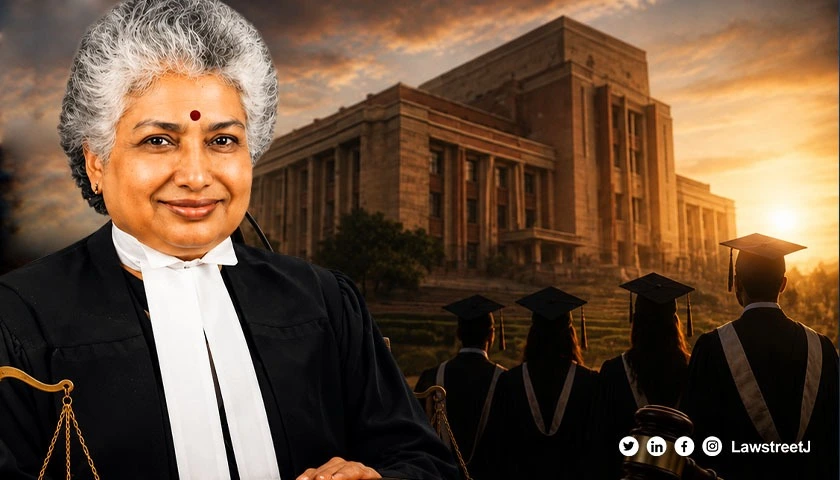
New Delhi: Supreme Court judge Justice B.V. Nagarathna on Saturday urged the graduating batch of National Law University (NLU) Delhi to treat the legal profession as a public trust rather than a commercial service, cautioning that "fast-growing commerce and increasingly lucrative opportunities" must not obscure the fact that a career in law is one rendered in public service.
Delivering the convocation address at the university's 13th convocation ceremony on August 29, 2026, Justice Nagarathna, who is Visitor of NLU Delhi, congratulated the institution after it was ranked second in the law category in the National Institutional Ranking Framework (NIRF) 2025 released by the Ministry of Education on September 4, 2025 the eighth consecutive year the university has held that position. "The day is not too far off when it may be ranked the first in the country," she said.
The ceremony was attended by Delhi High Court Chief Justice Devendra Kumar Upadhyaya, who is Chancellor of the university, former Chief Justice Rajiv Shakdher, Justices Sachin Dattaand Tejas Karia of the Delhi High Court, NLU Delhi Vice Chancellor Professor G.S. Bajpai, Bar Council of India co-chairman Vishwa Prakash Sharma, and Registrar Professor Risham Garg, among other dignitaries.
Addressing the batch of 2026, Justice Nagarathna described the day as marking "the beginning of your professional voyage into the world of law, justice, and public service," and acknowledged the sacrifices of parents and the efforts of the university's faculty and staff behind each graduate's achievement.
Turning to the responsibilities that come with legal training, she said that every courtroom appearance, contract drafted, class taught or settlement negotiated is "a public act infused with moral consequences," and asked graduates to continually interrogate their own conduct against constitutional values. "What does my client actually need?" she said should guide lawyers in such situations, adding that practitioners must reconcile duty to a client with a commitment to truth and justice, and must never use their knowledge to undermine the authority of courts or public faith in the legal system.
Justice Nagarathna rejected the idea of legal practice as a transactional service, telling the graduates that a lawyer "cannot be reduced to a person who sells legal knowledge by the hour." She said an essential part of the profession is the willingness to tell a client that a desired course of action is unwise or legally untenable, describing law as "an office of trust" in which duty runs simultaneously toward the client and toward the institution of justice. She called on the graduates to cultivate "devotion to duty" a fidelity to the administration of justice that persists notwithstanding personal gain or loss.
A significant part of the address was devoted to Alternative Dispute Resolution (ADR), which Justice Nagarathna described not merely as a set of procedures but as a way of thinking about legal work. She pointed to a continuing shift away from traditional litigation toward arbitration, mediation and conciliation, and said a lawyer best serves a client by recognising that the real objective in a dispute may be to preserve a relationship or avoid a commercial disaster, rather than to secure a courtroom victory. She noted the Mediation Act 2023 has contributed to institutionalising mediation in India, while stressing that timing remains crucial to its success.
On the role of technology in legal practice, Justice Nagarathna said human judgment remains impossible to automate even with the advance of Artificial Intelligence, since AI "cannot answer when to push, when to stop, or how to understand people." She cautioned graduates to exercise judgment in verifying citations and to ensure that fake judgments generated through AI tools are never relied upon in practice.
Closing her address, Justice Nagarathna reminded the graduates that the independence of the Bar is not a privilege for lawyers' own benefit but a necessity for constitutional democracy, since it allows professionals to challenge and represent without seeking the state's permission. "Lawyers are the safety valves of democracies" she said, adding that the Bar in India must introspect on its role in securing justice for the distressed litigant public and in sustaining democracy. She told the graduating batch that they leave the university as "officers of the court and stewards of the Constitution."


![SC Directs National Law Universities to Examine Disability Rights Law Implementation Nationwide [Read Order]](/secure/uploads/2026/05/lj_3913_SC_Directs_National_Law.webp)