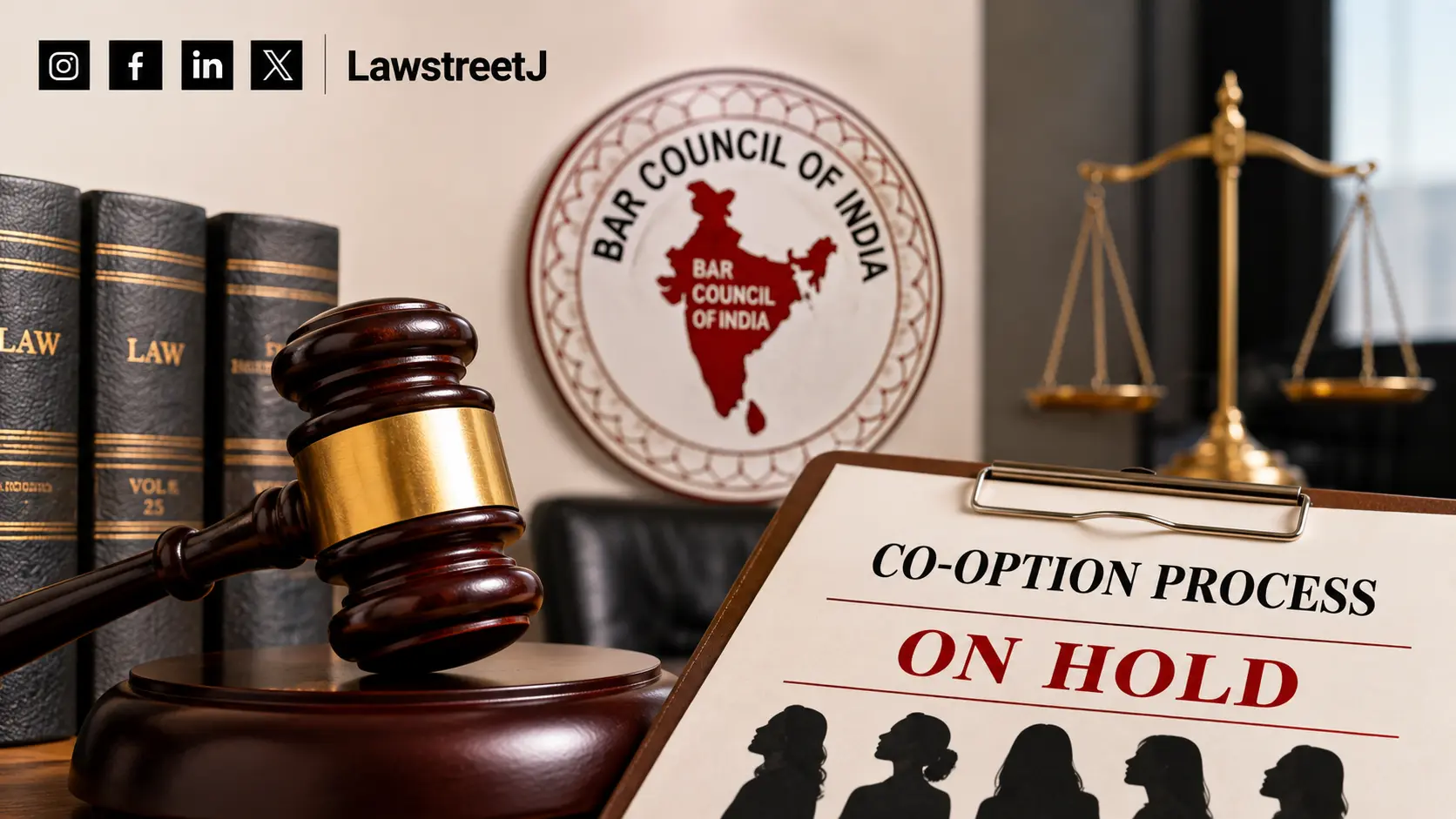
New Delhi: The Bar Council of India has directed all State Bar Councils to keep in abeyance its earlier communication dated 11.08.2026, which had proposed a meeting of elected members on 16.08.2026 concerning the co-option of women members, pending consideration of election-related issues by the competent forums.
In a communication dated 12.08.2026 addressed to the Secretaries of all State Bar Councils, and referencing the Supreme Court's order dated 04.08.2026 in Yogamaya M.G. v. Union of India & Ors. (W.P. (C) No. 581/2024 with W.P. (C) No. 1060/2025), the Bar Council of India noted that the Supreme Court had directed that two women members to be co-opted to the State Bar Councils shall be from the categories specified in the order, and that the Chief Justice of the jurisdictional High Court shall take into consideration all relevant factors and consult all the elected members of the respective State Bar Council before taking such a decision.
The Council further noted that the Supreme Court had directed that the issue concerning the methodology for calculation of transferable votes amongst contesting candidates, particularly women candidates, requires consideration by the High-Powered Election Supervisory Committee presided over by Justice Sudhanshu Dhulia, former Judge of the Supreme Court, with interested members of the Bar permitted to place their suggestions and opinions before the Committee.
Taking note of grievances and disputes concerning the election process, including issues which may affect the exclusion, elimination, ranking or electoral status of candidates, including women candidates, pending or likely to fall for consideration before the High-Powered Election Supervisory Committee, Election Committees, Tribunals or other authorities acting pursuant to the Supreme Court's directions, the Council observed that any determination in such proceedings may have a bearing on the electoral position of a woman candidate and could accordingly become relevant to the factual matrix pertaining to co-option of women members.
“the Bar Council of India considers that proceeding at this stage with the separate facilitative exercise contemplated by its communication dated 11.08.2026, including identification and recommendation of names pursuant thereto, may be premature and may give rise to avoidable overlapping processes or inconsistency with a subsequent determination of a competent forum.”
Terming it a matter of institutional prudence and abundant caution, the Council held that its communication dated 11.08.2026 and the meeting proposed to be convened on 16.08.2026 shall remain in abeyance for the present, and until further communication. All State Bar Councils were accordingly requested not to convene or proceed with the meeting, and not to undertake any further consequential exercise pursuant thereto.
The communication further clarified that where any preliminary steps may already have been taken pursuant to the 11.08.2026 communication, no further consequential action shall be taken thereon for the present, and that any material or recommendation already prepared pursuant thereto shall not be treated as final or acted upon merely on the strength of that communication while it remains in abeyance.
The Council has further also clarified that the communication was being issued solely to maintain procedural propriety and consistency, to avoid parallel or potentially conflicting processes, and to ensure that the administrative exercise initiated by the Bar Council of India proceeds in due conformity with the orders and directions of the Supreme Court and the determinations of the competent forums.
Reference: BCI:D:5314/2026 dated 12.08.2026, addressed to the Secretaries of All State Bar Councils