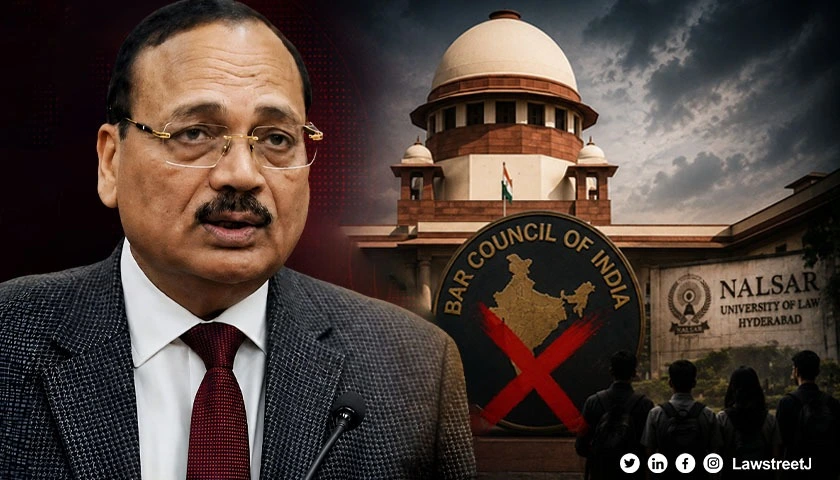
New Delhi: CJI Surya Kant has strongly criticised the Bar Council of India's now-withdrawn circular barring the 2026 graduating batch of NALSAR University of Law, Hyderabad, from enrolling as advocates, and has stayed any punitive or coercive action against students or faculty of NALSAR, or any other national law university, by the BCI or any State Bar Council.
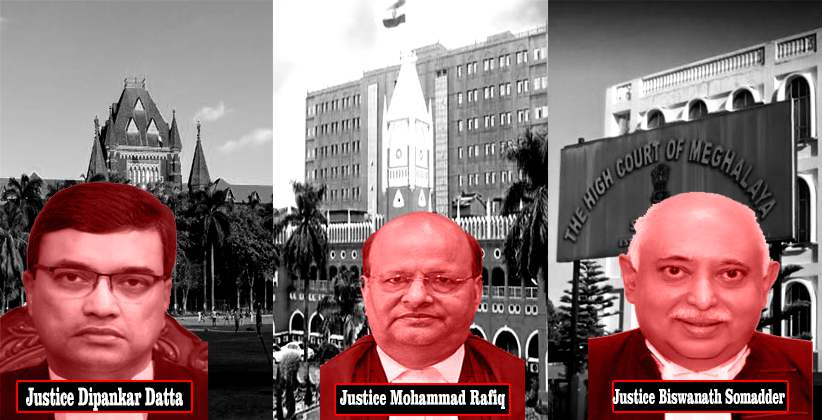
The Bench comprised Chief Justice of India Surya Kant, Justice Joymalya Bagchi and Justice V. Mohana.
The controversy arose after around 450 NALSAR students signed a campaign opposing the university's proposal to invite Chief Justice Surya Kant as chief guest for their upcoming convocation.
In response to the students' campaign, BCI Chairman Manan Kumar Mishra issued a circular halting the enrolment of NALSAR's 2026 law graduates. The BCI asserted that students showing disrespect towards the country's highest judicial office could not go on to become responsible advocates, and further alleged campus groupism and political instigation by certain faculty members. Following widespread public backlash, the BCI modified its position, withdrew the enrolment ban, and eventually closed all proceedings initiated against the students.
During the hearing before the Supreme Court, Senior Advocate K. Parameshwar, appearing for the petitioners, mentioned the writ petition challenging the BCI's directives, submitting that the regulator had no business interfering in the internal affairs of a university. He also questioned the manner in which the BCI had functioned, pointing out that no formal Council meeting had been convened to authorise the Chairman's action. Advocate Radhika Gautam, appearing for the BCI, confirmed before the Court that the controversial circulars had already been withdrawn.
Chief Justice Surya Kant agreed that the BCI's intervention in the matter was uncalled for.
The Chief Justice emphasised that the dispute, if any, was a direct dialogue between himself and the students, and questioned why the BCI had chosen to intervene at all. Recalling his own involvement in student leadership activities during his youth, he affirmed that students possess a fundamental right to protest peacefully, even where their position may be mistaken. Justice Joymalya Bagchi also pulled up the BCI on the same point, asking pointedly whether any formal resolution had ever been passed to authorise the circular.
As an interim measure, the Court issued formal notice to the BCI, directing it to file a counter-affidavit within two weeks, while staying any coercive action against the students or faculty in the meantime.
Before concluding the hearing, Chief Justice Surya Kant welcomed the NALSAR graduates to enrol without delay and join the Supreme Court Bar, announcing that the Court would empanel them for legal aid cases, which he described as a befitting answer to those who had attempted to create impediments in their legal careers.