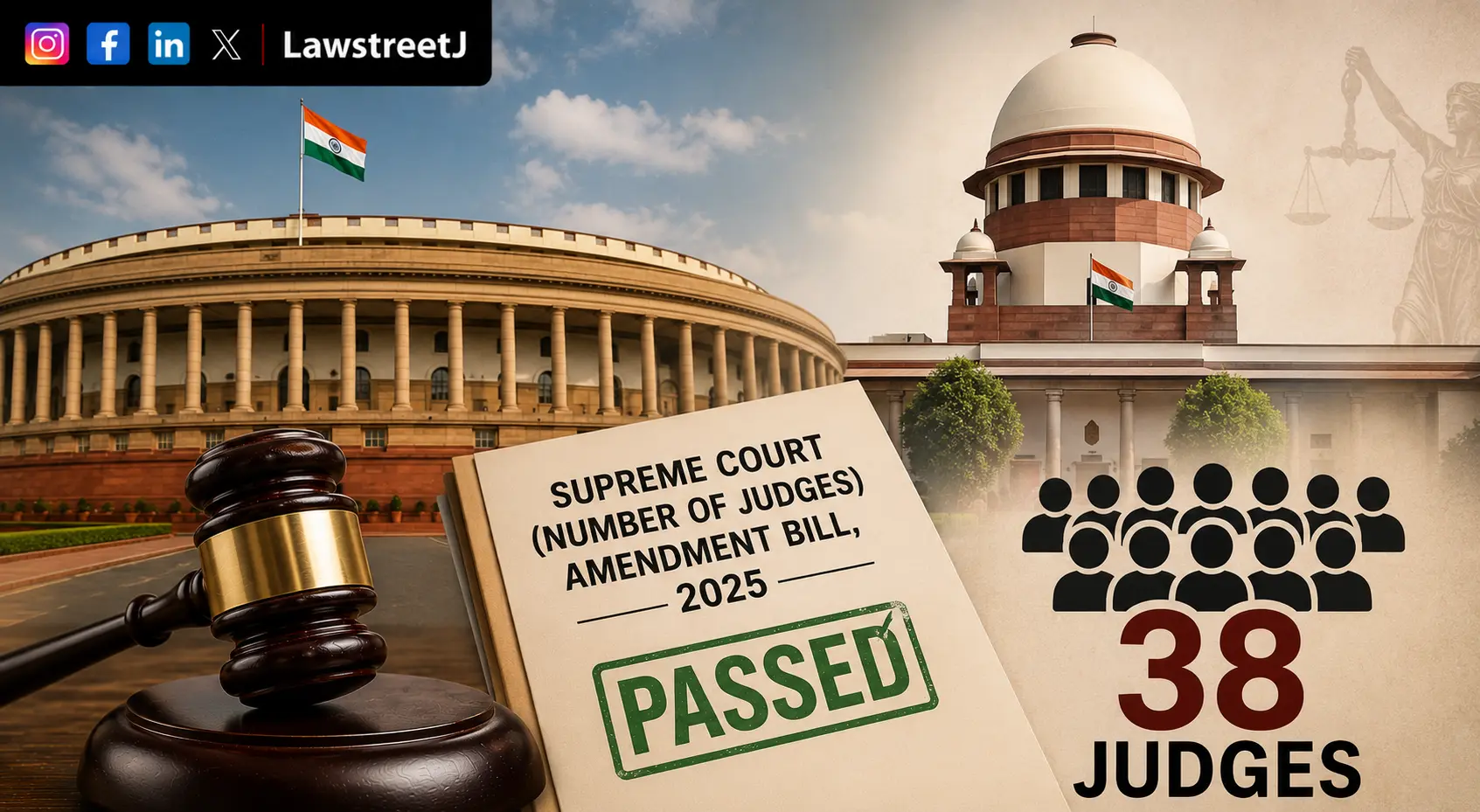
New Delhi: The Lok Sabha has passed the Supreme Court (Number of Judges) Amendment Bill, 2026, raising the sanctioned strength of Judges of the Supreme Court of India, excluding the Chief Justice of India, from thirty-three to thirty-seven.
The Bill, introduced by Union Minister of State (Independent Charge) for Law and Justice, Arjun Ram Meghwal, amends Section 2 of the Supreme Court (Number of Judges) Act, 1956, by substituting the word "thirty-three" with "thirty-seven," thereby increasing the Court's judge-strength by four.
The amendment is deemed to have come into force on 16th May, 2026.
The Bill also replaces the Supreme Court (Number of Judges) Amendment Ordinance, 2026, which had earlier been promulgated to give effect to the same increase. Clause 3 of the Act repeals the Ordinance while saving anything done or any action taken under the Act as amended by the Ordinance, deeming such action to have been taken under the corresponding provisions of the Act as amended by the present legislation.
The Statement of Objects and Reasons accompanying the Bill attributes the increase to the persistent and rising gap between institution and disposal of cases in the Supreme Court. As on 1st January 2026, 92,101 cases were stated to be pending before the Court. The Statement further notes that even while working at near-full sanctioned capacity of 34 Judges since 2019, the Supreme Court recorded institution of 75,410 fresh matters in 2025 against disposal of only 65,615 cases, resulting in "a persistent gap between institution and final disposal of cases which highlights the ongoing challenge of managing the docket, particularly in relation to older pending cases and those necessitating the attention and adjudication by larger Benches."
The Statement of Objects and Reasons describes the increase in judge-strength as "one of the most exigent and viable solutions for tackling the pending backlog of cases in the Supreme Court." It further states that the additional strength will enable the Chief Justice of India "to constitute Constitutional Benches for required period of days on a regular basis to hear cases involving substantial question of law," addressing a long-standing concern that Constitution Benches have often been difficult to convene given the competing demands on sitting Judges for regular docket work.
The Financial Memorandum appended to the Bill sets out the projected cost of the expansion. The creation of four additional posts of Judges, along with the requisite personal staff, rent-free official residences, and security arrangements, is estimated to entail a recurring annual expenditure of approximately Rs. 10,56,81,648 towards salaries, staff, conveyance and other miscellaneous expenses. Non-recurring expenditure, covering official vehicles, furnishing of residences and other one-time costs, has been estimated at approximately Rs. 3,47,36,000. The total expenditure on account of the creation of the four additional Judges' posts has accordingly been pegged at approximately Rs. 14,04,17,648. The Memorandum states that the legislation is not likely to involve any other recurring or non-recurring expenditure beyond what has been set out.
The amendment substitutes the existing figure of thirty-three Judges (excluding the Chief Justice of India) with thirty-seven, thereby increasing the Supreme Court's total sanctioned strength, including the Chief Justice of India, from thirty-four to thirty-eight Judges.


![Number of Constitution bench matters reduced drastically over decades, Lok Sabha informed [Read Statement]](/secure/uploads/2023/08/lj_1613_Constitution_bench_cases_sc.jpg)
![Amicus curiae supports plea for permanent disqualification of convicted lawmakers [Read Report]](/secure/uploads/2023/09/lj_2142_39a30518-7616-4c47-8f64-5f81898860ae.jpg)