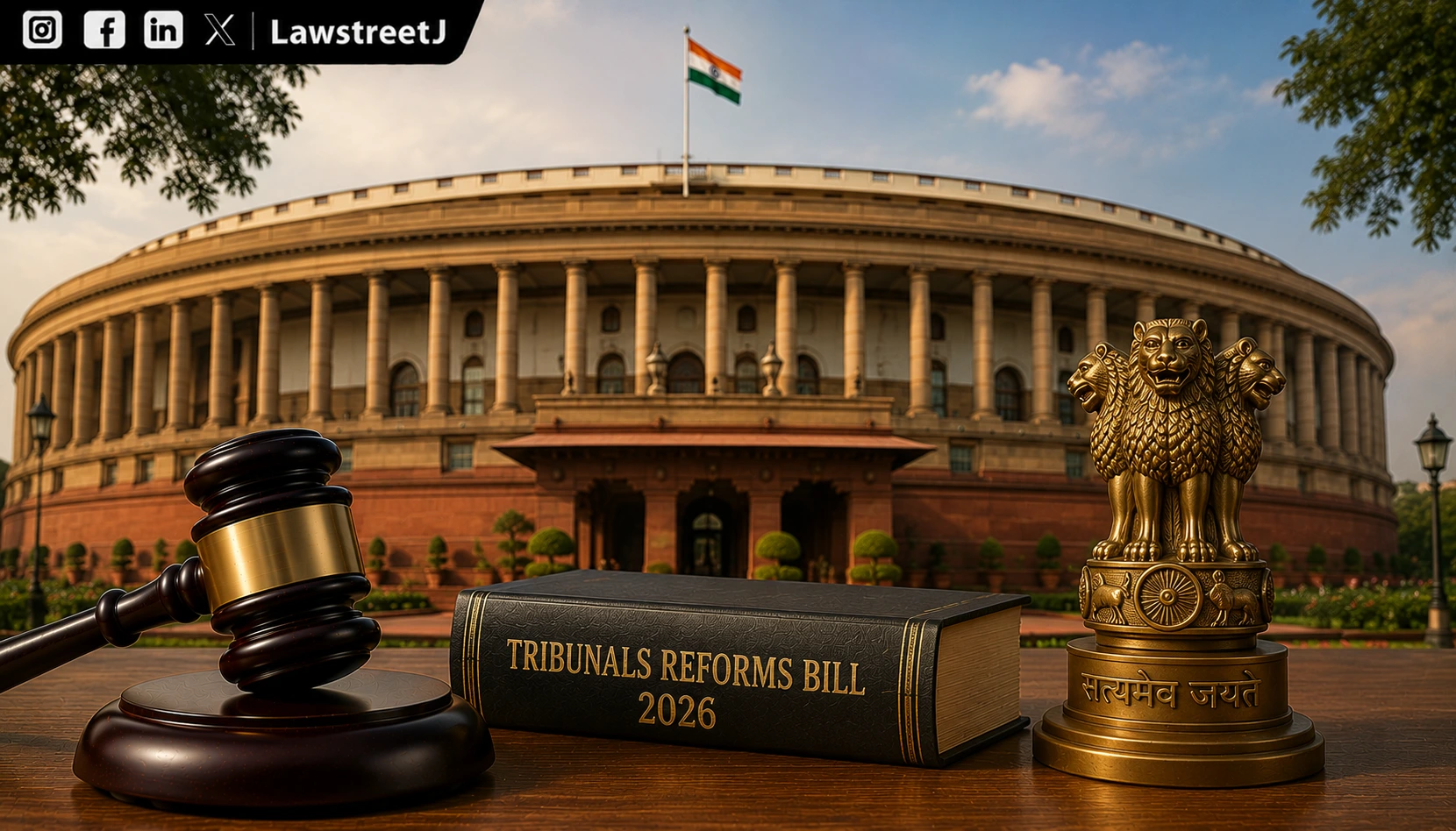
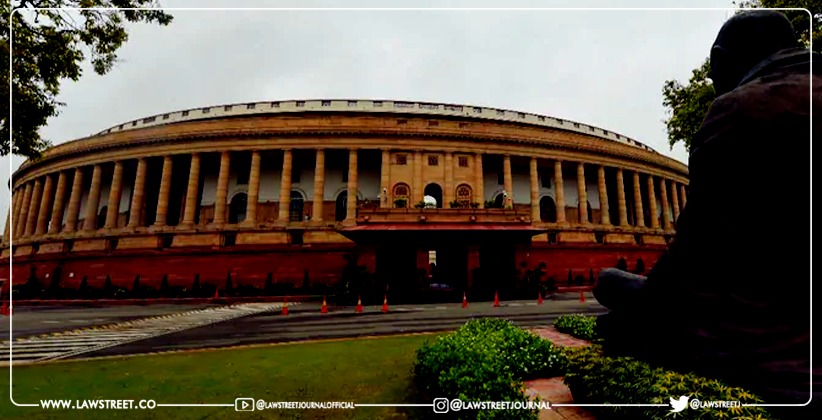
New Delhi: The Lok Sabha on Monday passed the Tribunals Reforms Bill, 2026, which proposes to set up a National Tribunals Commission to oversee the appointment, performance and functioning of Chairpersons and Members across 16 Tribunals.
The Bill was introduced and passed without debate amid sloganeering by Opposition members, who were protesting the alleged police crackdown on students following the July 20 demonstrations over the NEET paper leak.
Union Minister of State for Law and Justice Arjun Ram Meghwal, who piloted the Bill, clarified that the legislation does not alter the jurisdiction conferred on any Tribunal by its respective parent statute, and is intended solely to bring uniformity to appointments, tenure and service conditions. Parliamentary Affairs Minister Kiren Rijiju, in brief remarks, described the measure as part of the Government's broader legislative reform agenda.
The Bill seeks to repeal the Tribunals Reforms Act, 2021, and replace it with a fresh statutory framework, in response to the Supreme Court's ruling in Madras Bar Association v. Union of India, reported at (2026) 2 SCC 1, which struck down certain provisions of the 2021 Act on the ground that they were contrary to the principles of separation of powers and judicial independence. The Court had directed the Central Government to establish an independent National Tribunals Commission, possessing professional expertise and a transparent selection and oversight mechanism, for appointments to Tribunals.
Under the Bill, the National Tribunals Commission will be headquartered in New Delhi and will consist of a Chairperson and four Members, of whom two will be Judicial Members and two Technical Members. The Chairperson must have served as a Judge of the Supreme Court or Chief Justice of a High Court, while a Judicial Member must have served as a Chief Justice or Judge of a High Court. Technical Members must possess at least twenty-five years of experience in fields such as public administration, finance, law, accountancy, banking, management or technology. The Chairperson and Members will be appointed by the Central Government, in consultation with the Chief Justice of India for the Chairperson and Judicial Members, and will hold office for a term of five years or until the age of seventy, whichever is earlier.
The Commission has been tasked with conducting the selection process for Chairpersons and Members of the specified Tribunals through Search-cum-Selection Committees, reviewing the performance of Tribunals through an annual report to the Central Government, overseeing inquiries into complaints against Tribunal Chairpersons and Members, and developing a National Tribunals Data Grid to serve as a repository of case-related information across Tribunals.
The Bill provides for separate Search-cum-Selection Committees for the selection of Chairpersons and Members of Tribunals. For selection of a Chairperson, the Committee will be headed by the Chairperson of the Commission and will include a Technical Member of the Commission, a retired Chief Justice of a High Court, a Secretary to the Government of India nominated by the Centre, and two empanelled experts. For selection of Members, the Committee will be headed by a Judicial Member of the Commission and will similarly include a Technical Member, a retired High Court Judge, a Government nominee and two empanelled experts. The Committee's recommendations are to be forwarded to the Central Government, which must process and make the appointment within three months.
The Bill fixes the term of a Tribunal Chairperson at five years or until the age of seventy, and that of a Member at five years or until the age of sixty-seven, whichever is earlier, with eligibility for reappointment. Removal of a Chairperson or Member on grounds such as insolvency, conviction involving moral turpitude, incapacity, conflict of interest or incompetence will require a prior inquiry by the Commission, save where removal follows conviction, insolvency or incapacity.
The 16 Tribunals covered under the First Schedule to the Bill include the Customs, Excise and Service Tax Appellate Tribunal, the Central and State Administrative Tribunals, the Railway Claims Tribunal, the Securities Appellate Tribunal, the Debts Recovery Tribunal and Appellate Tribunal, the Telecom Disputes Settlement and Appellate Tribunal, the Appellate Tribunal for Electricity, the Armed Forces Tribunal, the National Green Tribunal, the National Company Law Appellate Tribunal, the National Consumer Disputes Redressal Commission, the Industrial Tribunal constituted by the Central Government, and the Income-tax Appellate Tribunal. The Bill also carries consequential amendments to the parent enactments governing each of these Tribunals, aligning their appointment and service provisions with the new framework.
According to the Financial Memorandum accompanying the Bill, the establishment of the Commission and its Secretariat, to be headed by an officer of the rank of Secretary to the Government of India, is estimated to entail a recurring expenditure of Rs 24.79 crore and a non-recurring expenditure of Rs 2.35 crore per annum, together with a projected annual increase in subsequent years.
The Bill will now be taken up in the Rajya Sabha before it can be enacted into law.


![Number of Constitution bench matters reduced drastically over decades, Lok Sabha informed [Read Statement]](/secure/uploads/2023/08/lj_1613_Constitution_bench_cases_sc.jpg)
![Amicus curiae supports plea for permanent disqualification of convicted lawmakers [Read Report]](/secure/uploads/2023/09/lj_2142_39a30518-7616-4c47-8f64-5f81898860ae.jpg)