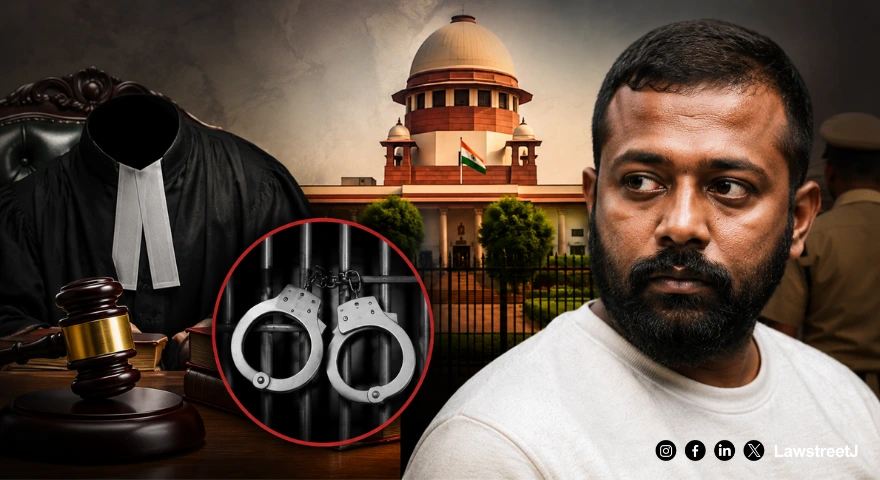
New Delhi: The Court of the Chief Judicial Magistrate, Central District, Tis Hazari Courts, Delhi, has convicted Sukesh Chandrasekhar for impersonating a sitting Judge of the Supreme Court of India over telephone calls made to a Special Judge in an attempt to secure his release on bail, while sharply criticising the Delhi Police for what it called a 'disconcertingly modest' investigation.
Chief Judicial Magistrate Ms. Harshita Mishra held Sukesh guilty under Sections 170, 189 and 507 of the Indian Penal Code, in a case arising from a complaint filed by Ms. Poonam Chaudhary, then Special Judge (PC Act cases, ACB), who was at the time seized of a separate corruption case against the accused.
As per the prosecution's case, on 27.04.2017, while in police custody in connection with a corruption case registered at PS Crime Branch, the accused obtained access to the mobile phone of Constable Manjeet, the police official in whose custody he was, and used it to contact the official landline and mobile number of the Special Judge. He allegedly first identified himself as the Private Secretary of a sitting Judge of the Supreme Court and then, on a second voice coming on the line, as the Judge himself, claiming to be calling on behalf of the Home Ministry and the Collegium, and directing her to grant the accused bail immediately, failing which she would face serious professional consequences.
Describing the nature of the case, the Court observed that "there are cases which test the limits of human audacity and mendacity", holding that the present case belonged to that category, as it involved a wholly impermissible attempt to interfere with the administration of justice by borrowing the authority of the highest court in the land.
The complainant Judge deposed that, upon receiving the call in her chamber, she noticed several missed calls from the same number, and, growing alarmed, called the PBX of the Supreme Court to be connected to the Private Secretary of the Judge she was told had called her. She was informed that no such Private Secretary existed in his office and that no such call had been made, upon which she realised that an imposter had impersonated a Judge of the Supreme Court, and lodged a complaint the next day with the Chief Metropolitan Magistrate seeking a thorough investigation. She correctly identified the accused in court as the same person who had earlier appeared before her in the corruption case.
The FIR was registered on 29.04.2017, and after a chargesheet filed in 2018 and trial spanning over seven years the prosecution examining sixteen witnesses between 2019 and 2026 the accused led defence evidence, examining his wife, Leena Paulose, while his two other proposed witnesses could not be examined as one had died and the other could not be traced.
The Additional Public Prosecutor, Mr. Amit Yadav, argued that the case represented a calculated assault on judicial independence, corroborated by Call Detail Records establishing the origin of the calls from Constable Manjeet's phone, and by the consistent testimony of a Judicial Officer with no motive to falsely implicate the accused. It was submitted that the accused, a self-professed conman with a history of similar impersonation, sought to contaminate the judicial process at its source, and that a conviction was necessary to send an unequivocal message against attempts to manipulate the judiciary.
Defence Counsel, Mr. Praveen Dabas, argued that the prosecution's case was built on conjecture and crippled by fatal investigative gaps that no pending bail application had been placed on record to establish motive, that no witness from the Supreme Court Registry or the complainant's court staff had been examined to corroborate the alleged impersonation, that the complainant's testimony suffered from internal contradictions regarding the date of the calls, and that neither the phone used to make the calls nor any voice recording had been recovered. It was further argued that the failure to explain how the accused obtained the complainant's unlisted official numbers left the prosecution's theory speculative, and that the case rested on circumstantial evidence falling short of the standard laid down in Sharad Birdhichand Sarda v. State of Maharashtra.
Rejecting the defence's contentions, the Court held that the absence of a formally pending bail application did not negate motive, since motive is ordinarily a matter of inference from surrounding circumstances rather than proof by a particular document. It held that the assumed identity, the choice of a judicial persona from the same region as the accused to ease the mimicry of voice and accent, the direct communication with a serving Judicial Officer, and the explicit direction to grant bail, taken cumulatively, were capable of establishing a deliberate intention to deceive and influence rather than an innocuous hoax call.
On the investigation itself, the Court did not mince words. While holding that the deficiencies were not sufficient to displace the otherwise credible and corroborated core of the prosecution's evidence, it observed that the chargesheet reflected an investigation of disconcertingly modest ambition, and cautioned that:
"judicial restraint cannot become judicial silence" when investigative deficiencies are material enough to risk obscuring the truth, adding that judicial institutions cannot be protected by polite euphemisms when investigating agencies falter on material counts.
The Court directed that a copy of the judgment be placed before the Commissioner of Police, Delhi, for institutional examination of the lapses identified including the preservation of electronic evidence, tracing of mobile devices, timely examination of witnesses, securing of CCTV footage and documentation of custody of material objects so that similar omissions do not recur in future investigations.
In a separate and pointed part of the judgment, the Court flagged the un-investigated role of Constable Manjeet, observing that the circumstances on record raised a far more disturbing possibility than mere negligence in losing his phone that he may himself have played a facilitating role in enabling the accused to access and use the device. The Court noted that relevant CCTV footage capable of shedding light on how the accused obtained access to the phone did not appear to have been seized and preserved with the seriousness the evidence demanded, and that the investigation appeared to have been conducted with far greater eagerness to establish the accused's guilt than to examine the possible role of a serving police official.
Holding that an investigation must follow the evidence wherever it leads, the Court observed that "the police uniform cannot become a shield against investigation", and directed the Commissioner of Police or the concerned DCP to re-examine Constable Manjeet's role, covering aspects such as the circumstances in which the phone was left unattended, whether it was locked, who knew its access credentials, the reasons for the absence of a prompt missing-phone report, and whether fresh departmental or criminal proceedings were warranted against him.
Holding that the prosecution had proved the guilt of the accused beyond reasonable doubt on all three charges, the Court convicted Sukesh Chandrasekhar under Sections 170, 189 and 507 of the IPC, clarifying that the conviction rested not on the notoriety or antecedents of the accused, but on the evidence led in the present case and the ingredients of the offences charged.
Concluding the judgment, the Court observed that "justice cannot be entered through the backdoor of impersonation, intimidation or manufactured authority", and posted the matter for hearing the convict on the point of sentence on 27.08.2026.
Appearances:
For the State: Mr. Amit Yadav, Additional Public Prosecutor.
For the Accused: Mr. Praveen Dabas, Advocate.
Case Title: State vs. Sukesh Chandrasekhar @ Sukash Chandrasekhar, CT. Case No. 5409/2016, FIR No. 100/2017, PS Subzi Mandi (later transferred to PS Crime Branch)

![Delhi High Court Sets Aside Arbitral Tribunal's Award Against NHAI in Highway Project Delay Case [Read Judgment]](/secure/uploads/2023/07/lj_9605_23374c2e-392c-4491-a2fe-f2f12fc5272f.jpg)
![Delhi Court Rejects Stay Request in Defamation Case Against Rajasthan CM Ashok Gehlot [Read Order]](/secure/uploads/2023/08/lj_5208_80de1ddc-d76a-4f7f-b180-408e3ae14fb4.jpg)