New Delhi | A Right to Information reply furnished by the Directorate of Estates under the Union Ministry of Housing and Urban Affairs has formally confirmed what government records have indicated for over a decade, that the Indian National Congress has remained in unauthorised occupation of Bungalow No. 24, Akbar Road, New Delhi, since June 26, 2013, without paying any rent to the Central Government for the property. The RTI reply, accessed by India Today on July 8, 2026, further states that the outstanding dues payable by the Congress for the property are "under review and yet to be determined."
The disclosure arrives in the backdrop of eviction notices issued by the Directorate of Estates to Congress in March 2026 under the Public Premises (Eviction of Unauthorized Occupants) Act, 1971, notices that, as of the date of this writing, have not been enforced, raising substantive questions about the administration of government property law when the occupant is a major political party and principal opposition.
Factual Background: Allotment, Cancellation, and Continued Occupation
The material facts disclosed by the RTI reply are as follows:
Bungalow No. 24, Akbar Road, located in Lutyens' Delhi, was allotted to the All India Congress Committee on August 7, 1992. The allotment was cancelled with effect from June 26, 2013, following the Congress party's failure to comply with a condition attached to the grant of a plot of land in June 2010 for the construction of a new party headquarters. That condition required the party to complete construction within three years and vacate four government bungalows it occupied, 24 Akbar Road, 5 Raisina Road, 26 Akbar Road, and C-II/109 Chanakyapuri, by June 2013.
The party did not complete construction within the stipulated period. Its allotments were cancelled on June 26, 2013. The Congress filed a request for a three-year extension and separately sought permission to retain the premises while paying the normal licence fee. That request was documented in a 2018 RTI reply as being "under consideration." The July 2026 RTI reply makes no mention of that request having been accepted or formally disposed of.
The Directorate of Estates has confirmed that no rent has been received from the Congress for the property since June 26, 2013, a period of thirteen years and two weeks. The outstanding dues remain uncalculated, with the government's response characterising them as "under review and yet to be determined."
A parallel RTI query regarding 11 Ashoka Road, the BJP's former headquarters, confirmed the property was allotted to the BJP on March 21, 1985, and is now part of the Lok Sabha Members' Pool. Rent-related queries have been transferred to the Lok Sabha Secretariat.
The Legal Framework: PP Act 1971 and the Estate Officer's Powers
The central statutory instrument governing the government's authority to reclaim 24 Akbar Road is the Public Premises (Eviction of Unauthorized Occupants) Act, 1971.
Under Section 2(e) of the PP Act, "public premises" includes any premises belonging to or taken on lease by the Central Government. Under Section 2(g), an "unauthorised occupant" means any person who is in occupation of public premises without authority, including a person whose authority has expired or been cancelled. The Directorate of Estates' own characterisation of Congress's occupation as "unauthorised" in the RTI reply satisfies the definitional threshold under Section 2(g) on its face.
The enforcement mechanism under the Act is as follows:
- Section 4 empowers the Estate Officer to issue a notice to a person believed to be in unauthorised occupation of public premises, requiring them to appear before the Estate Officer and show cause why an order of eviction should not be made.
- Section 5 empowers the Estate Officer, after giving the occupant a reasonable opportunity of being heard, to pass an eviction order if satisfied that the person is in unauthorised occupation. The order may direct the occupant to vacate within a specified period.
- Section 5A empowers the Estate Officer to recover arrears of rent as arrears of land revenue.
- Section 7 provides for the appellate authority before which an Estate Officer's order may be challenged.
An aggrieved party may further challenge the appellate order before the High Court under Article 226 of the Constitution on grounds of jurisdictional error, procedural violation, or constitutional infirmity, which Congress sources indicated in March 2026 they were considering.
The government's 2014 Supreme Court direction, requiring that political parties vacate government bungalows not allotted to them, has not been specifically revived in the current proceedings, though it remains an available judicial instrument.
The March 2026 Eviction Notices: What Was Issued, What Was Not Enforced
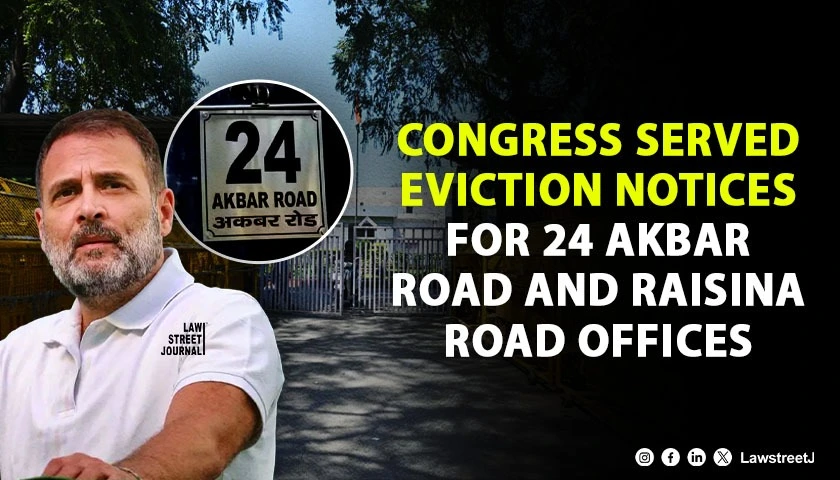
This is not the first time the legal dimensions of Congress's occupation of 24 Akbar Road have demanded scrutiny. Law Street Journal had reported in detail in March 2026, in a piece that remains essential reading for the procedural history of this dispute, that the Directorate of Estates issued formal eviction notices to the Congress under the PP Act, 1971 for both 24 Akbar Road and 5 Raisina Road, directing the party to vacate by March 28, 2026. That Law Street Journal report documented the statutory basis for the notices, the political response, and the legal options Congress was weighing and is directly relevant context for understanding the July 2026 RTI disclosure, which effectively confirms that the enforcement those March notices threatened has not materialised.
Also Read: Congress Asked to Vacate 24 Akbar Road HQ, Raisina Road Office by March 28; Eviction Notices Issued
The notices were described as the final notice following earlier communications, with a warning that forcible eviction proceedings under Section 5 of the Act could follow if the deadline was not met. Congress sources at the time indicated the party was examining a writ petition before the Delhi High Court under Article 226 of the Constitution, potentially challenging the eviction on grounds of procedural fairness, inadequacy of notice, and the historical significance of the premises. A legal team led by Rajya Sabha MP and senior Supreme Court advocate Abhishek Manu Singhvi was reported to be reviewing the matter.
Separately, back-channel negotiations involving senior Congress leaders Ashok Gehlot and Ajay Maken with government representatives were reported to have produced temporary relief, with party sources indicating the Congress might be permitted to retain the premises for up to six months. The March 28 deadline passed without publicly announced enforcement proceedings. The July 8, 2026 RTI reply now formally documents the post-deadline position on the government's own record and raises the question of why the legal machinery set in motion so publicly in March has produced no visible enforcement outcome four months later.
Unanswered Legal Questions
The RTI disclosure raises several substantive legal questions that remain unresolved:
On the dues: The Directorate of Estates' characterisation of outstanding dues as "under review and yet to be determined" is unusual for a property whose allotment was cancelled over thirteen years ago. A 2018 RTI response had noted a revised licence fee of Rs 3,920 per month effective July 1, 2017. Whether damage-rate licence fees, typically higher than standard licence fees for unauthorised occupants have been calculated and demanded is not disclosed in the July 2026 reply. The failure to quantify and demand outstanding dues may have procedural implications for any eviction proceedings under Section 5A of the PP Act.
On the pending request: The Congress's 2013 request for retention while paying normal licence fees was documented as "under consideration" in 2018. The RTI reply does not indicate whether this request has been formally rejected, a step that would be legally necessary before characterising the occupation as unambiguously unauthorised without qualification. If the request has not been formally disposed of, Congress may argue that its occupation retains a residual administrative character that falls short of the Section 2(g) definition.
On the writ petition: Whether Congress has in fact filed or is still contemplating a writ petition before the Delhi High Court under Article 226 challenging the eviction notices is not publicly known. If filed, any interim stay granted by the High Court would be a material factor in understanding why enforcement has not proceeded.
On institutional consistency: The RTI reply's confirmation that BJP's former headquarters at 11 Ashoka Road is now within the Lok Sabha Members' Pool introduces a comparative legal question. The terms on which Ashoka Road's transition was managed and its current rent status, transferred to the Lok Sabha Secretariat, are not fully disclosed in the RTI reply, leaving open the question of whether the administrative treatment of the two properties has been consistent.
Historical and Constitutional Significance of the Premises
The bungalow at 24 Akbar Road has significance beyond its administrative categorisation. The premises housed Sir Reginald Maxwell under the British administration and served as the residence of Daw Khin Kyi, Myanmar's ambassador to India, in the early 1960s, during which period her daughter, future Nobel Peace Prize laureate Aung San Suu Kyi, lived there.
The Congress converted the bungalow into its operational headquarters following the 1977 Lok Sabha elections, the first time the party had lost a general election. It was from 24 Akbar Road that the political organisation of Indira Gandhi's return to power in 1980 was conducted. The party formally shifted its headquarters to the newly constructed Indira Bhawan on January 15, 2025, but has retained physical possession of 24 Akbar Road since the shift.
The constitutional dimension of the dispute is significant. The use of government-owned property by a political party that is simultaneously the principal opposition in Parliament, with the government that controls the Directorate of Estates being the ruling party's administration, creates a structural tension between administrative law enforcement and the constitutional imperative of political fairness. Congress's characterisation of the eviction notices as politically motivated, while the government maintains they are purely administrative, reflects that tension directly.
What the Law Requires, and What Has Not Happened
The statutory position under the PP Act, 1971 is clear. A person in unauthorised occupation of public premises as the Congress is formally categorised by the Directorate of Estates, may be served notice under Section 4, heard under Section 5, and ordered to vacate. Outstanding dues may be recovered as arrears of land revenue under Section 5A.
What the July 2026 RTI disclosure confirms is that thirteen years after the cancellation of allotment, none of these statutory steps has been completed to finality. The dues have not been calculated. The eviction order under Section 5 has not been passed despite notices having been issued. The property remains occupied.
Whether the July 8 RTI reply, which puts these facts formally and publicly on the government's own record, accelerates administrative and legal proceedings, or whether the pattern of notice-without-enforcement continues, is the central question that both lawyers and political observers are now watching closely.