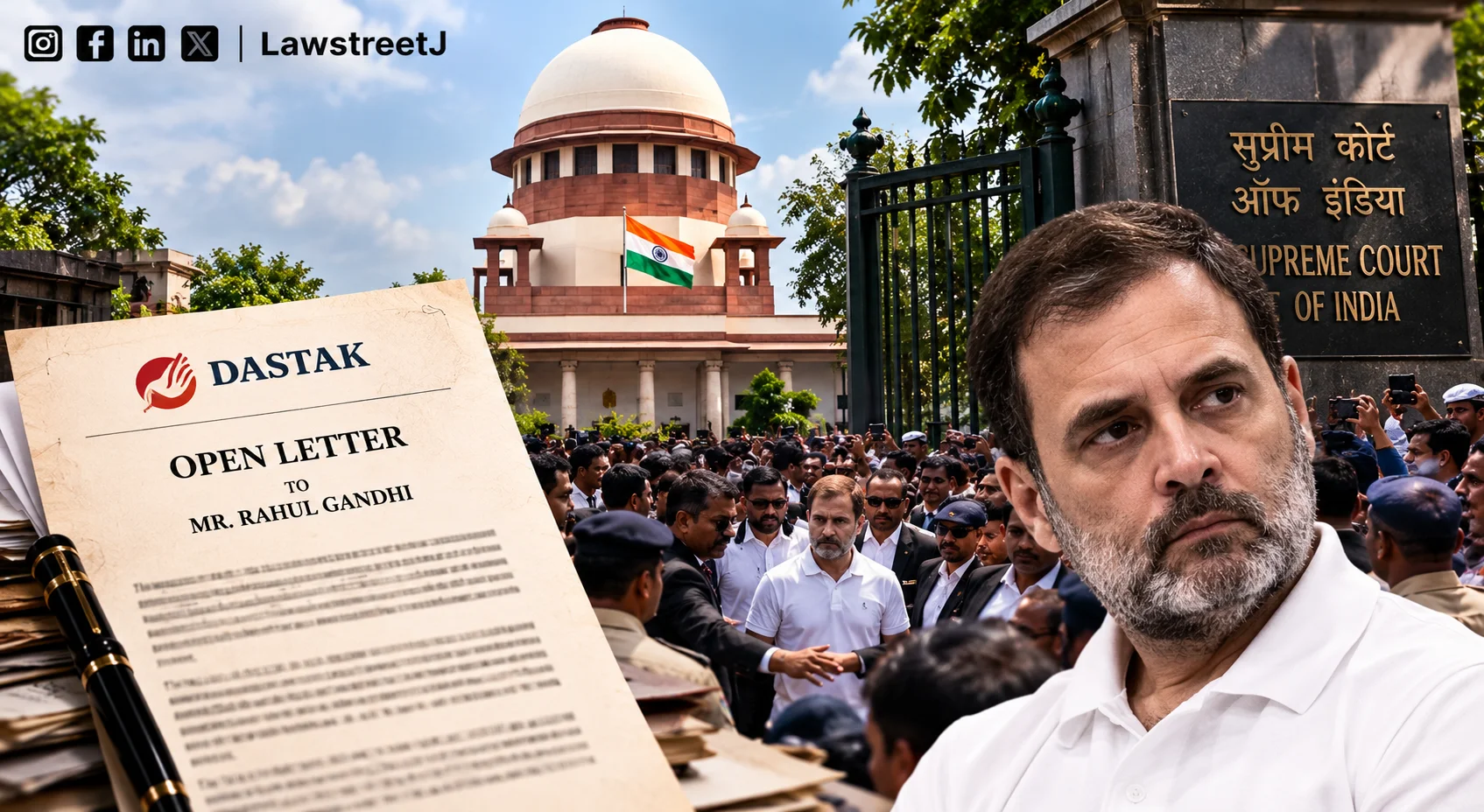
New Delhi: The Dr. Ambedkar Society for Thoughts, Actions and Consciousness (DASTAK) has issued a press note carrying an open letter to Leader of the Opposition Rahul Gandhi, demanding a public, unconditional apology for what it describes as conduct that harmed the dignity of the Indian judiciary and insulted the constitutional ideals of Dr. B.R. Ambedkar. The letter is dated October 14, 2026.
The organisation states that it is writing “with deep concern and anguish” as a body representing Scheduled Castes, Scheduled Tribes and Backward Classes. According to the letter, on October 12, 2026, Gandhi and other opposition leaders entered the Supreme Court premises with a large crowd and without permission, allegedly creating chaos and, in the organisation’s words, attempting to hold the Supreme Court “hostage” for political interests.
DASTAK describes the day as a “highly controversial chapter” in India’s democratic history, one that will be called the “blackest day for Indian democracy since the Emergency.” The letter says the manner of entry raises questions about Gandhi’s political maturity, his adherence to constitutional decorum and his faith in the Constitution. It calls the Supreme Court “the most sacred pillar” of democracy, describes the episode as a security breach and an assault on the spirit of the Constitution, and adds that it has hurt the sentiments of crores of SC, ST and Backward Class citizens who look up to Ambedkar.
The letter states that Gandhi’s recent actions make it appear that he is targeting constitutional institutions and damaging public faith in democracy, and says this raises suspicion that he may be acting at the behest of “certain other forces”. It lists seven actions in support. First, it says Gandhi demanded the resignation of the Election Commission and Chief Election Commissioner Gyanesh Kumar over alleged vote theft and repeatedly questioned the credibility of EVMs. Second, it says Gandhi and INDIA bloc leaders have alleged unilateral decision-making and large-scale deletion of voters’ names in the Special Intensive Revision (SIR) of electoral rolls, which the letter calls contradictory to the vote-theft claim, asking what need a party able to win by stealing votes through EVMs would have for an SIR.
Third, the letter alleges that when a joint opposition delegation met President Droupadi Murmu regarding alleged electoral irregularities, it could not produce concrete data or evidence even when requested. Fourth, it claims that during visits to the US and UK, Gandhi described Indian democracy, the judiciary and investigative agencies as “weak” or “under government control”. Fifth, it alleges continuous attempts to instigate the youth, similar to events in Nepal and Bangladesh. Sixth, it accuses him of attempting to hold the elected government hostage by staging street protests without prior permission.
Seventh, the letter alleges that while the Chief Justice of India is hearing petitions on the questions raised, Gandhi demanded a meeting with him and entered the Supreme Court with a heavy crowd, attempting to pressure the judiciary so that the impartiality of the Court is compromised.
DASTAK demands that Gandhi clarify the facts and “tender a public, unconditional apology” to the people of the country, the honourable judiciary and citizens who respect Ambedkar’s ideals. It describes the October 12 act as “a blow to Babasaheb’s dream of a democratic India” and says that, because of the damage to constitutional institutions, the SC, ST and Backward Class communities are “feeling extremely insecure”. The organisation hopes Gandhi will offer a clarification and apologise to the nation from a public platform.
The letter is signed by Dr. N. K. Sant, President, DASTAK. The society states that it was established in 2000 and works in the fields of education, health and prosperity.


.jpeg)