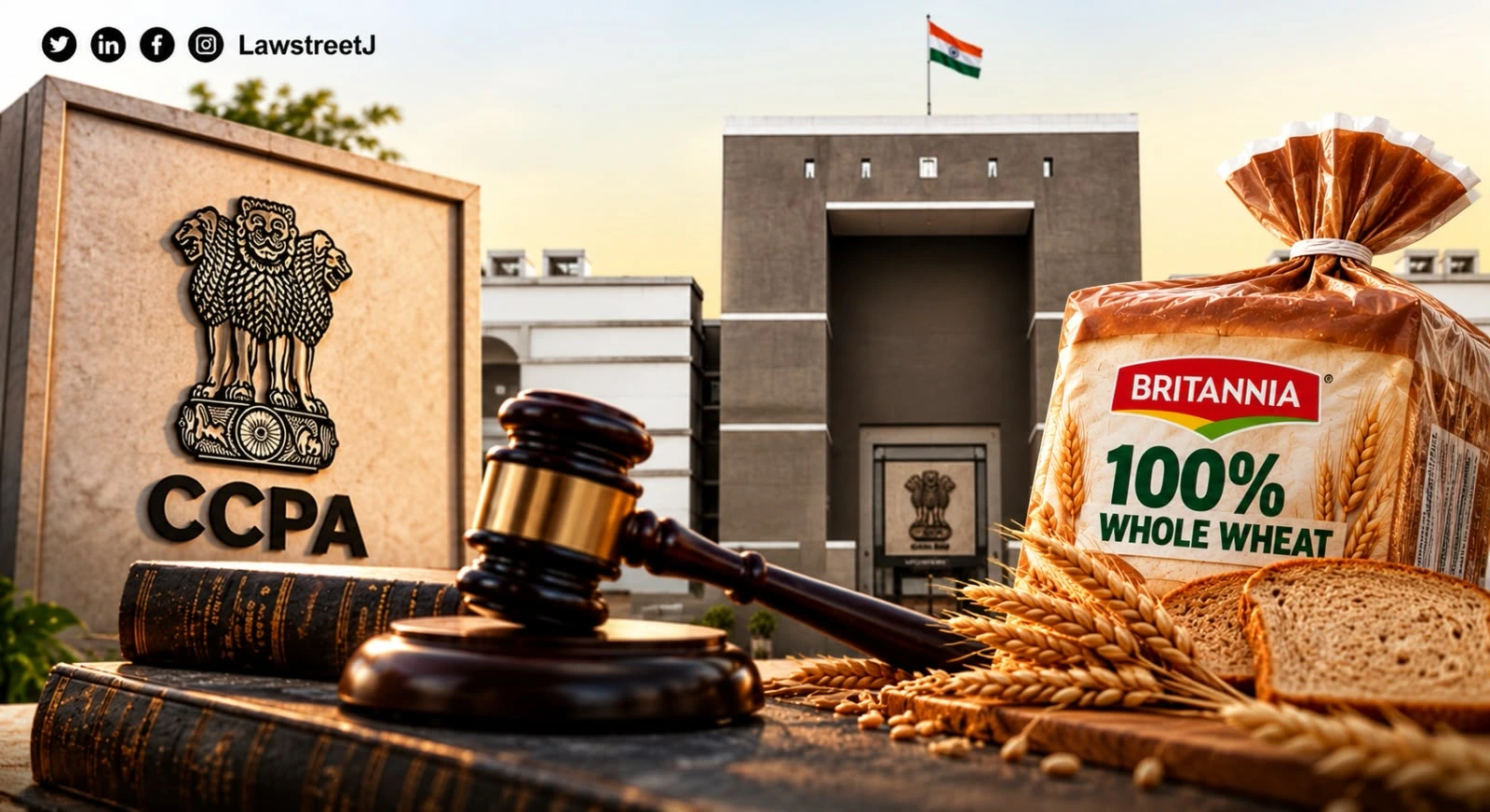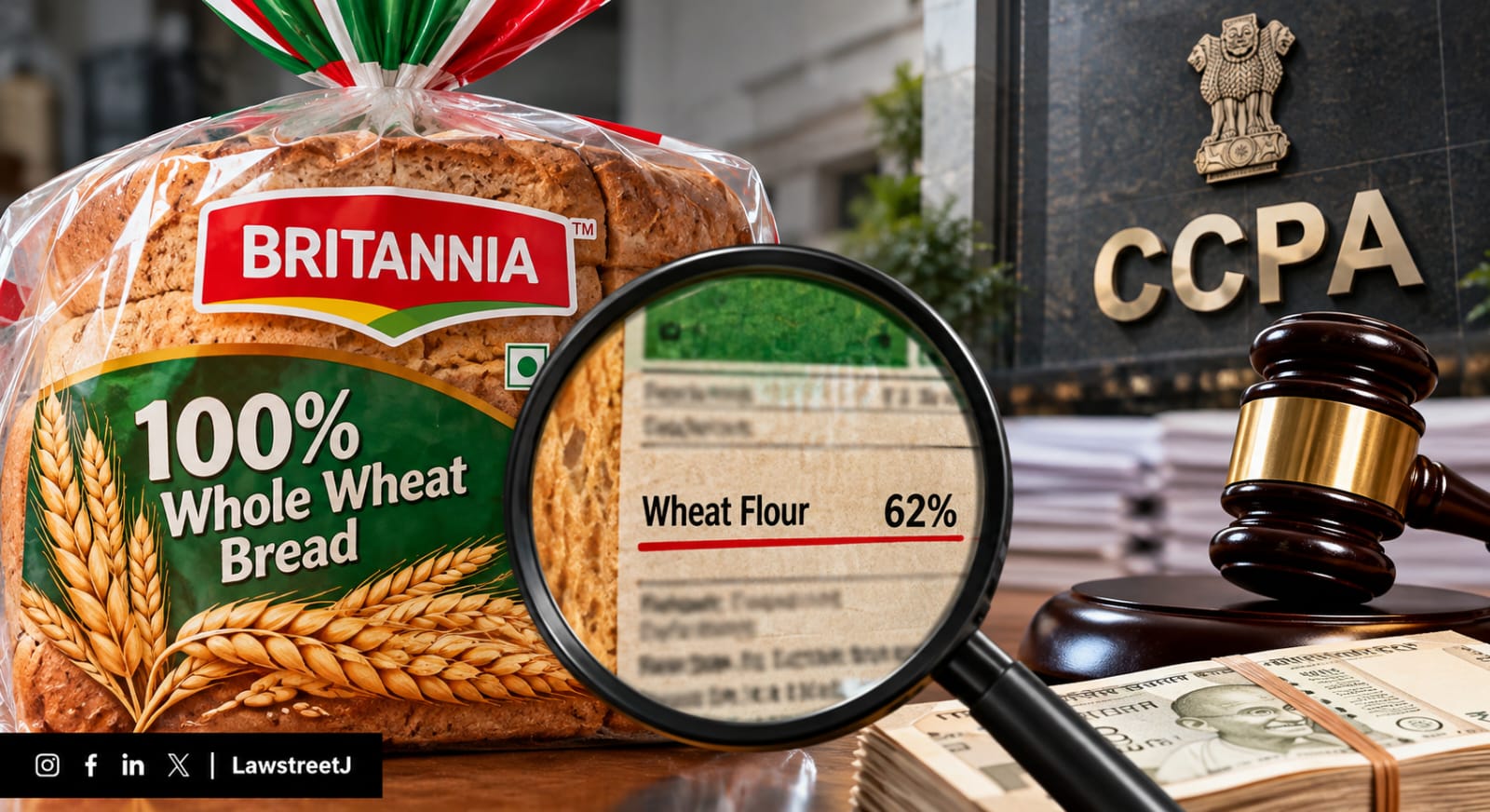
New Delhi — India's Central Consumer Protection Authority (CCPA) has imposed a penalty of ₹1 lakh on Britannia Industries Limited for misleading advertising and unfair trade practice, after finding that the company's "100% Whole Wheat Bread" contained only approximately 62 percent whole wheat flour, well short of both the literal claim and the regulatory threshold required to use the "Whole Wheat Bread" nomenclature at all.
The Order
In an order dated October 22, 2026, the CCPA held that Britannia's prominent "100% Whole Wheat Bread" claim was misleading because the product's declared composition showed whole wheat flour (atta) accounted for only around 62 percent of the finished bread, with the remaining roughly 38 percent comprising other ingredients, including water, yeast, wheat bran, vital gluten, sugar, iodised salt, refined palmolein oil, colour, a preservative, flour improvers, emulsifiers, an acidity regulator and a flour treatment agent.
The authority found that an ordinary consumer encountering the prominent "100%" claim would reasonably understand it to mean the entire product was made from whole wheat, an impression the authority said was reinforced by an accompanying "0% Maida" claim on the packaging.
The CCPA directed Britannia to discontinue the "100% Whole Wheat Bread" claim with immediate effect across all print, electronic and social media, including the company's website and social media platforms, in addition to imposing the ₹1 lakh penalty. The authority described Britannia's conduct as "solely motivated to take advantage of goodwill" associated with whole wheat products.
Britannia's Defence
Britannia, in its response submitted to the CCPA on January 28, 2025, argued that the "100%" claim referred specifically to the composition of the flour used in the bread, rather than to the composition of the finished product as a whole. The company maintained that the flour component of its bread was entirely whole wheat flour, with no refined wheat flour (maida) used at all, and that the other ingredients present, including water, yeast and the various additives, were simply necessary components of the bread-making process rather than part of the "flour" the 100 percent claim was meant to describe. The company pointed to a smaller, qualifying line on the back of the packaging, which read "Made From 100% Whole Wheat Flour on Flour Basis," as evidence that the claim was always intended to be understood on this narrower, flour-only basis.
The CCPA rejected this defence, holding that the prominent, front-of-pack "100% Whole Wheat Bread" claim, especially when read alongside the "0% Maida" claim, created an overall impression for an ordinary consumer that the finished bread itself was entirely composed of whole wheat, an impression the authority found was not adequately corrected by a smaller qualifying statement elsewhere on the packaging.
The Regulatory Threshold Issue
Beyond the specific "100%" claim, the CCPA's order identified a second, independent problem with Britannia's labelling: the product's use of the term "Whole Wheat Bread" at all. Under Regulation 2.6 of the Food Safety and Standards (Labelling and Display) Second Amendment Regulations, 2022, a bread product must contain whole wheat flour accounting for at least 75 percent of its composition to be labelled and marketed as "Whole Wheat Bread." Britannia's product, with whole wheat flour accounting for only around 62 to 62.5 percent of the finished bread by various reported figures, fell short of this 75 percent regulatory threshold, meaning the product arguably should not have carried the "Whole Wheat Bread" designation at all, independent of the separate, additional "100%" claim layered on top of it.
The CCPA's order was issued under the Consumer Protection Act, 2019, India's principal consumer-protection statute, which establishes the Central Consumer Protection Authority under Section 10 as a regulatory body empowered to protect, promote and enforce the rights of consumers as a class. Section 2(28) of the Act defines "unfair trade practice" to include the making of false or misleading representations concerning the composition, characteristics or standard of goods, while Section 2(47) separately defines a "misleading advertisement" as one that falsely describes a good or service, gives a false guarantee, or conveys an express or implied representation likely to mislead consumers as to the nature, substance, quality or quantity of the product advertised.
Section 21 of the Act empowers the CCPA, where it is satisfied that an advertisement is false or misleading and prejudicial to the interest of consumers, to direct the discontinuation of such advertisement and to impose a penalty, which may extend up to ₹10 lakh for a first contravention, with enhanced penalties of up to ₹50 lakh for subsequent contraventions.
The CCPA's order concluded that Britannia's claims constituted both a misleading advertisement and an unfair trade practice within the meaning of the Act, affecting consumers as a class, which formed the statutory basis for both the discontinuation direction and the monetary penalty imposed.
Separately, the Food Safety and Standards Act, 2006, and its associated labelling regulations, including the specific 75 percent whole-wheat-flour threshold under the 2022 Second Amendment Regulations, establish the compositional standards a food product must meet before it can lawfully be marketed using a particular nomenclature, such as "Whole Wheat Bread." Non-compliance with FSSAI labelling standards can separately attract regulatory consequences under the Food Safety and Standards Act, distinct from, though potentially overlapping with, the CCPA's enforcement action concerning misleading advertising under the Consumer Protection Act.