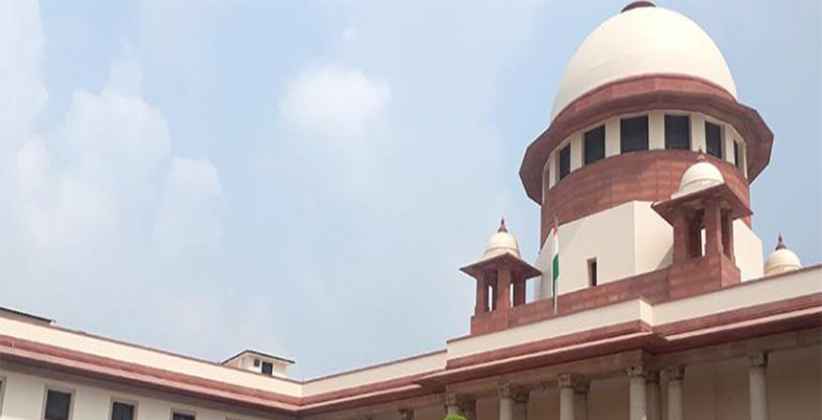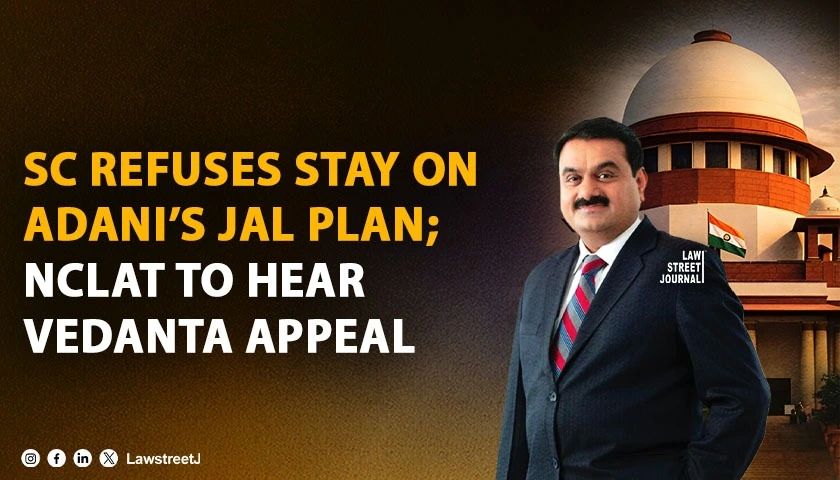
New Delhi: The Supreme Court of India has declined to interfere with the ongoing implementation of Adani Enterprises Ltd.’s resolution plan for the debt-ridden Jaiprakash Associates Ltd. (JAL).
On April 6, 2026, a bench led by Chief Justice of India Surya Kant and Justice Joymalya Bagchi refused to stay the ₹14,543 crore acquisition process, marking a significant development in the high-stakes corporate battle between the Adani Group and billionaire Anil Agarwal’s Vedanta Ltd.
The legal dispute centres on the acquisition of the insolvent Jaiprakash Associates, which entered the corporate insolvency resolution process in June 2024. The company had defaulted on loans worth approximately ₹57,185 crore, leading to its admission into insolvency following a petition by ICICI Bank. JAL’s diversified portfolio, which includes nearly 4,000 acres of land in the National Capital Region (NCR), marquee real estate projects like Jaypee Greens, and significant cement and hospitality assets, has made it a highly sought-after target for India’s infrastructure conglomerates.
The National Company Law Tribunal (NCLT) had previously approved Adani’s resolution plan on March 17, 2026. Following this, Vedanta Ltd., a rival bidder, moved the National Company Law Appellate Tribunal (NCLAT) to challenge the decision. On March 24, 2026, the NCLAT declined to grant an interim stay on the plan’s implementation but clarified that any actions taken would be subject to the final outcome of the appeal. Vedanta subsequently escalated the matter to the Supreme Court.
During the proceedings before the Supreme Court, Senior Advocate Kapil Sibal, appearing for Vedanta, argued that the bidding process was fundamentally flawed. Sibal contended that Vedanta’s offer was financially superior, citing a total value of approximately ₹17,926.21 crore compared to Adani’s bid of roughly ₹14,000 crore. He argued that by choosing the lower bid, the Committee of Creditors (CoC) had disregarded the objective of value maximisation under the Insolvency and Bankruptcy Code (IBC).
Vedanta further argued that its offer carried a higher Net Present Value (NPV) of ₹12,505 crore, claiming it exceeded Adani’s proposal by at least ₹1,000 crore in NPV terms. The company alleged that the process was “unfair, opaque, and inequitable,” and characterised the rejection of its revised bid as a procedural failure. Vedanta claimed it had received written confirmation of being the highest bidder before the decision was reversed without adequate explanation.
In response, the Committee of Creditors, represented by Solicitor General Tushar Mehta, defended the selection of Adani’s plan. The CoC maintained that resolution plans are evaluated on multiple factors beyond just the headline value. It emphasised that Adani’s plan offered a substantial upfront cash payment of approximately ₹6,000 crore and a swift repayment timeline of just two years. In contrast, Vedanta’s proposal reportedly spread payments over a period of up to five years.
Lenders also highlighted that Vedanta’s improved offer, submitted on November 8, 2025, came after the bidding process had officially closed. The CoC argued that accepting such a bid would have necessitated reopening the entire process for all participants, leading to further delays. They reiterated that the “commercial wisdom” of the creditors is paramount under the IBC, a principle that the NCLT had upheld in its earlier order.
Senior Advocate Mukul Rohatgi, representing the Adani Group, submitted to the Supreme Court that there was no substantive legal challenge to the resolution plan itself. He argued that the process followed all prescribed IBC rules and that no bidder has a guaranteed right to win solely based on offering the highest headline value. Additionally, the Resolution Professional, represented by Senior Advocate Dr. Abhishek Manu Singhvi, alleged that Vedanta’s late offer followed a potential leak of previous bidding information.
The Supreme Court bench noted that company appeals related to the case are already scheduled for a final hearing before the NCLAT on April 10, 2026. Refusing to halt the current momentum of the resolution, the bench requested the NCLAT to hear the matter on an out-of-turn basis. The court also directed the monitoring committee overseeing the transition to seek the NCLAT’s leave before taking any major policy decisions in the interim period.
The financial health of the bidders was also a point of discussion in the broader market context. While the Vedanta Group reportedly faces significant financial pressure with a high debt-to-equity ratio, Adani Enterprises maintains a more stable leverage profile. The creditors, led by the National Asset Reconstruction Co. Ltd. (NARCL), favoured the Adani plan with an overwhelming 93.81% voting share, emphasising the need for immediate liquidity and certainty of recovery.
The total value of Adani’s plan, including capital expenditure and working capital, is estimated at around ₹15,343 crore. Given the admitted claims of approximately ₹60,637 crore, this translates into a recovery of roughly 24% for lenders. The assets at stake include the Jaypee International Sports City near the upcoming Noida International Airport, five hotel properties, and a cement capacity of 6.5 million tonnes across Uttar Pradesh and Madhya Pradesh.
While the Supreme Court’s refusal to grant a stay allows the takeover to proceed, the court explicitly kept Vedanta’s challenge alive. The appellate tribunal’s upcoming decision will be critical in determining whether the CoC’s preference for upfront cash and execution capability outweighs the principle of highest financial value under the IBC framework.
Case Title: Vedanta Limited v. Bhuvan Madan & Ors., C.A. Nos. 4098–4099 of 2026