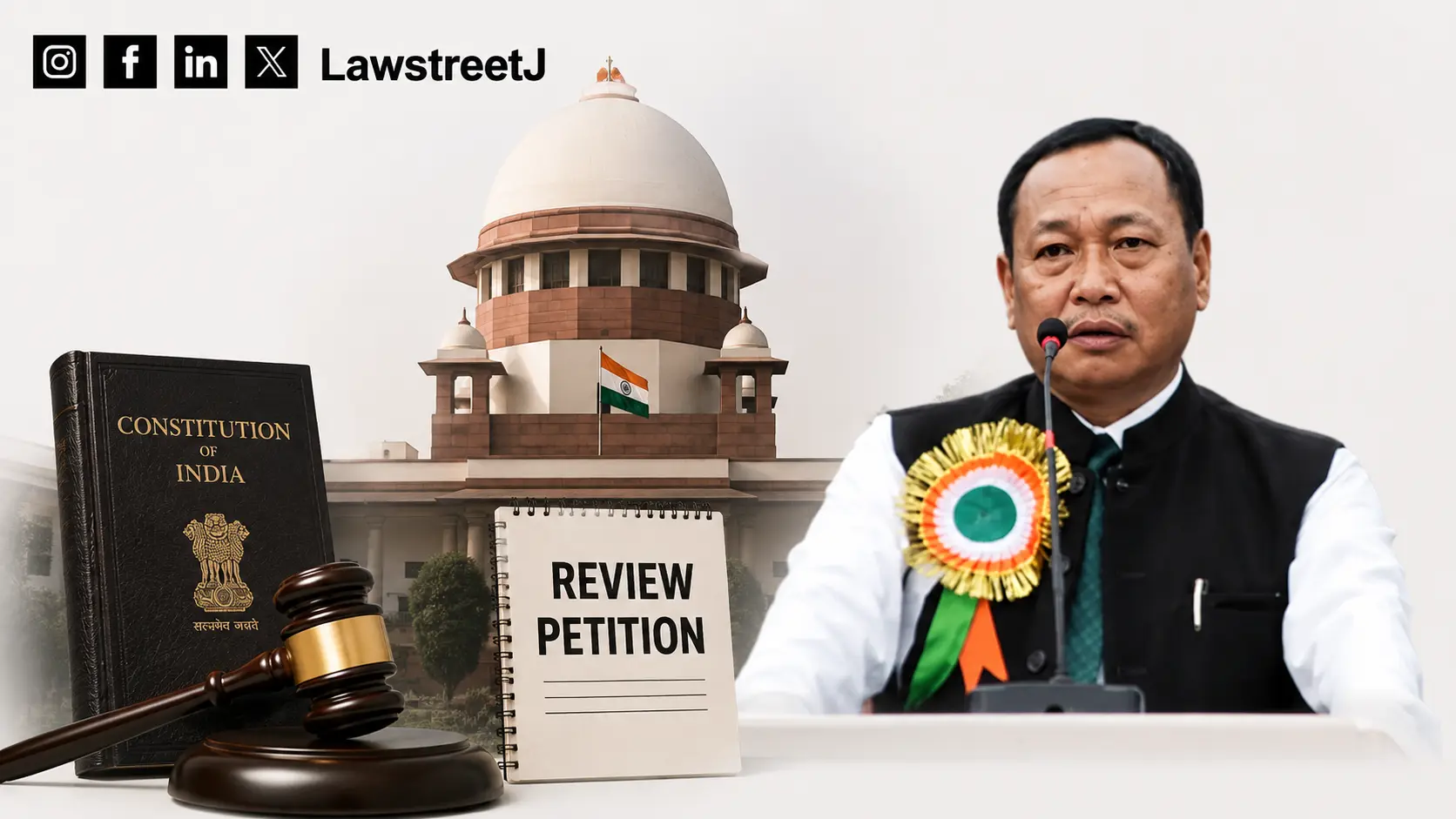
Aizwal/Mizoram: Veteran Mizoram politician and legislator Rasik Mohan Chakma has announced his decision to file a review petition before the Supreme Court challenging its recent judgment on dual membership of Autonomous District Councils (ADCs) and State Legislative Assemblies.
The proposed review is based upon the apex court’s July 20, 2026, judgment in Rustom Chakma v. The State of Mizoram & Ors. (Civil Appeal No. 9212 of 2026). In that verdict, the Supreme Court had directed the Chakma and Mara ADCs to restore their original rules prohibiting members from simultaneously holding seats in both the district councils and the Mizoram Legislative Assembly.
Also Read: SC Asks Chakma, Mara Councils To Reconsider Dual Membership In Mizoram Assembly
The supreme court's ruling was based on the premise that all three autonomous district councils within Mizoram namely the Chakma, Mara, and Lai districts should stand on equal footing regarding the dual-membership bar.
The three-judge Bench comprising Chief Justice Surya Kant, Justice Joymalya Bagchi, and Justice V. Mohana noted that while the Lai ADC still retained the prohibition, the Chakma and Mara councils had removed it via amendments, creating an undesirable disparity. However, Rashik Mohan Chakma, who simultaneously serves as the Chief Executive Member of the Chakma ADC and as an MLA from the Tuichawng constituency, disputes this factual finding.
The primary factual ground of the upcoming review petition is that the Lai ADC actually removed its dual-membership restriction in 2010. According to Chakma, the Lai ADC repealed its original 2002 Constitution and Conduct of Business Rules, replacing them with a new set of rules in 2010. These new rules bar simultaneous membership across multiple ADCs but completely omit any restriction regarding state assembly seats. Chakma contends that the original petitioner, Rustom Chakma, concealed this material fact from the top court, thereby securing a favorable judgment through the omission of crucial information.
Furthermore, the legislator argues that the sudden disposal of the appeal violated the principles of natural justice. He claims he was unable to place these factual records before the bench because the Supreme Court disposed of the civil appeal during the first hearing after issuing notice. Consequently, he was not afforded an opportunity to file a formal written response or submit a counter-affidavit, leaving key evidence off the judicial record.
The review petition is also expected to raise complex constitutional questions concerning the disqualification of members on the ground of holding an "office of profit" under Article 191(1) of the Indian Constitution. Chakma maintains that the authority to enact laws or set disqualifications regarding an office of profit is vested exclusively in Parliament and State Legislatures. He argues that the Sixth Schedule does not grant autonomous district councils the legislative power to determine qualifications or disqualifications for their members. Because the councils lack this legislative jurisdiction, Chakma claims the Supreme Court's directive to the ADCs is legally unimplementable.
Finally, Chakma also argues that the judgment has broad regional implications that affect autonomous councils beyond Mizoram. There are seven other Sixth Schedule ADCs across Assam, Meghalaya, and Tripura where dual membership remains a common practice. In Assam, for instance, leaders like Tuliram Ronghang of the Karbi Anglong Autonomous Council and Tankeswar Rabha of the Rabha Hasong Autonomous Council simultaneously serve as state MLAs. The petition will assert that these external councils ought to have been given an opportunity to present their views before a final order was passed.