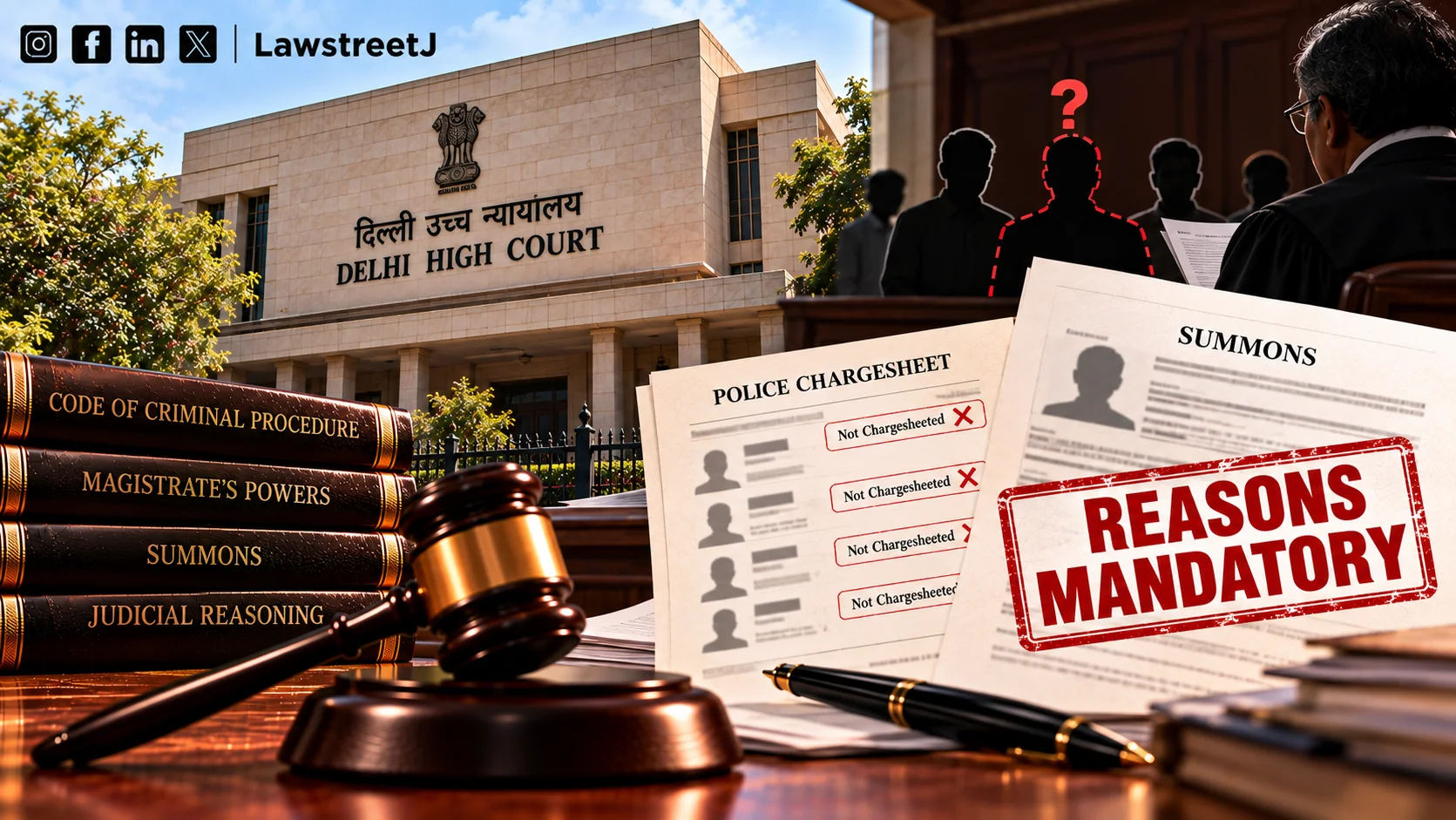
New Delhi: The Delhi High Court has settled a split among Single Judges on the sequence of steps a Magistrate must follow before taking cognizance of an offence on a private complaint under Section 223(1) of the Bharatiya Nagarik Suraksha Sanhita, 2023, holding that the complainant and witnesses must be examined on oath before the accused is given a hearing.
A Bench of Justice Navin Chawla and Justice Ravinder Dudeja, answering questions of law referred by a Single Judge's order dated 18.03.2026 in Crl.M.C. 2551/2025, Dr. Rita Bakshi vs. Seema Bajaj & Anr., along with the connected Crl.M.C. 3169/2026, Anita Rani Mehra & Anr. vs. Neena Kapoor, was called upon to reconcile conflicting Single-Judge rulings on when notice must issue to a proposed accused under the first proviso to Section 223(1) of the BNSS.
The Court noted that while some Single-Judge decisions, including Neeti Sharma v. Saranjit Singh and Brand Protectors India Pvt. Ltd. v. Anil Kumar, had held that notice to the accused must be issued after recording the complainant's statement, other High Courts, relying on the Karnataka High Court's ruling in Basanagouda R. Patil v. Shivananda S. Patil, had proceeded on the premise that cognizance is not taken until after the accused's hearing, creating a divergence that prompted the reference.
Tracing the meaning of “cognizance” through a line of Supreme Court authority beginning with R.R. Chari v. State of U.P., the Court reiterated that taking cognizance “does not involve any formal action . . . but occurs as soon as a Magistrate . . . applies his mind to the suspected commission of the offence,” following a proper judicial assessment of the complaint and any material placed before him.
The Court held that under Section 223(1) of the BNSS, the new proviso requiring an opportunity of hearing to the accused is additional to, and does not dispense with, the requirement of examining the complainant and witnesses on oath, so that “the examination of the complainant and the witnesses present on oath . . . and hearing the accused, are steps prior to taking the cognizance of the offence.”
Answering the first referred question, the Court held that a Magistrate can take cognizance of an offence “only after examining the complainant and the witnesses present on oath . . . and giving an opportunity to the accused to be heard.”
Answering the second question, the Court held that notice to the accused under the first proviso to Section 223(1) must be issued “after examining the complainant and the witnesses present on oath . . . and forming a prima facie opinion that the complaint does not deserve to be dismissed” under Section 226 of the BNSS, with the formal decision to take cognizance following only after the accused has been heard.
With these answers, the Court directed that the petitions be listed before the Roster Bench on 28th October, 2026, subject to the orders of the Chief Justice, and that a copy of the judgment be communicated to the Referral Court.
Appearances: In Crl.M.C. 2551/2025, Mr. Rakesh Malhotra, Mr. Bharat Malhotra, Mr. Kushal Malhotra, Mr. Abhijeet Singh and Ms. Gayatri Bhatia, Advocates, appeared for the petitioner. Mr. Raajan Chawla and Ms. Pooja Joshi, Advocates, appeared for Respondent No. 1; Mr. Aman Usman, APP, with Mr. Manvendra Yadav, Advocate, appeared for Respondent No. 2/State; and Mr. Amit Tiwari, CGSC, with Ms. Ayushi Srivastava, Mr. Arpan Narwal, Mr. Kushagra Malik and Mr. Ujjwal Tyagi, Advocates, appeared for the Union of India. In the connected Crl.M.C. 3169/2026, Mr. Pavan Narang, Senior Advocate, with Mr. Sidhartha Das, Mr. Himanshu Sethi, Mr. Tushar Sharma, Mr. Siddharth Gautam, Mr. Kamal Nayan and Mr. Himanshu Goel, Advocates, appeared for the petitioners; Ms. Smiti Verma, Mr. Pranay Chitale, Mr. Udayvir Rana and Mr. Aditya Dutta, Advocates, appeared for the respondent.
Case Title: Dr. Rita Bakshi vs. Seema Bajaj & Anr. (with connected Crl.M.C. 3169/2026, Anita Rani Mehra & Anr. vs. Neena Kapoor)


![Delhi High Court Sets Aside Arbitral Tribunal's Award Against NHAI in Highway Project Delay Case [Read Judgment]](/secure/uploads/2023/07/lj_9605_23374c2e-392c-4491-a2fe-f2f12fc5272f.jpg)
![Delhi Court Rejects Stay Request in Defamation Case Against Rajasthan CM Ashok Gehlot [Read Order]](/secure/uploads/2023/08/lj_5208_80de1ddc-d76a-4f7f-b180-408e3ae14fb4.jpg)