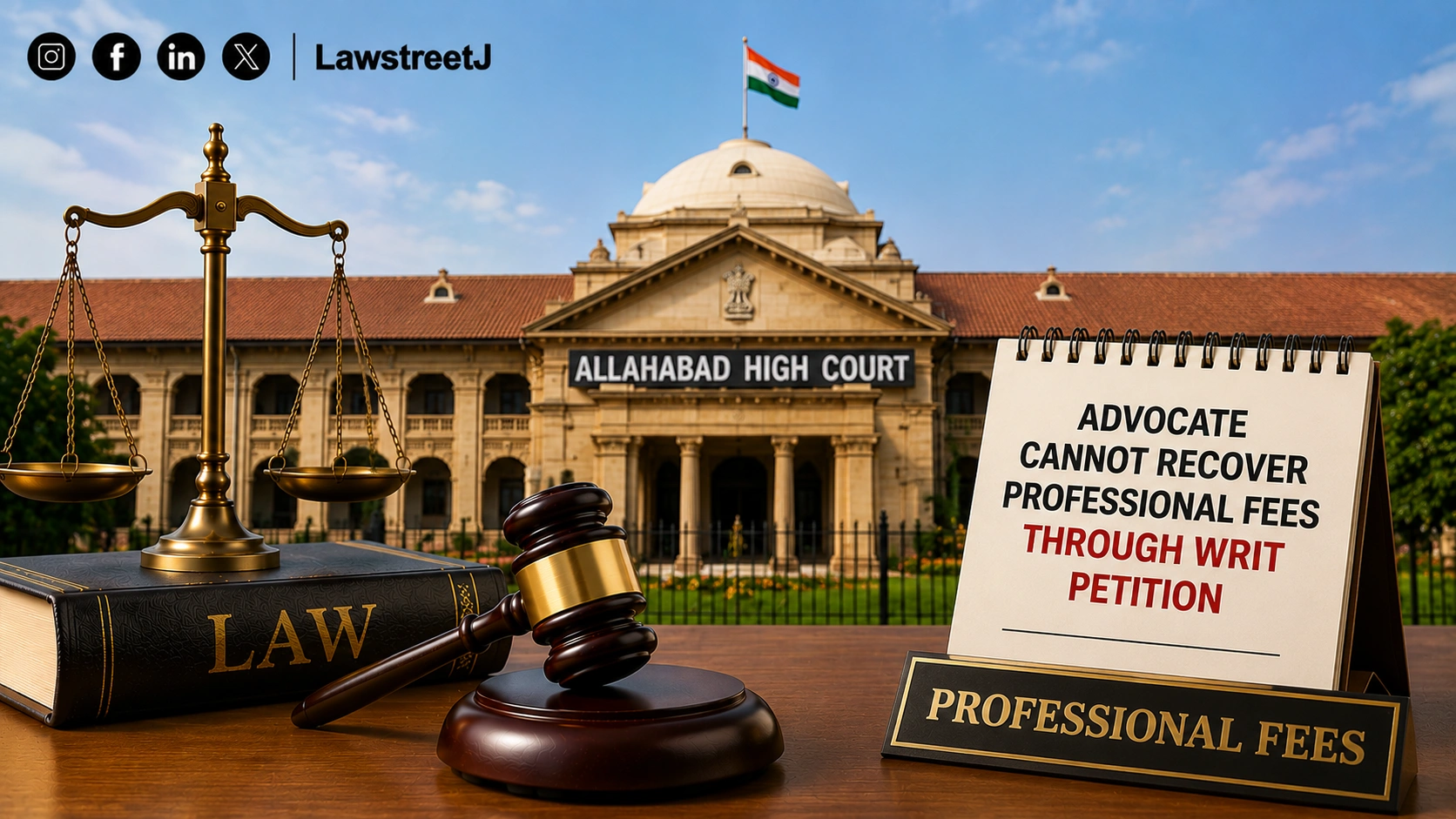
Lucknow : The Allahabad High Court, Lucknow Bench, has dismissed four writ petitions filed by a practising Advocate seeking a mandamus directing the State Government to release over Rs. 4.80 crore towards his outstanding professional fees as Special Counsel, holding that a dispute over payment of an Advocate's fee is essentially contractual and cannot be adjudicated in writ jurisdiction.
A Bench of Justices Shekhar B. Saraf and Abdhesh Kumar Chaudhary was hearing four connected writ petitions filed by Jyotinjay Verma, a practising Advocate of the Oudh Bar Association appearing in person, who claimed to have been engaged as Special Counsel for the Basic Shiksha Parishad in special appeals arising out of the districts of Sitapur, Lucknow, Hardoi and Raebareli.
At the outset, the Court deprecated the practice of the State failing to pay its engaged Counsel, observing that payment of professional fees ought to be a private affair between an Advocate and client, and that litigation between the two defeats the very foundation of trust on which the relationship rests. The Court, however, noted that it was still called upon to decide the maintainability of the petitions since it had been squarely raised by the respondents.
The petitioner contended that he had been authorised, vide a Government Order dated April 23, 2009, to receive notices and appear in special appeals on behalf of the Basic Education Department, and that a subsequent Government Order dated March 2, 2011, prescribed Special Counsel fees ranging between Rs. 15,000 and Rs. 5,00,000 per case. Claiming entitlement to the maximum fee for a total of 96 special appeals across the four districts, he placed reliance on a Supreme Court order dated February 12, 2024, in State of Uttar Pradesh v. Gopal K. Verma, where interest had been granted on delayed payment of Counsel fees.
The State and the concerned District Basic Education authorities opposed the petitions, contending that the petitioner had been removed from the panel of Counsel with effect from October 13, 2011, that the fee bills pertained largely to periods outside his empanelment, and that the Government Order of 2011 applied only to outside-panel Counsel and not to empanelled Counsel such as the petitioner. It was further submitted that no bill had ever been admitted or acknowledged by the department, and that the dispute involved complex questions of fact unsuited to writ jurisdiction.
Rejecting reliance on the Gopal K. Verma order, the Court held that the said order, having been passed by the Supreme Court in exercise of its power under Article 142 of the Constitution to do complete justice, did not lay down any binding precedent under Article 141 and was, in any event, distinguishable on facts. Relying on the Supreme Court's ruling in State of Punjab v. Rafiq Masih, (2014) 8 SCC 883, the Court reiterated that directions issued under Article 142 while moulding relief do not constitute the ratio decidendi of a case and cannot bind subsequent proceedings.
Surveying a line of precedents, including the Supreme Court's decision in Improvement Trust, Ropar v. S. Tejinder Singh Gujral, as well as rulings of the Bombay, Madhya Pradesh and Madras High Courts, the Court held that a writ petition for recovery of an Advocate's professional fee does not ordinarily lie, since such a claim is founded in contract and involves disputed questions of fact.
The Court also found that the petitioner had failed to place on record any fee bills or documents showing that the respondents had admitted the claimed amounts, holding that “it is one thing to say that the engagement of the petitioner as special Counsel is admitted by the respondents and it is another thing to say that the bills which were raised by the petitioner have been admitted by the respondents.” In the absence of any admitted or acknowledged liability, the Court held that no mandamus could be issued for payment.
The Court further observed that the case involved disputed questions regarding the applicability of the 2011 Government Order to empanelled Counsel, the quantum of fee actually agreed for each case, and the effect of the petitioner's removal from the panel in October 2011, all of which required evidence and could only be adjudicated in a civil suit.
While declining to examine the respondents' objection that the claim was time-barred, having already held the petitions not maintainable, the Court dismissed all four writ petitions with liberty to the petitioner to approach the competent civil court, granting him the benefit of Section 14 of the Limitation Act, 1963 in computing the period spent in the writ proceedings. No order as to costs was passed.
Appearances:
For the Petitioner: In person.
For the State: Mr. Pankaj Khare, Learned Additional Chief Standing Counsel.
For Respondent Nos. 7 and 8: Mr. Shivam Sharma, Advocate.
Case Title: Jyotinjay Verma vs. State of U.P. Thru. Secy. Basic Education Lko. And 5 Others, Writ - C No. 5832 of 2025 with connected matters



!["No Loudspeakers For Azan, No Fundamental Right To Create Noise," Says Allahabad HC To Two Mosques [Read Judgment]](/secure/uploads/2020/01/lj_4995_Allahabad_HC_AZAN.jpg)