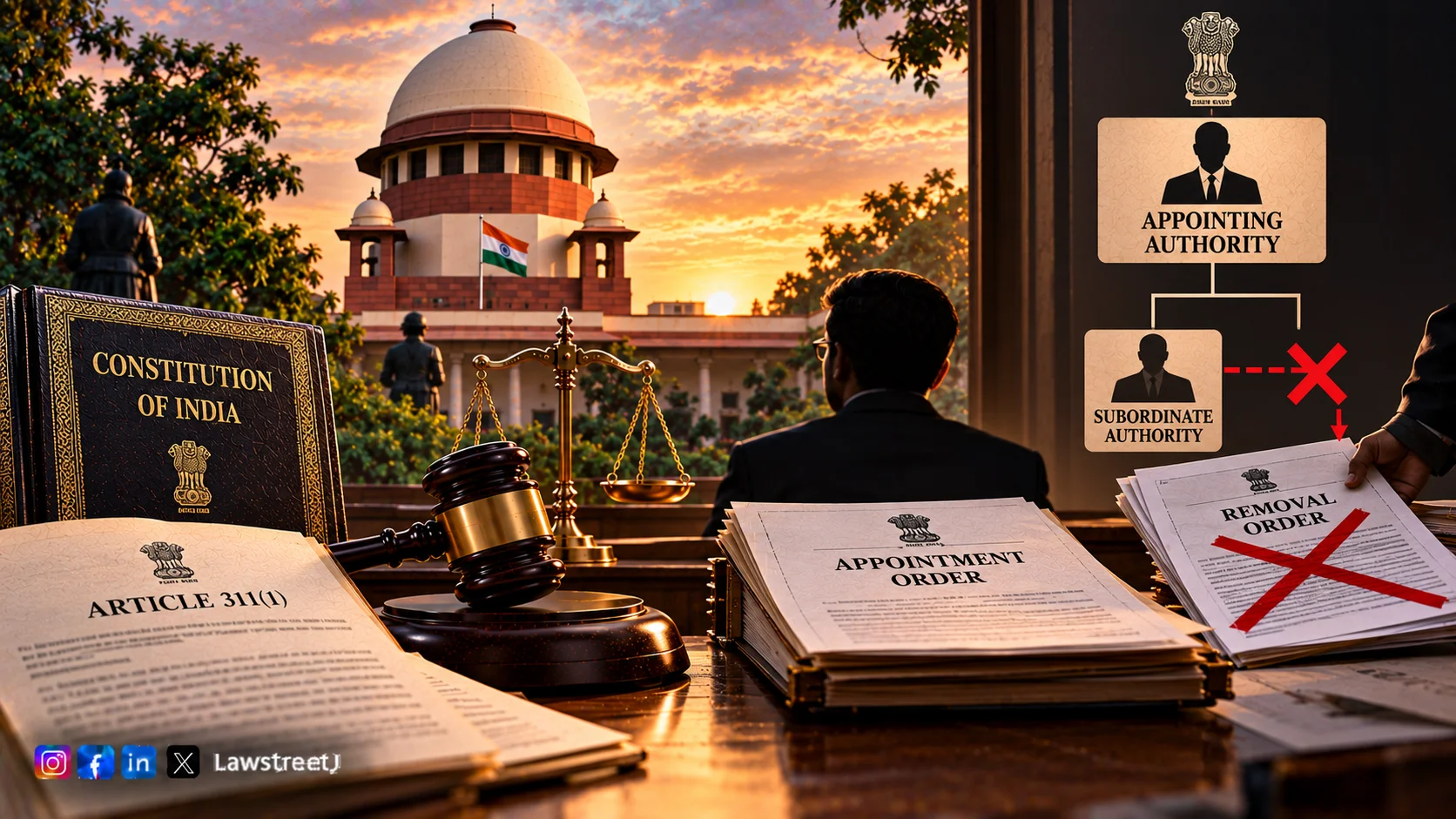
New Delhi: The Supreme Court has restored the removal of a Railway Protection Special Force Rakshak, holding that a call letter issued by the Commandant asking a selected candidate to report for initial training does not constitute the operative order of appointment, and that the order of removal, having been passed by an authority not subordinate to the officer who actually appointed him, did not violate Article 311(1) of the Constitution.
A bench of Justice Vipul M. Pancholi and Justice Aravind Kumar, was hearing an appeal filed by the Union of India against the judgment dated 12.01.2023 of the High Court of Judicature at Allahabad, which had dismissed the Union's second appeal and affirmed the First Appellate Court's judgment holding that the removal of the respondent, Ramdhani Prasad, from the post of Rakshak in the Railway Protection Special Force was invalid for want of compliance with Article 311(1).
The respondent had been called upon, by a letter dated 03.05.1979 issued by the Commandant, to report for initial training for the post of Rakshak, the letter expressly making his appointment conditional upon successful completion of that training. Upon completion of training, Battalion Order No. 2BN/9/4/9/409 dated 04.12.1979, issued by the Assistant Commandant, recorded that the respondent and other recruits stood appointed as Rakshaks with effect from that date and were posted to their respective Battalions, a position subsequently reaffirmed by Battalion Order No. 58/1980. While in service, the respondent remained absent without leave for 72 days in 1982, leading to a departmental enquiry which proceeded ex-parte after he failed to appear on the date fixed, and culminated in an order dated 18.03.1983 passed by the Adjutant removing him from service. His departmental appeal against this order was rejected in 1984.
The respondent's civil suit challenging the removal was dismissed by the Trial Court, which held that he had been validly appointed by the Assistant Commandant and validly removed by the Adjutant. The First Appellate Court, however, reversed this finding, holding that the respondent had in fact been appointed by the Commandant/Chief Security Officer pursuant to the 1979 call letter, and that since the Adjutant who ordered his removal was subordinate in rank to the Commandant, the removal violated Article 311(1); it also held that the ex-parte departmental enquiry had denied the respondent a reasonable opportunity of defence given his medical condition at the relevant time. The High Court affirmed this view in second appeal.
Before the Supreme Court, Mr. Vikramjit Banerjee, learned Additional Solicitor General for the appellants, submitted that the 1979 call letter was merely a direction to report for training and did not constitute an appointment, since the Battalion Order dated 04.12.1979 was the actual order of appointment, issued after the respondent successfully completed his training. Mr. Mananjay Mishra, learned counsel for the respondent, maintained that the Commandant's letter itself was the appointment order and that the subsequent Battalion Order was only a posting order, and also pressed the plea of denial of natural justice in the departmental enquiry.
Examining the two documents, the Court held that the call letter had used conditional language such as "accept the offer" and "candidature for the post", making the proposed appointment contingent on completion of training, whereas the Battalion Order recorded, unconditionally, that the recruits stood "appointed as RK" with effect from 04.12.1979, an order that could validly operate as both an appointment order and a posting order.
The Court held: “the Call Letter dated 03.05.1979 issued by the Commandant was only a communication requiring the selected candidates to report for and undergo the prescribed initial training and did not constitute the operative appointment order.”
Having thus found that the Assistant Commandant, and not the Commandant, was the appointing authority, the Court held that the order of removal passed by the Adjutant, who was not subordinate to the Assistant Commandant and was competent under the Railway Protection Force Rules, 1959 to impose the penalty of removal, could not be invalidated on the ground of violation of Article 311(1). The Court further rejected the plea of denial of natural justice, holding that the respondent had been served the charge-sheet, given notice of the enquiry, and afforded an opportunity to participate and to respond to the show cause notice, which he failed to avail, and that the ex-parte enquiry could not on that ground alone be held vitiated.
Accordingly, the appeal was allowed, the judgments of the High Court and the First Appellate Court were set aside, and the order of removal of the respondent dated 18.03.1983 was restored.
Appearances:
For the Appellants: Mr. Vikramjit Banerjee, Additional Solicitor General.
For the Respondent: Mr. Mananjay Mishra, Advocate.
Case Title: Union of India & Ors. vs. Ramdhani Prasad