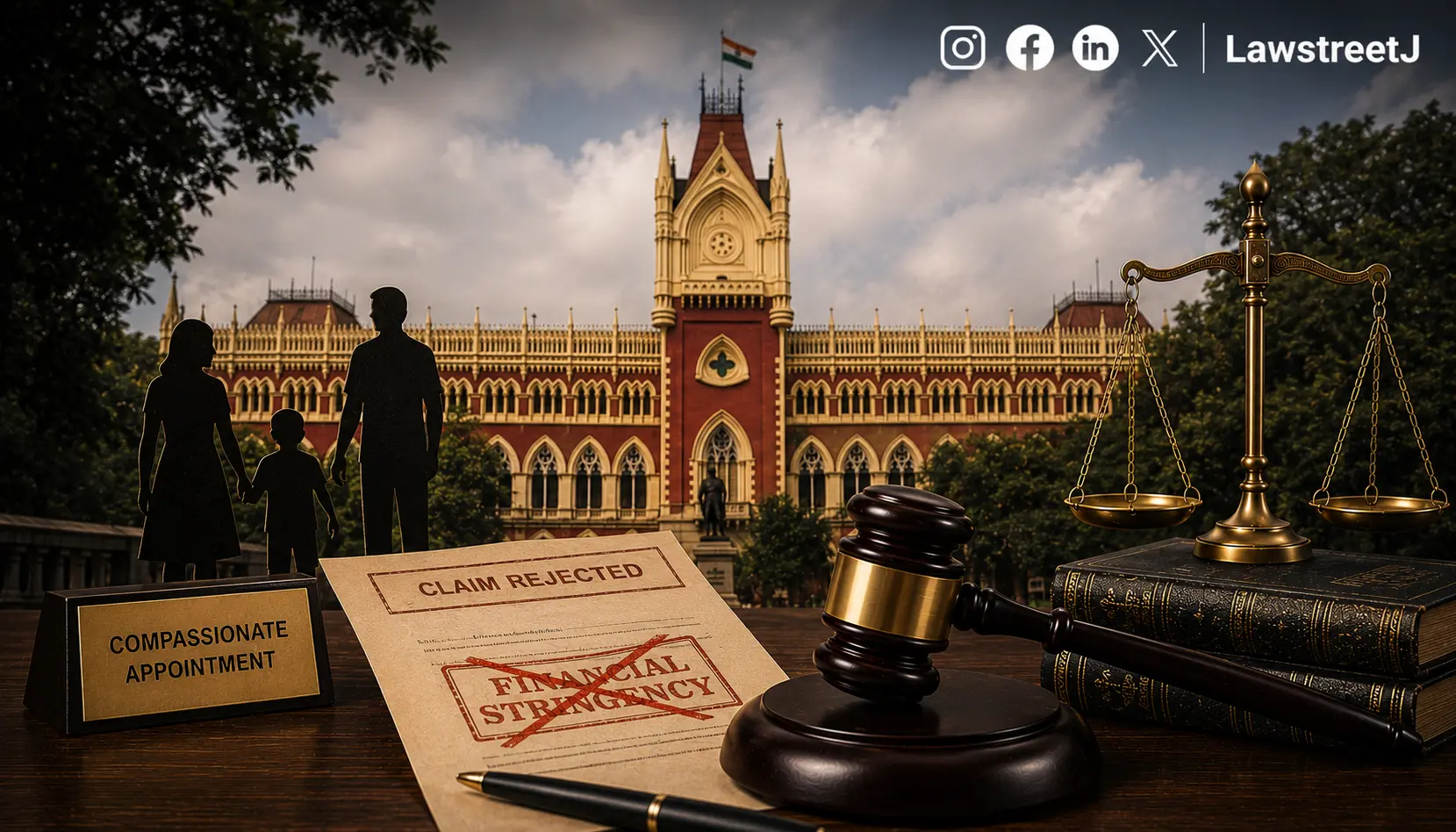
Kolkata: The Calcutta High Court has held that a public authority cannot raise a plea of financial stringency to justify rejection of a compassionate appointment claim in a writ affidavit, if that ground was never part of the original order or enquiry report under challenge, dismissing an intra-court appeal by the West Bengal Transport Corporation.
A Division Bench of Justice Madhuresh Prasad and Justice Prasenjit Biswas was hearing an intra-court appeal filed by the West Bengal Transport Corporation Ltd. against a Single Judge's order dated 23 May 2025, which had set aside an Enquiry Committee report dated 11 December 2020 and a communication dated 3 February 2021 by which the Managing Director rejected the writ petitioner's claim for compassionate appointment, and had directed that the petitioner be appointed accordingly. The Division Bench had earlier, by an order dated 26 February 2026, framed the sole issue for consideration as whether the petitioner's claim could be rejected on the ground of financial stringency.
The claim was governed by a notification dated 13 January 2011 laying down the scheme for compassionate appointment in State Transport Undertakings, framed to provide immediate relief to the families of employees who die or are prematurely retired while in service. Counsel for the Corporation relied on Clause 10 of the notification, which requires organisations to keep an eye on their financial capability while considering compassionate appointments, and argued that the rejection on this ground did not warrant interference by the Single Judge. Counsel for the writ petitioner countered that the plea of financial stringency was factually unsustainable and had not featured in the Enquiry Committee's actual findings, which had, after due consideration of the scheme, found the claim admissible.
Examining the Enquiry Committee's report, the Court found that the Committee had itself recorded that the deceased employee's family was "in need of immediate financial assistance," after considering the death benefits, pension and dependant's income. Despite this finding, the Committee went on to reject compassionate appointment on administrative grounds, that recent appointments were being made on a contractual basis through agencies, and that several other pending compassionate appointment recommendations remained unapproved, and instead recommended a one-time monetary grant under Clause 6 of the scheme.
The Court held that the Enquiry Committee's report did not even mention, let alone consider, Clause 10 of the scheme, and contained no finding that the Corporation's financial condition stood in the way of compassionate appointment. Since the Managing Director's rejection communication of 3 February 2021 also made no reference to financial stringency or Clause 10, the Court held that the ground could not be introduced for the first time through an affidavit filed in the writ proceeding.
Reiterating a settled principle of administrative law, the Court held that when an order is challenged in a court proceeding, it must be examined with reference to the grounds actually stated in it, and an authority cannot supplement or introduce new grounds by way of affidavit that do not appear in the document under challenge. On this basis alone, the Court held the financial stringency plea to be unsustainable.
The Court also rejected the Corporation's attempt to distinguish the petitioner's case from that of one Upendra Kumar, who had earlier been granted compassionate appointment, noting that the Corporation's explanation that the appointment was made only to comply with an earlier court order did not actually distinguish the merits of the two claims, particularly since it was undisputed that a vacancy existed. The Court further noted that the Corporation had itself granted a compassionate appointment as recently as 2023.
Turning to the scheme itself, the Court held that Clause 6 permits payment of one-time financial assistance in lieu of appointment only where no suitable vacancy is found in the organisation. Since there was no dispute that a suitable vacancy existed, the Court held there was no scope for rejecting the petitioner's claim and substituting it with monetary compensation.
Finding no infirmity in the Single Judge's reasoning or the consequential directions issued, the Division Bench upheld the judgment under appeal and dismissed the intra-court appeal filed by the Corporation.
Appearances: Mr. Biswaroop Bhattacharya, Mr. Niladri Bhattacharya and Ms. Deblina Chattaraj, Advocates, appeared for the appellants; Mr. Debdutta Basu and Ms. Soumalika Nandan, Advocates, appeared for the respondents.
Case Title: West Bengal Transport Corporation Ltd. & Anr. versus Dipankar Banik & Ors. [APO/38/2025 in WPO/531/2021]




![Calcutta High Court conducts late-evening hearing, orders release of lawyer arrested inside court [Read Order]](/secure/uploads/2023/12/lj_4146_Court_lawyers_arrest.jpg)
![Indian Courts this Week: Law Street Journal's Weekly Round-Up of SC & HCs [Jan 1 - Jan 6]](/secure/uploads/2024/01/lj_9050_WhatsApp_Image_2024-01-06_at_12.07.10_PM.jpeg)