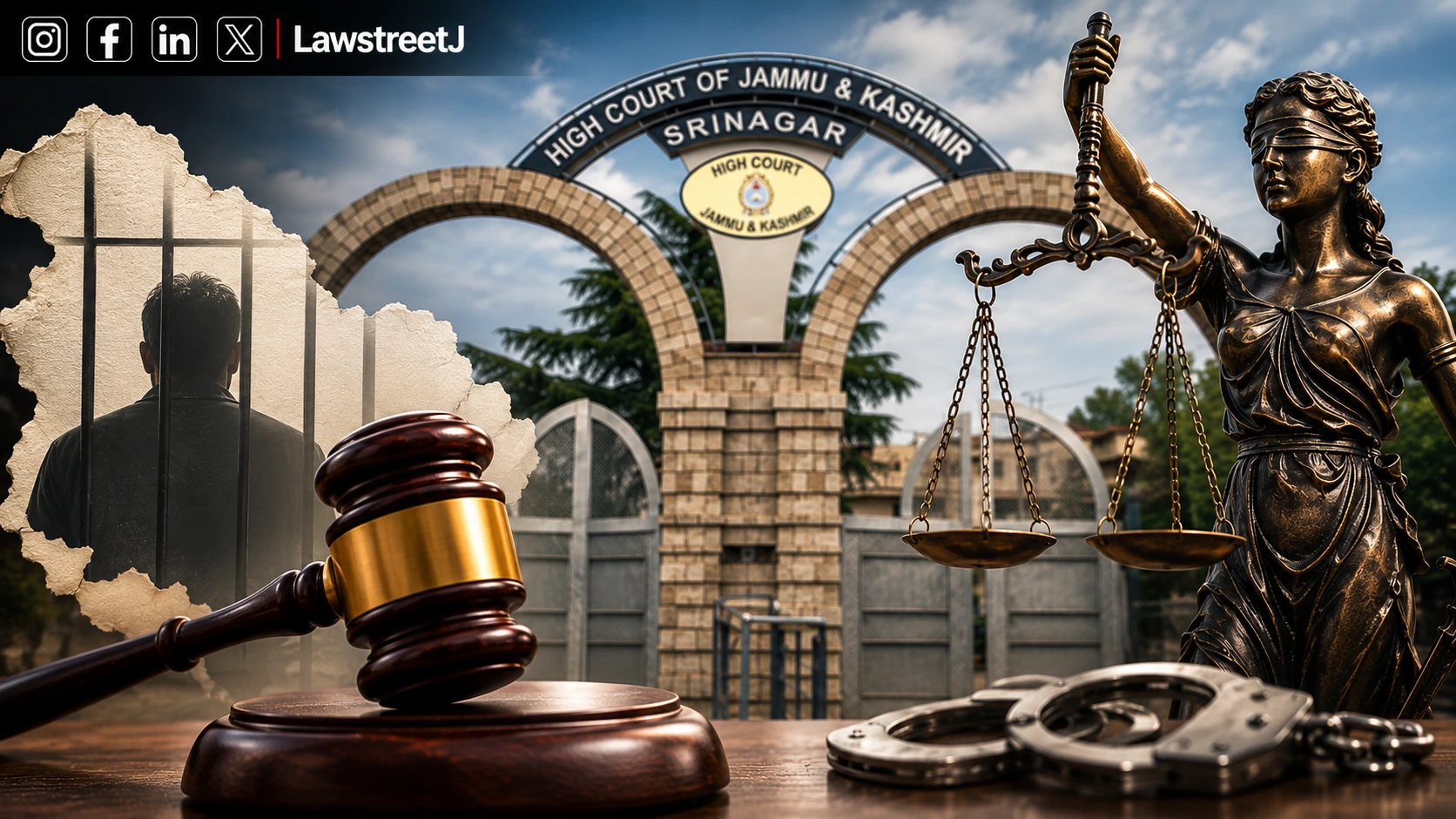
Srinagar: The High Court of Jammu & Kashmir and Ladakh at Srinagar has granted bail to a POCSO accused, holding that mere gravity of the offence and the possibility of life imprisonment cannot justify denial of bail once the accused's prima facie involvement stands doubtful, observing that concession of bail cannot be denied 'just to teach him a lesson or to satisfy the conscience of the society', as that would amount to inflicting pre-trial punishment, impermissible in law.
Justice Sanjay Dhar was hearing a bail application filed by Nisar Ahmad Joo, the fourth accused in a case arising out of an FIR registered at Police Station M.R. Gunj, Srinagar, for offences under Section 137(2) and 64 of the Bharatiya Nyaya Sanhita and Sections 3/4 of the POCSO Act, pending trial before the Special Judge, POCSO Cases, Srinagar.
The case arose from a missing-person complaint filed by the father of a minor girl in November 2024. The minor was recovered days later, and her preliminary enquiry revealed that she had allegedly been sexually assaulted by four different persons at different places over the course of her time away from home. Her medical examination and forensic sampling were conducted, and her statement was recorded under Section 183 of the BNSS before a Judicial Magistrate.
Three persons identified from her account Mohammad Ashraf Sheikh, Chaman Lal, and Basharat Ahmad Shora were arrested between November and December 2024, and a challan was filed against them. During further investigation, the petitioner was identified as the fourth accused and arrested in May 2025, following which a supplementary charge sheet was laid and charges framed against him in July 2025. The petitioner's application for bail before the trial court was dismissed in February 2025, with the trial court holding that his case stood on a different footing since the victim had, in her testimony, supported the prosecution's version regarding his role. The three co-accused, in contrast, had already been granted bail by the High Court in November 2025.
On the question of maintainability, the State had contended that the successive bail application, filed after the trial court's rejection, was not maintainable in the absence of a change in circumstances. Rejecting this, the Court held that the rejection of a bail application by a subordinate court does not bar the High Court from entertaining a fresh application under Section 483 of the BNSS on the same facts, relying on the Supreme Court's ruling in Gurcharan Singh v. State (Delhi Administration) as followed by the Bombay High Court in Devi Das Raghu Nath Naik v. State.
On merits, the Court noted that while the statutory presumption of guilt under Section 29 of the POCSO Act stood triggered against the petitioner upon the framing of charges, the presumption is rebuttable, and an accused may rely on cross-examination or defence evidence to show it does not survive. The Court found a material inconsistency in the victim's own account: while her statement under Section 183 BNSS had implicated the petitioner, her subsequent testimony during trial not only exonerated the three co-accused but also indicated that she had no grievance against the petitioner and wished the case to be dismissed. This, the Court held, offered him a sound defence to the charge.
The scientific evidence further weighed in the petitioner's favour. DNA profiling from the victim's vaginal swab did not reveal the presence of any foreign DNA, and the medical report recorded no marks of violence on her private parts and no evidence of recent sexual intercourse. The victim's father, in his further statement after the supplementary charge sheet, also did not support the prosecution's version of events concerning the petitioner.
"Merely because the petitioner is facing trial for heinous offences which entail punishment extending upto life imprisonment, is not a good enough reason to deny concession of bail to him when his, prima facie, involvement in the alleged crime is highly doubtful."
The Court held that the trial court had erred in rejecting the bail application without analysing the victim's statement, even for the limited purpose of the bail plea, rendering its order unsustainable in law. It further noted that the petitioner had already been in custody for over a year, that statements of material witnesses including the victim and her close relatives had been recorded, and that there was accordingly no real risk of witness tampering if he were released.
"...it would amount to inflicting pre-trial punishment upon them, which is impermissible in law."
Allowing the petition, the Court admitted the petitioner to bail on furnishing a personal bond of Rs. 50,000 with two sureties of like amount, subject to conditions requiring him to appear before the trial court on every hearing date, remain within the territorial limits of the Union Territory of Jammu & Kashmir without prior permission, and refrain from intimidating or tampering with prosecution witnesses or evidence. The Court clarified that its observations were confined to the decision on the bail application and would not be construed as an expression of opinion on the merits of the case.
Appearances:
For the Petitioner: Mr. Danish Majeed, Advocate, with Ms. Monisa Manzoor and Ms. Mehjabeena Gulzar, Advocates.
For the Respondents: Mr. Mohsin Qadiri, Sr. AAG, with Mr. Mohammad Younis, Assisting Counsel.
Case Title: Nisar Ahmad Joo v. UT of J&K and Anr., Bail App No. 18/2026


![J&K and Ladakh HC upholds preventive detention, confirms validity beyond criminal proceedings [Read Order]](/secure/uploads/2024/09/lj_7116_WhatsApp_Image_2024-09-11_at_11.36.56_AM.webp)
![High Court of J&K and Ladakh clarifies dress code rules for Advocates, dismisses domestic violence petition [Read Order]](/secure/uploads/2024/12/lj_1748_Women_lawyers_cant_appear_before_court_with_face_covered.jpg)
![Jammu & Kashmir High Court limits scope of Judicial Review in Tender disputes [Read Judgment]](/secure/uploads/2025/01/lj_8309_0f418c46-349d-4866-907b-bcd34c9236a3.jpg)
![Jammu & Kashmir and Ladakh High Court rules Section 27 statements insufficient to prove knowledge in NDPS cases [Read Order]](/secure/uploads/2025/02/lj_9406_Jammu_&_Kashmir_and_Ladakh.webp)