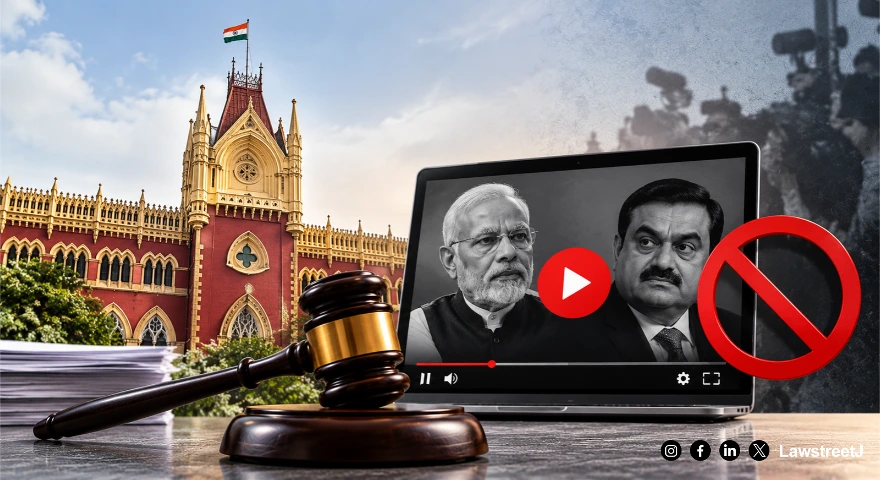
Kolkata: The Calcutta High Court (Original Side) has granted Adani Enterprises Limited an ad-interim injunction against Sabeer Bhatia and others, restraining the publication and circulation of a 36-minute video titled “How Modi and Adani Stole India: The Friendship Files”, and directing its removal from the platforms concerned.
Justice Aryak Dutt, applying the Supreme Court’s decision in Bloomberg Television Production Services India Pvt. Ltd. v. Zee Entertainment Enterprises Ltd., held prima facie that the case falls in the “exceptional class” in which a pre-trial injunction in a defamation suit may be granted. The order is ad-interim till 31.01.2027, and its observations are prima facie.
The order was passed in C.S. No. 75 of 2026, a suit for damages for defamation and for permanent and mandatory injunction. The first respondent, Sabeer Bhatia, is stated to be the creator and operator of the YouTube channel “Bcubed” and the X account “@sabeer”, while respondent Nos. 2, 3 and 4 operate the YouTube, X and Instagram platforms. Respondent Nos. 5 and 6 are unidentified persons said to be republishing the content. The Court noted prima facie that publication occurred within its jurisdiction, the video having been viewed by the plaintiff’s officers in Kolkata on 09.10.2026.
According to the plaint, the video was uploaded on 09.10.2026 in collaboration with another channel, “Shadow Citizens”, and by that day had been viewed by 46,134 persons on YouTube and about 40,000 on X. The original upload has since been disabled within India apparently on a Government complaint under Rule 3(1)(d) of the IT Rules, 2021, but it continues to be re-uploaded, with Schedule A listing 3 YouTube, 30 X and 6 Instagram entries. Mr. Bhatia is stated to have reposted it on X on 22.10.2026.
Senior Advocate Anirban Ray, for the plaintiff, submitted that the statements are false, that material facts, including payment of premium for several land projects, were suppressed, and that the right to reputation is part of Article 21. He stated that the plaintiff does not seek to restrain constructive criticism of Government policy, business concentration or its commercial activity, and that the intermediaries must remove unlawful content upon a court order under Section 79(3)(b) of the IT Act, 2000 and Rule 3(1)(d) of the 2021 Rules.
The Court began with a caution. A pre-trial injunction in a defamation action touching matters of public interest, it said, “must be granted with great caution.” Under Bloomberg v. Zee (2024), apart from prima facie case, balance of convenience and irreparable injury, the Court must bear in mind the public’s right to know and the chilling effect of such orders, and may grant an injunction before trial only in exceptional cases where the content is prima facie malicious or palpably false, recording reasons and not acting mechanically.
Having considered the transcription of the video, the Court gave five reasons for holding the case exceptional: the video is not a news report or account of proceedings, but a dramatised narrative whose title imputes theft and whose narration and visuals are represented as factual; the imputations of complicity in narcotics smuggling linked to terror funding, and of procuring police violence and false prosecution against a farmer, are “assertions of fact and not expressions of opinion”, with nothing placed before the Court showing any finding of any authority to that effect; the original upload had been disabled in India on a Government complaint; the first respondent’s repost after the original was disabled “prima facie shows a want of good faith”; and the video repeatedly names “Adani” and the “Adani Group”, so that the imputations are prima facie of and concerning the plaintiff.
On balance of convenience, the Court noted that the restraint is confined to one identified video, its clips and materially identical reproductions, and the defamatory imputations pleaded in the plaint. Because online content spreads quickly through reposts, the injury “cannot be adequately compensated in money”, and without an order now, “its purpose will be defeated by further dissemination before the respondents can be heard.”
“It is made clear that this order does not restrain constructive criticism or fair reporting on the petitioner, the Adani Group or any Government policy, otherwise than by means of the impugned video, its reproductions or the defamatory statements referred to…”
The respondents are restrained from publishing or disseminating the video or any clip or reproduction, and must remove it from accounts they control. Respondent Nos. 2 to 4 must disable access at each Schedule A URL and the related engagements such as reposts and quote posts, and, for entries that are not specific posts, act once the plaintiff furnishes the URLs. They must preserve subscriber and IP records, disclose basic subscriber information of unidentified account holders in a sealed cover, not run advertisements on or share revenue from those URLs, and file compliance affidavits within two weeks.
The respondents must file affidavits-in-opposition within four weeks of service, with the reply two weeks thereafter, and the application is listed in the Monthly list of January 2027 as an “Adjourned Motion”, with the interim order continuing till 31.01.2027 or further orders.
Appearances:
For the Plaintiff/Petitioner: Mr. Anirban Ray, Senior Advocate, with Mr. Sanjay Basu, Mr. Amit Kumar Nag, Mr. Piyush Agarwal, Ms. Shivangi Thard, Ms. Ranjabati Ray, Ms. Shrivalli Kajaria and Mr. Debojyoti Das, Advocates.
For Defendant No. 2: Ms. Pragya Jain, Advocate (through video conferencing).
Case Title: Adani Enterprises Limited vs. Sabeer Bhatia & Ors., C.S. No. 75 of 2026, IA/GA No. 1 of 2026