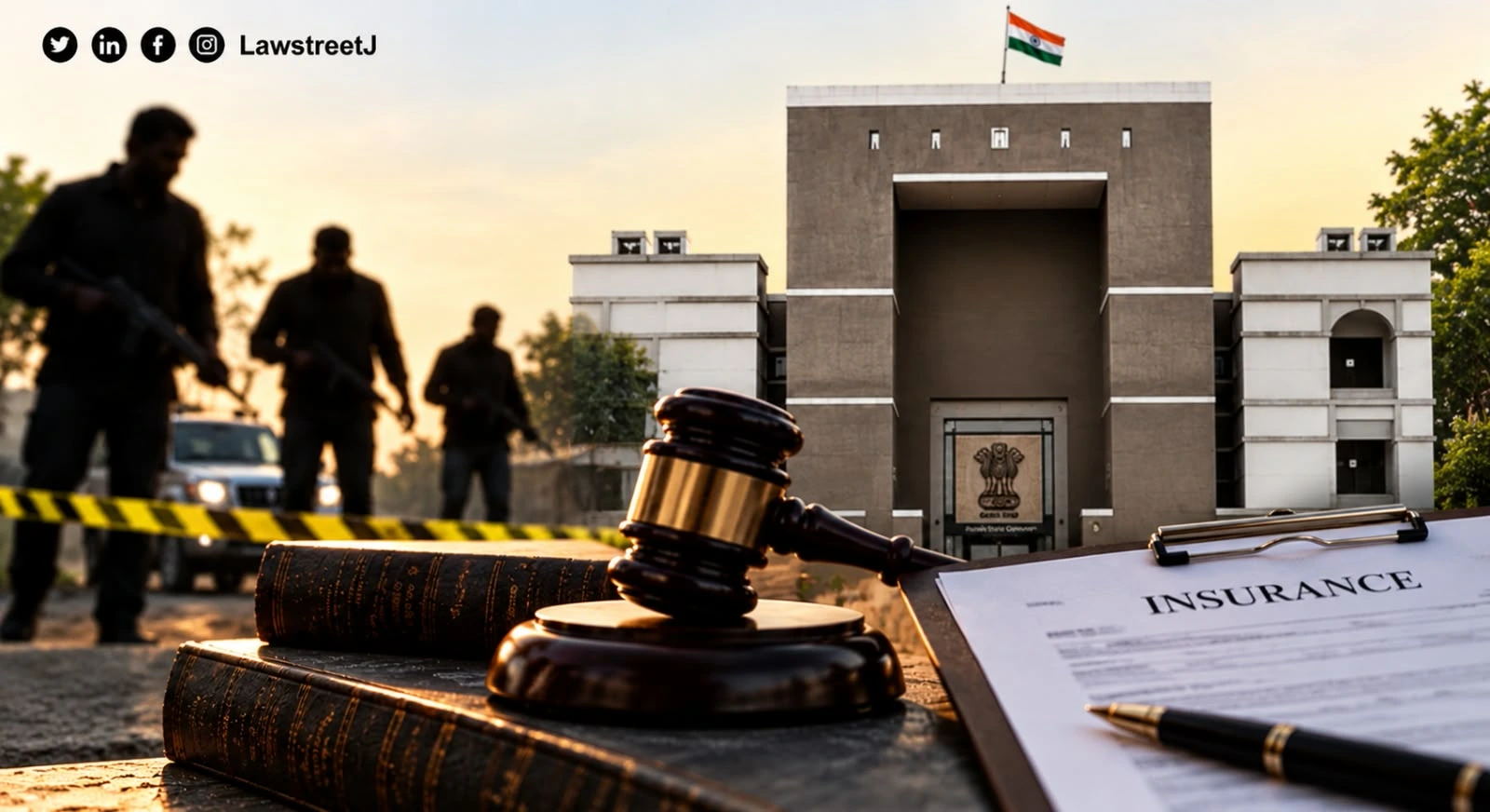
Chandigarh: The Punjab State Consumer Disputes Redressal Commission has held that the Life Insurance Corporation of India could not refuse the Double Accident Benefit under four policies merely because the policyholder’s murder was pre-planned, when it neither proved any exclusion clause nor any involvement of the insured in the crime.
Setting aside the District Commission, Moga, the Commission directed LIC to pay the double accident benefit with 6% interest from the date of repudiation, along with Rs. 50,000 as costs.
A Bench of Presiding Judicial Member H.P.S. Mahal and Member Kiran Sibal, in a judgment authored by Ms. Sibal, was hearing First Appeal No. 58 of 2023 under Section 41 of the Consumer Protection Act, 2019, filed by Ripendeep Kaur Kambo, her minor son Abir Singh Kambo and Satwinder Kaur Kambo, the widow, son and mother of the late Tajinder Singh Kambo.
Tajinder Singh held four LIC policies carrying Double Accident Benefit, with sums assured of Rs. 10 lakh, Rs. 5 lakh, Rs. 10 lakh and Rs. 1.60 lakh. He was murdered on 14.07.2020 while sitting at his shop in Moga. LIC paid only the basic death benefit and repudiated the additional benefit, relying on social media material and the police closure report to contend that the killing was a pre-planned murder by gangster Sukhpreet Singh alias Sukha Gill Lamme, intended to create terror in the area, and was therefore not an “accident”. The complainants sought Rs. 26.60 lakh with 12% interest, besides compensation. The District Commission dismissed the complaint.
Before the State Commission, counsel for the appellants, Ms. Liza Bansal, argued that the DSP’s report showed the deceased had no role in the gangster’s activities and was not the specific target. Counsel for LIC, Sandeep Bhardwaj, relied on the dictionary meaning of “accident” as an unexpected event and on Rita Devi v. New India Assurance Co. Ltd. (2000) and Prithvi Raj Bhandari v. LIC (NCDRC, 2006).
The Commission agreed with the proposition in Rita Devi, under which a murder is not accidental where the dominant intention is to kill a particular person, but is accidental where the act was not originally intended and was committed in furtherance of another felonious act. It held, however, that these rulings did not apply, because LIC’s own case was that the deceased was killed by gangsters to create terror and the FIR and the DSP’s closure report showed he was killed as part of the gangsters’ criminal activities.
LIC had also relied on a social media post by the accused claiming a dispute with the deceased, who had approached the police instead of settling it. The Commission refused to rely on it, noting that neither the FIR nor the DSP’s report corroborated any threat or prior communication, and that the post had “no evidentiary value in the eyes of law unless the same has been proved.”
The core holding is that intent and coverage are separate questions. The Commission said:
“The intention of the assailants to commit murder and the question whether the resulting death falls within the meaning of accidental death under the insurance policies are two distinct matters. Merely because the death was caused by a pre-planned criminal act, it cannot automatically be concluded that the claim is not payable under the policies, especially in the absence of any terms and conditions.”
It added that LIC had adopted a “hyper technical approach” and was required to establish that the circumstances of death fell outside the coverage under the policy terms, which it had not done by placing any exclusion clause on record.
The Commission also turned to LIC’s own Central Office Circular No. CO/CRM/607/23 dated 15.10.2007, clause 6 of which says that where a policyholder is murdered and the police report and charge-sheet do not raise suspicion that the murder was self-provoked or that the claimant had a hand in it, the accident benefit claim should not be withheld or repudiated. It also noted the National Commission’s ruling in Royal Sundaram Alliance Insurance Co. Ltd. v. Pawan Balram Mulchandani (2018), which treated death as accidental where the injury was not caused by any deliberate act of the insured.
Holding the repudiation to be a deficiency in service, the Commission partly allowed the appeal and complaint, directing LIC to pay the double accident benefit under all four policies with 6% interest from 30.04.2021 till realisation, in equal shares to the appellants, and Rs. 50,000 as composite costs, within 60 days of receipt of the certified copy.
Appearances:
For the Appellants: Ms. Liza Bansal, Advocate.
For the Respondents: Mr. Sandeep Bhardwaj, Advocate.
Case Title: Ripendeep Kaur Kambo & Ors. vs. Life Insurance Corporation of India & Anr., First Appeal No. 58 of 2023