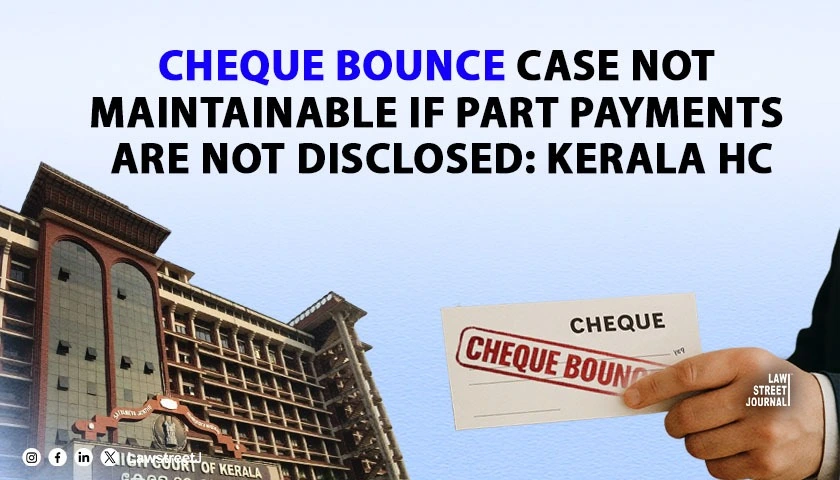
Kerala: The Kerala High Court has dismissed a criminal appeal filed by a complainant in a cheque dishonour case, holding that a cheque presented for its full face value cannot sustain a prosecution under Section 138 of the Negotiable Instruments Act when the drawer has already made part payments after issuing the cheque and those payments were neither endorsed on the cheque nor disclosed in the complaint.
The judgment was delivered by Justice A. Badharudeen of the Kerala High Court.
The dispute arose from a loan of Rs. 10,90,000 advanced by one Danikutti Philip to Johnykutty J., a retired professor, in May 2011. The accused issued a cheque dated 31.10.2017 for the full loan amount in discharge of the debt. When the cheque was presented through the Idukki District Co-operative Bank, Nedumkandam branch on 02.11.2017, it was returned dishonoured for want of funds.
However, within days of that first dishonour, the accused paid Rs. 1,94,000 on 14.11.2017 and Rs. 1,96,000 on 15.11.2017 to the complainant, reducing the outstanding amount by nearly Rs. 3,90,000.
Despite having received these payments, the complainant presented the same cheque a second time on 16.01.2018, again for the full sum of Rs. 10,90,000, without making any endorsement on the cheque to reflect the part payments already received. When this second presentation was also dishonoured, the complainant filed a complaint under Section 142 of the Negotiable Instruments Act, claiming the entire cheque amount, without disclosing the part payments.
The Judicial First Class Magistrate, Nedumkandam, acquitted the accused, relying on the Supreme Court’s decision in Dashrathbhai Trikambhai Patel v. Hitesh Mahendrabhai Patel and Another, 2022 (7) KHC 61. The Magistrate found that since the accused had made part payments between the date of issuance of the cheque and its second presentation, the cheque no longer represented a legally enforceable debt as on the date of presentation. Therefore, the offence under Section 138 of the NI Act was not made out. The complainant challenged this acquittal before the High Court.
Before the High Court, the complainant’s counsel argued that the amount stated on the cheque was genuinely due and that the omission to endorse the part payments should not defeat the prosecution. The accused’s counsel countered that the law laid down in the Dashrathbhai case was clear and had been correctly applied by the Magistrate.
The High Court, after examining the legal position under Sections 15 and 56 of the NI Act alongside the Dashrathbhai ruling, confirmed the acquittal. The Court explained that Section 56 of the NI Act provides that when a part payment is made on a negotiable instrument, a note to that effect must be endorsed on the cheque, after which it may be presented for the remaining balance. If the cheque is then dishonoured for the balance amount, the offence under Section 138 would be attracted.
However, if the part payments are not endorsed and the cheque is presented for the original full amount, it does not represent the actual legally enforceable debt on the date of presentation, and no criminal liability can arise from its dishonour.
Applying this principle, the Court noted that after the first dishonour, the accused had paid nearly Rs. 3,90,000 to the complainant. The complainant then re-presented the cheque for the full Rs. 10,90,000 without endorsing the reduction and filed the complaint claiming the full face value without disclosing the payments received.
The Court held that, in these circumstances, the prosecution was not maintainable, as the cheque did not represent a legally enforceable debt of Rs. 10,90,000 on the date of its second presentation.
The appeal was accordingly dismissed, and the acquittal confirmed.
Appearances:
For the Appellant: Adv. Shri Lalji P. Thomas
For the Respondents: Advs. Shri Sarath Babu Kottakkal, Smt. Archana Vijayan, Shri Sebastin; Shri Vipin Narayan A., Senior Public Prosecutor
Case Title: Danikutti Philip v. Johnykutty J. and State of Kerala, CRL.A No. 1965 of 2025, 2026:KER:27586.



![Kerala HC Quashes 498A Dowry Harassment Case Against Live-In Partner, Citing Lack of Relative Status [Read Order]](/secure/uploads/2023/08/lj_5693_1057c042-1e57-4e27-8c9e-25af0ec38ec4.jpg)
![Watching porn on mobile: Kerala HC highlights importance of mother cooked meals, outdoor sports [Read Order]](/secure/uploads/2023/09/lj_9155_Parental_supervision_of_mobile_phone_usage.jpg)
![Lakshadweep MP Mohammed Faizal Disqualified from Lok Sabha After Conviction Suspension Plea Rejected by Kerala High Court [Read Notice]](/secure/uploads/2023/10/lj_9640_87b5fd97-0e05-4ff8-9a99-3be1e4446192.jpg)