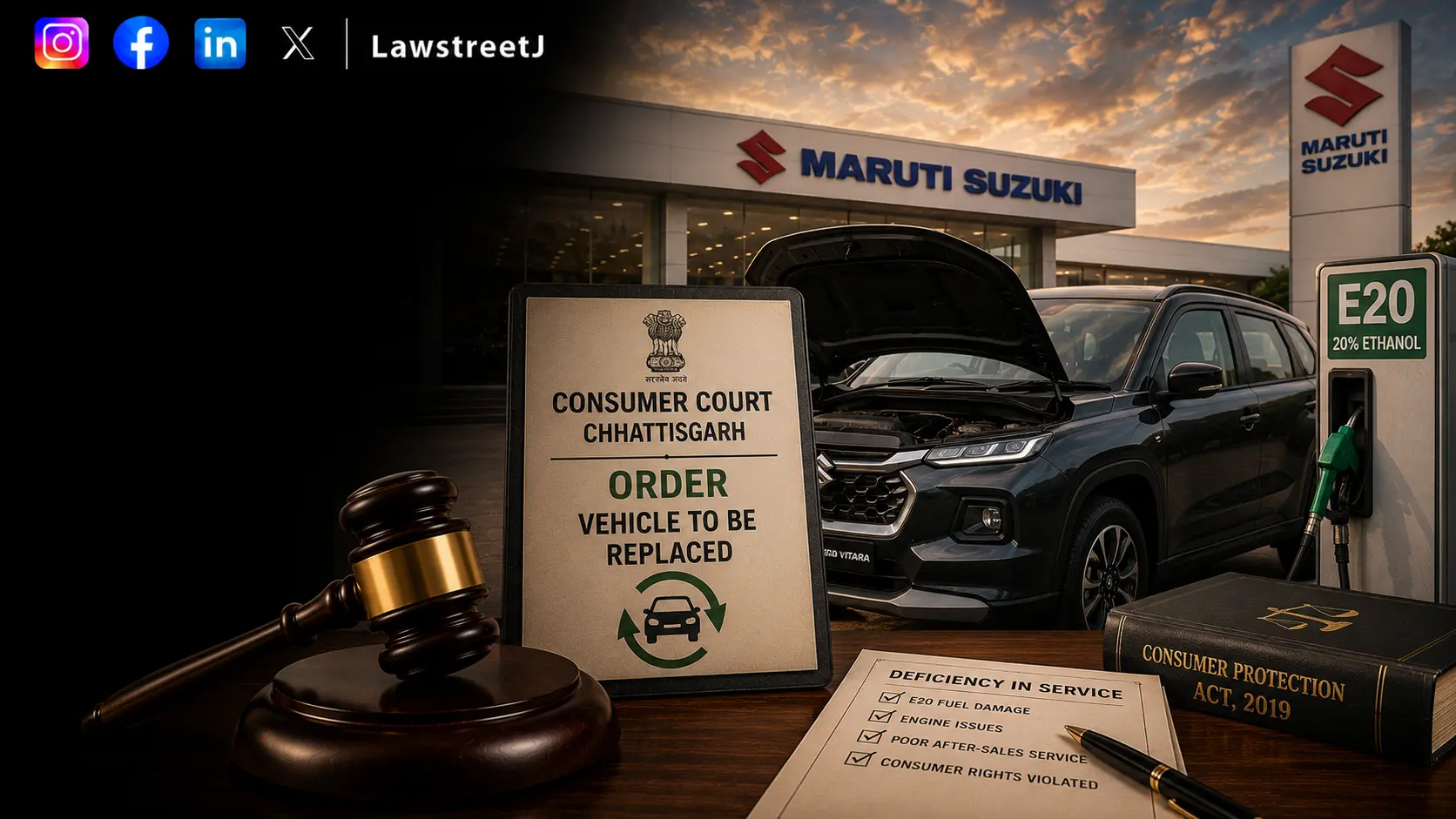
A consumer court in Chhattisgarh has ordered Maruti Suzuki India Ltd and its dealer to replace a customer's car or refund its full price in a dispute centred on E20 petrol, the 20 percent ethanol-blended fuel that has been at the heart of a nationwide controversy over engine damage. It is the first known ruling of its kind on the issue. Maruti Suzuki has said it will challenge the order.
The District Consumer Disputes Redressal Commission, Additional Bench, Raipur, delivered the ruling on July 14 in a complaint filed by a Raipur-based nephrologist who had bought a Maruti Grand Vitara Alpha Intelligent Electric Strong Hybrid in June 2024.
The order is the first known instance of a consumer forum granting relief to a car owner in a case where E20 compatibility is central, a debate that has so far played out largely between the government, automakers and protesters rather than in the courts.
India completed its rollout of 20 percent ethanol-blended petrol in 2025, five years ahead of the original 2030 target. The transition has been accompanied by consumer concern over whether older and existing vehicles can safely run on the higher blend, along with complaints of reduced mileage and engine trouble. Industry bodies, automakers and the sugar sector have maintained that no vehicle breakdown has been traced to E20.
What the complaint alleged
The complainant bought the vehicle on June 3, 2024, for Rs 18,29,000, taking the total outlay to about Rs 20,50,288 with insurance and registration. He said he needed the car to travel between cities to treat patients. After roughly 21,913 km, in November 2024, the dashboard flagged an engine problem and the vehicle shut down. Despite repeated visits to the dealer's workshop, where the fault was attributed to contaminated petrol and the fuel tank was drained and cleaned multiple times, the car kept breaking down and has been parked in the dealer's yard since March 2025.
He was eventually given a repair estimate of more than Rs 5 lakh to replace the engine and other parts, which the dealer said fell outside warranty. He refused, arguing the car carried an extended warranty valid to 2029 or 1,00,000 km, and sought a replacement or a full refund, along with damages.
Why the court ruled against Maruti
The court's finding turned on two points. On the fuel itself, the manufacturer's own evidence, an SGS lab test report, showed the petrol in the car was E20, by then sold at nearly every pump in the country. The court held that the opposite parties never clarified whether this particular model's engine was designed to run on E20, and found that their own documents effectively established the engine was not suited to the fuel.
On the sale, the car was manufactured in January 2023 but sold to the complainant in mid-2024, making it about 17 months old at the point of sale, yet sold at the price of a new vehicle. The court concluded that selling an older, non-E20-compatible car at new-car price without disclosure, and then failing to repair it under warranty or replace it, amounted to deficiency in service and unfair trade practice. It relied on precedents including Hindustan Motors vs Rajendra Kumar Ganesha Bhai Prajapati and C-Core India vs Sameer V.
What the order directs
The court directed Maruti Suzuki and its dealer, jointly, to take back the Grand Vitara and provide a new E20-fuel-supported vehicle of the same model within 45 days. Failing that, they must refund Rs 20,50,494, covering the vehicle, registration and insurance. They were also directed to pay Rs 1 lakh as compensation for mental distress and Rs 10,000 towards litigation cost, with 7 percent annual interest applying on the compensation and cost if not paid within 45 days.
Maruti Suzuki to challenge the order
Maruti Suzuki said it will appeal, maintaining that the vehicle was E20-compatible and that the fuel drawn from it was contaminated. The company said it had learnt of the order directing it to replace the customer's vehicle with a new E20-compatible one, and asserted that the car in question was fully equipped to handle E20 fuel and disclosed as such in the owner's manual. It said there was evidence of contamination in the fuel collected from the vehicle and that several other relevant facts had not been reflected in the order, adding that it would challenge the ruling before an appropriate higher forum and remained committed to quality, safety and customer satisfaction.
Legal experts say the ruling could prompt more consumers to approach courts over E20-related complaints against automakers, a scenario one lawyer described to Reuters as a potential headache for Maruti and other carmakers. Maruti has separately said its checks on cars manufactured before 2023 have not found anything of concern.