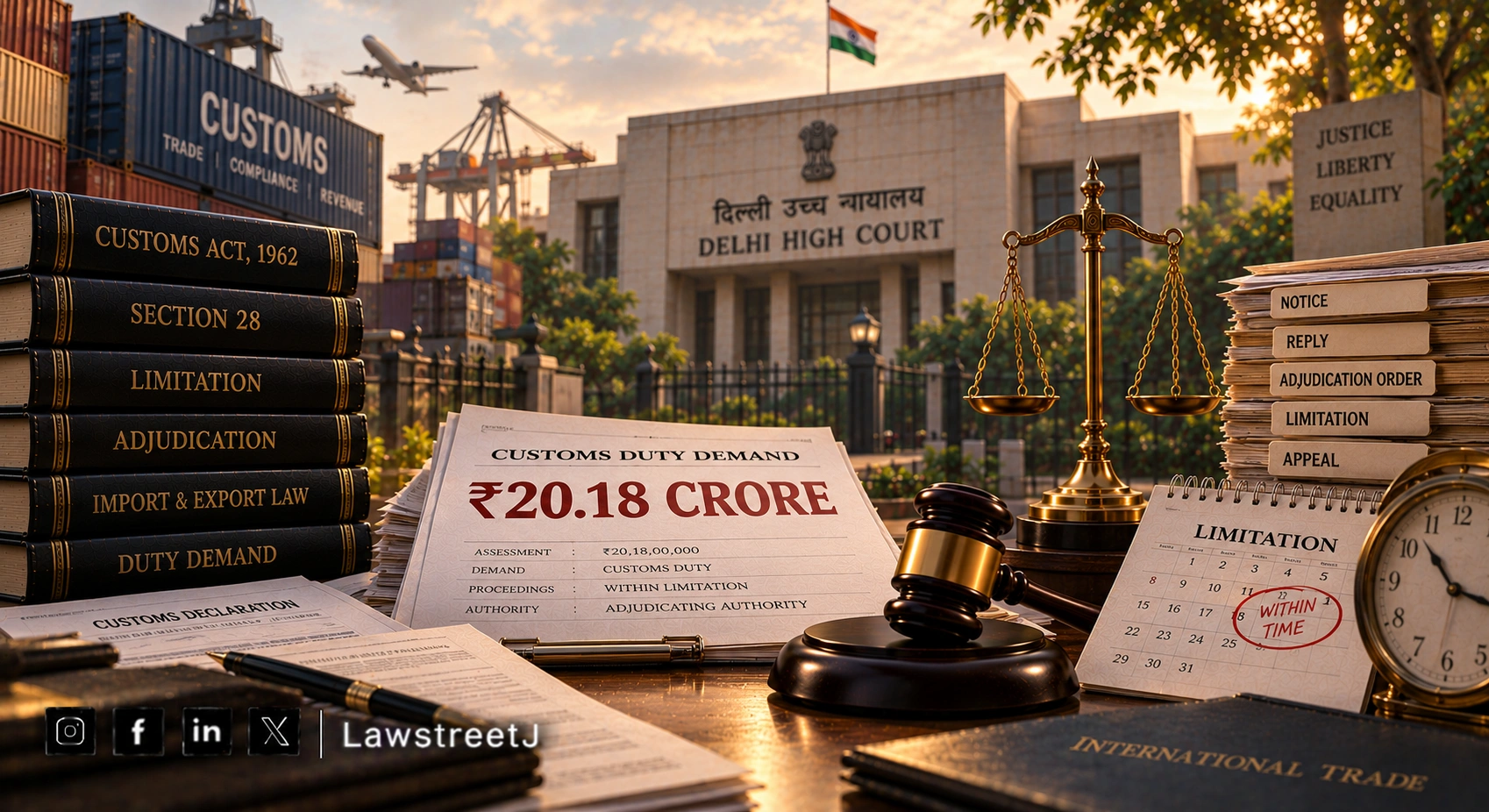
New Delhi: The Delhi High Court has dismissed a writ petition filed by two copper import-export firms and their group entity challenging a customs adjudication order confirming a differential duty demand of about Rs. 20.18 crore, holding that the order was passed within the limitation period prescribed under Section 28(9) read with Section 28(9A) of the Customs Act, 1962.
A Division Bench comprising Justice Anil Kshetarpal and Justice Shail Jain was considering a petition seeking a declaration that a Show Cause Notice dated 24.06.2022 had become non-est, and consequential recall of the Order-in-Original dated 29.11.2024, on the ground that adjudication had been undertaken beyond the statutory period despite an efficacious alternate remedy of appeal being available.
The petitioners had imported duty-free Electrolytic Copper Rods under Advance Authorisation Licences issued by the DGFT, with an obligation to use the material for value addition and export finished Copper Wire and Power Cables. A Customs investigation found that they had instead diverted the imported raw material into the domestic market through alleged job-work arrangements with firms existing only on paper, without fulfilling their export obligation and in violation of the actual-user condition of the licences.
The impugned Show Cause Notice sought recovery of differential customs duty and interest under Sections 28(4) and 28AAA of the Customs Act. The petitioners challenged the proceedings on limitation, arguing that under Section 28(9)(b), the adjudication had to be completed within one year, extendable by another year. They contended that even with the eight-month extension communicated on 12.07.2023, the period expired on 24.02.2024, whereas the Order-in-Original was passed only on 29.11.2024. They also argued that transferring the matter to the Call Book did not extend limitation, as they were not separately informed of the transfer or given reasons for the delay. Reliance was placed on State of Punjab v. Bhatinda District Coop. Milk P. Union Ltd., Shri Ram Agro Chemical Pvt. Ltd. v. Union of India and Vos Technologies Private Limited v. Principal Additional Director General.
The Revenue, however, maintained that the petitioners’ earlier pending writ petition and an interim order restraining coercive recovery constituted impediments covered by Section 28(9A)(a) and (b). According to the Revenue, the limitation period under Section 28(9) therefore commenced only after the impediment ended on 08.12.2023, making the OIO dated 29.11.2024 timely. The Revenue also highlighted that the petitioners had failed to appear or had sought adjournments on several dates of hearing.
Rejecting the petitioners' reliance on the Supreme Court's deferment order in Union of India v. GMR Airport Infrastructure Ltd., the Bench held that the judgment in Vos Technologies concerned Show Cause Notices issued prior to the Finance Act, 2018, which continued to be governed by the unamended, un-timebound Section 28(9), and rested on a general "reasonable period" principle rather than the specific statutory scheme of Section 28(9A) applicable to post-amendment notices such as the one in the present case.
On the merits of limitation, the Court held that Section 28(9A) is a non-obstante provision under which the prescribed period runs not from the date of the notice but from the date the impeding circumstance ceases to exist, and that this consequence flows from the existence of the statutory circumstance itself rather than from the administrative act of a Call Book transfer. Since it was the petitioners who had themselves invoked the pendency of their earlier writ petition and the interim protection therein as the ground for deferment, the Court held that the object of the communication requirement under Section 28(9A) stood substantially achieved by the petitioners' own conduct, even absent a formal intimation from the proper officer. The limitation period was accordingly held to run from 08.12.2023, when the earlier writ petition was dismissed, making the OIO of 29.11.2024 well within time.
As an independent ground, the Court also held that the petitioners, having sought deferment of adjudication on the basis of the pending writ petition while expressly reserving the right to file a substantive reply, never filed such a reply even after that petition was dismissed, and never informed the Adjudicating Authority of the dismissal. Observing that a party cannot invoke a circumstance to keep adjudication in abeyance and then seek to derive an equitable advantage from the very passage of time so occasioned, the Court held that this conduct, coupled with the availability of an efficacious statutory appeal in which the petitioners had raised no challenge to the merits of the findings, independently disentitled them to relief under Article 226.
The petition was accordingly dismissed, with the Court granting the petitioners liberty to avail the statutory appellate remedy and raise all grounds on merits, clarifying that its observations would not prejudice consideration of such contentions by the Appellate Authority.
Appearances:
For the Petitioners: Mr. Deepak Gandhi and Ms. Ida Bhatnagar, Advocates.
For Respondent No.1: Mr. Arjun Malik, Senior Standing Counsel with Ms. Mayuri Makhija, Advocate.
Case Title: GKEM International Pvt. Ltd. & Ors. vs. Commissioner of Customs ICD PPG and Others ICDs, W.P.(C) 5796/2025


![Delhi High Court Sets Aside Arbitral Tribunal's Award Against NHAI in Highway Project Delay Case [Read Judgment]](/secure/uploads/2023/07/lj_9605_23374c2e-392c-4491-a2fe-f2f12fc5272f.jpg)
![Delhi Court Rejects Stay Request in Defamation Case Against Rajasthan CM Ashok Gehlot [Read Order]](/secure/uploads/2023/08/lj_5208_80de1ddc-d76a-4f7f-b180-408e3ae14fb4.jpg)