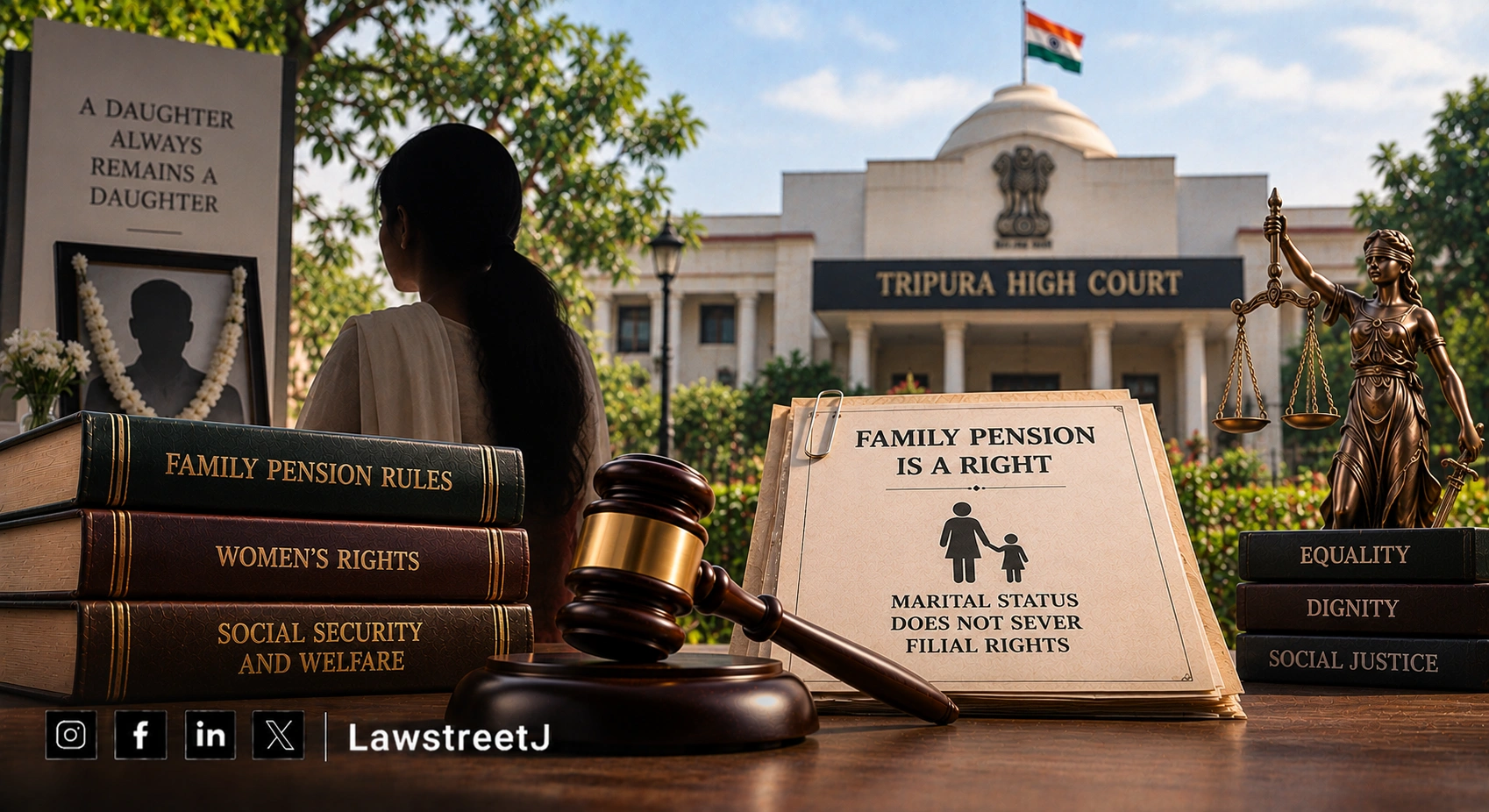
Agartala: The Tripura High Court has held that a divorced daughter of a deceased government pensioner is entitled to Family Pension even though her divorce was finalised after her father's death, setting aside a Single Judge order that had denied the benefit on the ground that she was still married, and not divorced, on the date her father died.
A Division Bench of Chief Justice M.S. Ramachandra Rao and Justice Biswajit Palit was hearing a writ appeal filed against a judgment of a Single Judge dismissing her writ petition challenging the rejection of her claim for Family Pension by the Agartala Municipal Corporation (AMC).
The appellant's father, an AMC employee, had superannuated in 2004 and was receiving pension until his death on 02.12.2018, his wife having predeceased him. At the time of his death, the appellant was married, but the marriage had effectively broken down years earlier when her husband went missing shortly after their wedding, following which she had taken shelter in her father's house and lived there for over four decades. She and her husband later obtained a mutual consent divorce from the Family Court, Agartala, on 04.10.2021, after which she applied for Family Pension in February 2022 under the Tripura State Civil Services (Revised Pension) Rules, 2017.
The AMC rejected her claim in October 2024, asserting that a Finance Department memorandum dated 28.03.2018, which extended Family Pension to a divorced daughter of a state government pensioner, had not been adopted or ratified by the Corporation. The Single Judge, while agreeing that Rule 8 of the 2017 Pension Rules entitled a divorced daughter to Family Pension, nonetheless denied relief on the ground that the appellant was not yet divorced when her father died, holding that the rule did not extend to a daughter merely separated from, but still married to, her husband at that time, and that the court could not rewrite the rule to cover such a situation.
Before the Division Bench, the appellant relied on a series of government notifications to show that the Central Civil Services (Pension) Rules, 1972 and their subsequent amendments had been formally adopted by the Agartala Municipality as far back as 1992, so that benefits extended under those rules automatically applied to AMC pensioners as well. She pointed out that the AMC's own counter affidavit before the Single Judge had admitted that a legally divorced daughter was entitled to Family Pension under both Rule 8 of the 2017 Rules and a corresponding 2017 amendment to the CCS Pension Rules, contradicting its earlier stated ground for rejecting her claim.
Examining the record, the court held
the AMC's position in its rejection letter, that the 2018 memorandum had not been adopted by the Corporation, was blatantly false and contrary to its own counter affidavit, and that neither Rule 8 of the 2017 Pension Rules nor the corresponding CCS Pension Rules amendment required a daughter to be divorced on the specific date of the pensioner's death in order to claim Family Pension.
The court relied on a Government of India office memorandum dated 19.07.2017, which explicitly permitted Family Pension to a divorced daughter even where divorce proceedings were filed during the pensioner's lifetime but the decree was granted only after his death, with pension commencing from the date of divorce. It held that this memorandum, binding on the AMC through its 1992 adoption of the CCS Pension Rules framework, confirmed that a daughter need not be divorced on the date of her father's death to qualify for the benefit.
The court drew support from a Division Bench ruling of the Calcutta High Court in Union of India and others vs. Mita Saha Karmakar, which had granted Family Pension on similar facts where the divorce decree was granted after the pensioner's death, and from a decision of the Orissa High Court in Biswamitra Dhal vs. State of Odisha and others, holding that the Family Pension scheme is welfare legislation intended to provide financial security to dependent family members, and that a rigid, technical interpretation denying the benefit to a dependent who had been ousted from her matrimonial home would defeat its very purpose.
Rejecting the AMC's suggestion that the appellant's account of being deserted by her husband should be doubted, the court observed that it saw no reason to disbelieve her version, particularly since her former husband had not disputed it in the divorce proceedings, and described it as unfortunate that the Corporation had taken such an unfair stand against a claim for what it called a modest pension benefit.
Holding that the Single Judge had taken an unduly hypertechnical view by focusing on the appellant's marital status on the date of her father's death rather than on her established dependency on him, the court allowed the writ appeal, set aside the Single Judge's judgment, and allowed the underlying writ petition.
It directed the AMC to pay Family Pension to the appellant from the date she secured her divorce decree, that is, with effect from 04.10.2021, and to continue payment during her lifetime, with arrears to be paid within three months along with interest at 6 per cent per annum from the date each payment fell due until actual payment.
Appearances:
For the Appellant: Mr. Purusuttam Roy Barman, Senior Advocate, with Mr. Samarjit Bhattacharjee, Advocate.
For the Respondents: Mr. Dipankar Sarma, Additional Government Advocate; Mr. Arijit Bhaumik and Mr. Agniva Chakraborti, Advocates.
Case Title: Smt. Ujjwala Rani Paul vs. Agartala Municipal Corporation and Others, W.A. No. 37 of 2026


![Filing of chargesheet not a ground for bail in NDPS cases: Tripura High Court [Read Order]](/secure/uploads/2024/06/lj_4838_756ef768-26b3-49f8-bb60-1d6f1fb48d3a.webp)
![Tripura HC Sets Aside Tender, Slams ‘Bangladesh Emergency’ Claim as Pretext to Favour L2 Bidder [Read Judgment]](/secure/uploads/2026/03/lj_3936_Tripura_HC_Sets_Aside_Tender.webp)
![Cannot Penalise Lawyers For Attending Court Despite Boycott Calls: Tripura HC [Read Order]](/secure/uploads/2026/05/lj_8569_Cannot_Penalise_Lawyers_For.webp)