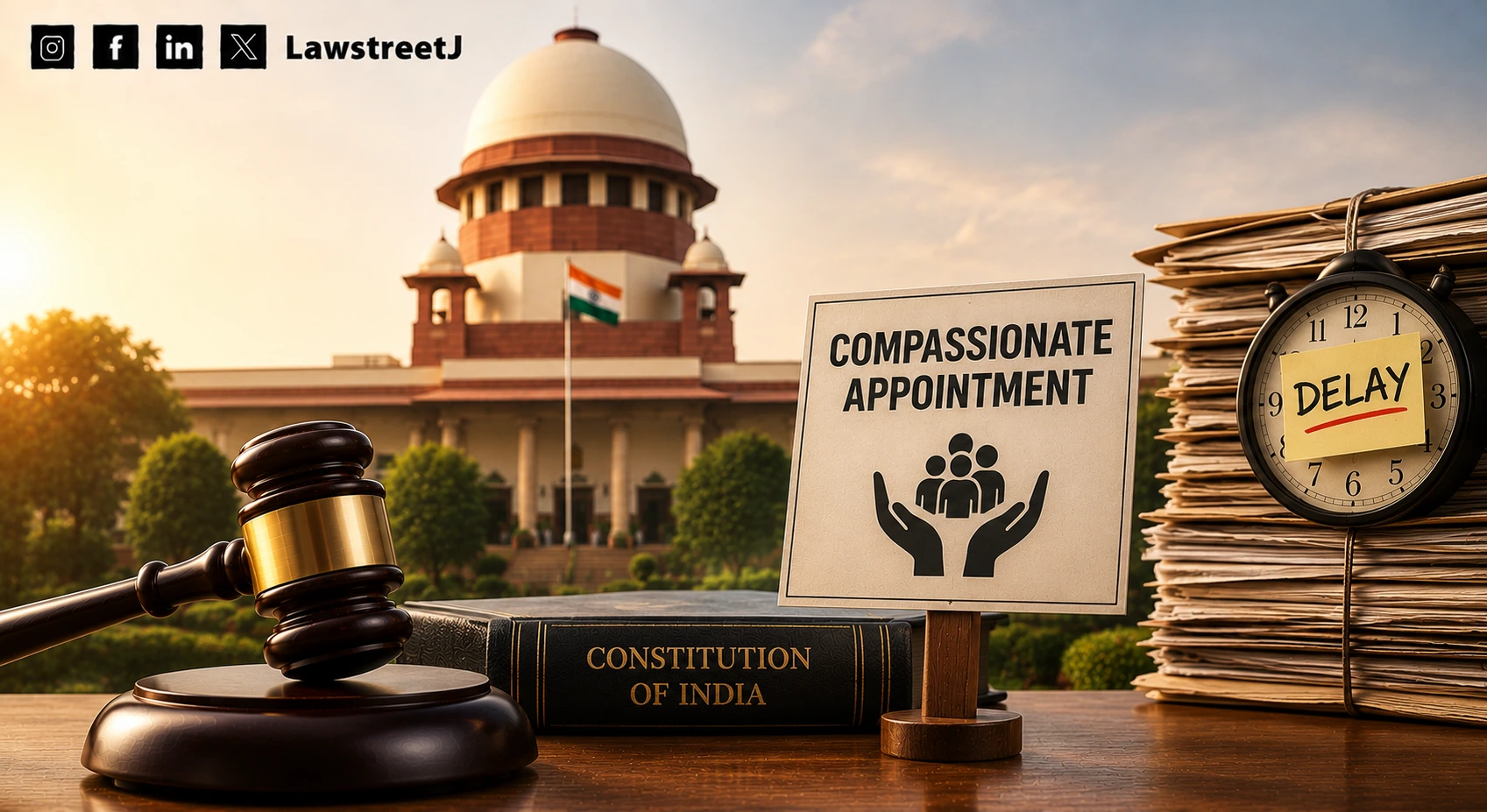
New Delhi: The Supreme Court has held that an employer cannot keep an employee's application for voluntary retirement on medical grounds pending until the employee crosses the prescribed age limit, and thereafter rely on that very delay to deny compassionate appointment to the employee's dependent, setting aside a Bombay High Court judgment and directing New India Assurance Company Limited to appoint the son of a former employee.
A Bench of Justices Sanjay Karol and Nongmeikapam Kotiswar Singh was hearing an appeal filed by Rahul, son of Ramnarayan Madankar, against a judgment of the Nagpur Bench of the Bombay High Court, which had dismissed his writ petition and upheld the rejection of his claim for compassionate appointment under the Scheme for Compassionate Appointment in Public Sector General Insurance Companies.
The appellant's father, Ramnarayan Mahadeo Madankar, had joined the respondent-company in 1984 and was working as Assistant Clerk-cum-Cashier at its Gondia Branch when he suffered serious neurological problems. On 21.07.2015, the Civil Surgeon, General Hospital, Gondia, certified him as completely and permanently incapacitated for further service, and the very next day, while still short of 55 years of age, he applied for voluntary retirement on medical grounds. The Scheme covered dependents of employees retired on medical grounds due to incapacitation "before reaching the age of 55 years," with incapacitation required to be certified by a duly appointed Medical Board.
As his application remained undecided, the employee sent reminders on 06.11.2015 and 01.12.2015, both before he turned 55 on 10.12.2015. The company neither accepted the application, rejected the medical certificate, nor asked for a Medical Board certificate before that date. It was only by a letter dated 03.02.2016 after the employee had already crossed 55 that the company first called for a Medical Board certificate, which the employee obtained within seven days, on 10.02.2016. His voluntary retirement was eventually accepted on 31.05.2016, and his son's claim for compassionate appointment, forwarded shortly thereafter, was rejected only in 2019, on the ground that the employee had retired after completing 55 years.
The High Court had upheld this rejection, holding that the Civil Surgeon's certificate did not satisfy the Scheme's requirement of Medical Board certification, and that such certification was obtained only after the employee crossed 55.
The Supreme Court disagreed. Tracing the timeline of events, the Court found that the employee had applied for retirement, submitted a government medical certificate, and sent reminders all before the age threshold expired and that the company remained silent throughout this period, calling for the Medical Board certificate only after the threshold had passed.
"Clause 1.1 cannot be construed in a manner that enables the employer to control eligibility through delayed processing. The purpose of the age condition is to identify cases where an employee is medically incapacitated before the prescribed age. The purpose is not to enable the employer to defer scrutiny until the age condition expires and thereafter reject the dependent’s claim on that basis," the Court held.
While affirming that compassionate appointment is a matter of policy and cannot be claimed as a matter of right, referring to the settled principles in Umesh Kumar Nagpal v. State of Haryana and Bhawani Prasad Sonkar v. Union of India, the Court held that these principles did not permit an employer to receive a timely application, sit on it beyond a reasonable period, communicate the essential deficiency only after the age threshold had passed, and then invoke that very delay to defeat the claim.
Invoking the broader principle that no authority may take advantage of its own default, the Court relied on Kusheshwar Prasad Singh v. State of Bihar, which held that "a wrong doer ought not to be permitted to make a profit out of his own wrong."
The Court also drew on Malaya Nanda Sethy v. State of Orissa, where it had earlier deprecated prolonged and unexplained delay by authorities in deciding compassionate appointment claims, and directed that such applications be decided, as far as possible, within six months of submission.
Rejecting the company's contention that Clause 1.1 required actual retirement, and not merely an application for retirement, before the age of 55, the Court held that this submission could not assist the company on the facts of the case, since the delay in obtaining the Medical Board certificate was itself a consequence of the company's own delay in communicating the requirement.
Setting aside both the High Court's judgment and the company's rejection order, and noting that the claim had remained pending since 2016 despite the appellants' consistent pursuit of the matter, the Court directed the company to grant compassionate appointment to the appellant within eight weeks, with any applicable age relaxation on account of the delay, while making him eligible for monetary benefits only from the date of actual appointment. The Court left undisturbed the High Court's direction regarding payment of the father's unpaid dues.
The appeal was allowed accordingly, with no order as to costs.
Case Title: Rahul S/o. Ramnarayan Madankar & Anr. vs. The New India Assurance Company Limited & Ors., Civil Appeal No. of 2026 (Arising out of SLP (Civil) No. 27425 of 2025)