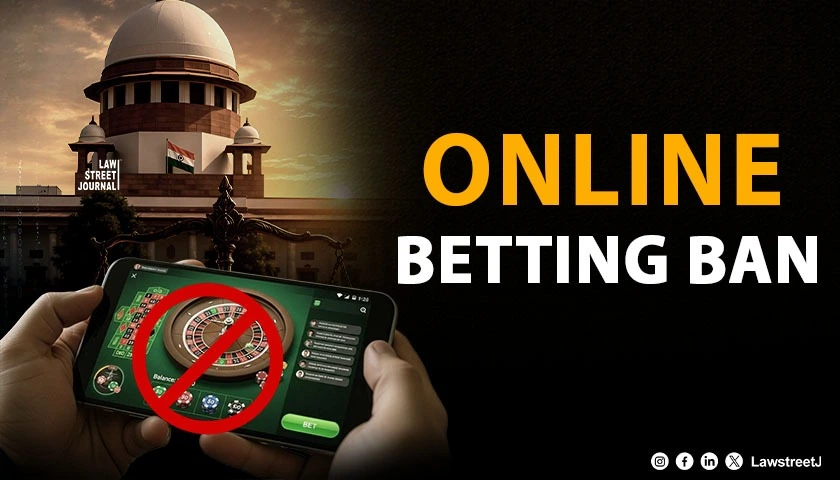
New Delhi: The Supreme Court of India has upheld the legislative competence of State Governments to prohibit online betting and gambling, including wagering on games of skill, holding that the widespread prevalence of online money gaming poses a serious threat to public order, public tranquillity, and public health. The Court observed that technological developments have transformed every mobile phone into a “virtual common gambling house,” rendering ineffective the very mischief that gambling legislation historically sought to curb.
A bench comprising Justices J.B. Pardiwala and R. Mahadevan delivered the judgment in a batch of civil appeals arising from judgments of the Madras High Court and the Karnataka High Court that had struck down State amendments to gaming legislation as ultra vires the Constitution. The Supreme Court set aside both impugned judgments and restored the validity of the respective State enactments.
The Tamil Nadu appeals arose from the Madras High Court’s judgment dated August 3, 2021, which struck down Part II of the Tamil Nadu Gaming and Police Laws (Amendment) Act, 2021, on the ground that the word “betting” under Entry 34 of List II of the Seventh Schedule to the Constitution could not be divorced from “gambling” and that Entry 34 did not cover games of skill. A connected set of appeals arose from the Madras High Court’s later judgment dated November 9, 2023, which struck down the Schedule to the Tamil Nadu Prohibition of Online Gambling and Regulation of Online Gaming Act, 2022, insofar as it included rummy and poker as prohibited games of chance. The Karnataka appeals arose from the Karnataka High Court’s judgment dated February 14, 2022, striking down Sections 2, 3, 6, 8 and 9 of the Karnataka Police (Amendment) Act, 2021, in their entirety and issuing a mandamus restraining interference with the respondent online gaming companies’ business.
The Tamil Nadu amendments had extended the 1930 Gaming Act to cyberspace by amending the definition of “gaming” to include wagering or betting on any game played in cyberspace through electronic transfer of funds, introducing Section 3-A to prohibit wagering or betting in cyberspace on rummy, poker, or any other game, and removing the protection previously extended to games of mere skill under Section 11 of the 1930 Gaming Act. The Karnataka amendments had similarly enlarged the definitions of “gaming,” “instruments of gaming,” and “place” under the 1963 Police Act to bring online gaming platforms, mobile phones, computers, and cyberspace within the scope of common gambling house legislation.
On the core constitutional question, the Court held that both High Courts committed an egregious error in giving a narrow interpretation to Entry 34 of List II. The Court held that the expression “betting and gambling” in Entry 34 must receive a broad and liberal interpretation consistent with the intention of the framers of the Constitution as disclosed in the Constituent Assembly Debates, and that the conjunction “and” joining “betting” and “gambling” did not operate to make them synonymous or to confine the State’s power to games of pure chance. The Court held that while games of substantial skill may not fall within the expression “gambling,” betting or wagering on any game, including a game of skill, falls squarely within the State Legislature’s competence under Entry 34 and does not enjoy the constitutional protection available to games of skill under Article 19.
The Court revisited its landmark decisions in State of Bombay v. R.M.D. Chamarbaugwala (RMDC-I, AIR 1957 SC 699), R.M.D. Chamarbaugwala v. Union of India (RMDC-II, AIR 1957 SC 628), and Dr. K.R. Lakshmanan v. State of Tamil Nadu (1996) 2 SCC 226, and held that neither RMDC-I nor RMDC-II had occasion to consider the scope of “betting” as a separate term, while K.R. Lakshmanan was concerned with the scope of a skill-based exception carved out by the State Legislature itself and had no application to cases where the Legislature chose to regulate or prohibit betting on games of skill without affording any such exception. The Court further held that betting and gambling activities are res extra commercium and that no fundamental right can be claimed in respect of activities that fall outside the bounds of lawful commerce.
On the public order dimension, the Court held independently that the States were also competent to legislate on the subject under Entry 1 of List II, which covers public order. After an extensive examination of the constitutional doctrine of public order, drawing on decisions from Romesh Thappar v. State of Madras (1950 SCR 594) through Ram Manohar Lohia v. State of Bihar (1966) 1 SCR 709, Arun Ghosh v. State of West Bengal (1970) 1 SCC 98, and Shreya Singhal v. Union of India (2015) 5 SCC 1, the Court held that the widespread prevalence of online money gaming poses a clear threat to public order, public tranquillity, and public health that satisfies the proximate nexus requirement for State legislative action.
The Court observed that the mischief which public gambling legislation had historically sought to suppress, namely the existence of common gambling houses, has been rendered wholly ineffective by technological change. In a pointed observation, the Court held:
“With the growth of technology, the mischief that the Public Gambling Act sought to curb, i.e., prevent the rise of common gambling houses, has gone completely in vain as every mobile phone is now a virtual common gambling house as well as the instrument of gaming.”
The Court noted that online money gaming has been normalised to a large extent and that statistics demonstrate its penetrative accessibility, with a large number of players drawn from rural backgrounds and lower-income groups.
On the question of addiction and public health, the Court found that the cycle of dopamine-driven reward, escalating losses, debt, and depression associated with online money gaming has caused widespread suicides and constitutes a manifest threat to public mental health. Invoking the Court’s recent recognition of the right to mental health as an integral component of the right to life in Sukdeb Saha v. State of Andhra Pradesh (2025 INSC 893), the Court held that States bear a duty to protect this right by curbing activities detrimental to public mental health. The Court concluded that even though public health forms a distinct legislative head, the cascading effect of gambling-induced disorder on large sections of the community brings the mischief squarely within the domain of public order.
The Court also rejected the challenges on grounds of manifest arbitrariness and proportionality. It held that the element of addiction and the desire to stake money on an uncertain event loom large irrespective of whether the underlying game is one of skill or chance, and that once the staking element enters the picture, the nature of the game ceases to be relevant. Since betting and gambling are res extra commercium and no fundamental right can be claimed in their respect, the question of proportionality did not arise, and the States were competent to impose a total prohibition without the restriction being constitutionally vulnerable.
The Court held that the definition of “gaming” is not nomen juris and is a statutory concept that legislatures may mould according to the needs of the time, and that the expression is fluid and varies across States and legislations. It further held that the finding that “betting and gambling” should be read as “betting on gambling” amounted to a clear constitutional aberration that effectively rewrote the constitutional text, which courts are not legally permitted to do.
Allowing the appeals, the Court set aside the judgments of the Madras High Court and the Karnataka High Court and restored the validity of Part II of the Tamil Nadu Gaming and Police Laws (Amendment) Act, 2021, the Tamil Nadu Prohibition of Online Gambling and Regulation of Online Gaming Act, 2022, and the Karnataka Police (Amendment) Act, 2021.
Case: State of Tamil Nadu & Ors. v. Junglee Games India Pvt. Ltd. & Ors. and connected matters (Citation: 2026 INSC 594).