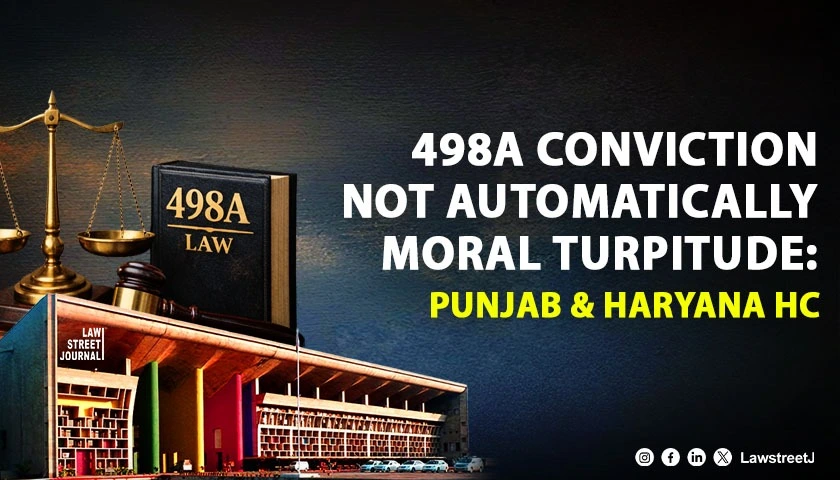
Punjab: The Punjab and Haryana High Court has held that not every conviction under Section 498A of the Indian Penal Code can automatically be treated as an offence involving moral turpitude for the purpose of civil consequences such as employment, promotion, or higher education.
The Court set aside the discharge order passed by the State Bank of India against a Branch Manager who had been convicted under Section 498A IPC arising out of a matrimonial dispute, holding that the Bank had acted mechanically by labelling the conviction as one involving moral turpitude without conducting any independent assessment of the facts or applying the well-settled legal tests.
The petitioner, Brahmjeet Kaushal, was working as a Branch Manager in the MMGS-III grade at Panipat when FIR No. 314 dated 27.05.2000 was registered against him and his family members under Sections 304B, 406, and 498A IPC, alleging demand for dowry and abetment of suicide by his deceased wife.
The Sessions Court, vide judgment dated 28.10.2002, acquitted the petitioner under Sections 304B and 406 IPC but convicted him under Section 498A IPC, sentencing him to three years’ rigorous imprisonment along with a fine of Rs. 5,000. The conviction was subsequently affirmed by a Division Bench of the High Court vide judgment dated 14.12.2018, and the petitioner’s review petition was also dismissed.
Consequent to the affirmation of conviction, the respondent Bank issued an order dated 27.06.2019 discharging the petitioner from service with effect from 14.12.2018, invoking Rule 68(7)(i) of the State Bank of India Officers’ Service Rules, 1992, read with Section 10(1)(b)(i) of the Banking Regulation Act, 1949, on the ground that the conviction under Section 498A IPC amounted to an offence involving moral turpitude.
Counsel for the petitioner argued that the Appointing Authority had merely reproduced the label of “moral turpitude” without disclosing any reasons as to how a conviction under Section 498A IPC, arising out of a domestic matrimonial dispute, satisfies the description of such an offence. It was contended that the Bank had neither referred to any list of offences nor applied the well-settled tests enunciated by the Supreme Court in State Bank of India & Others v. P. Soupramaniane, (2019) 18 SCC 135.
It was further argued that a conviction under Section 498A IPC, particularly where the allegations relate to neglect, insult, and harassment in a strained marriage, cannot per se and without factual analysis be mechanically equated with moral turpitude. It was also pointed out that none of the criminal courts—from the Sessions Court up to the Supreme Court—recorded any finding that the petitioner’s conviction involved moral turpitude.
On behalf of the petitioner, it was also submitted that the suicide note recovered from the deceased wife’s kameez, wherein she clearly stated that she was committing suicide on her own and that none should be held responsible—without attributing any specific act of violence or dowry demand to the petitioner—further negated any inference of such depraved conduct as would shock the moral conscience of society.
Counsel for the petitioner also urged that the Appointing Authority had not adverted to the petitioner’s long and unblemished service record, including his promotions from Clerk to JMGS Scale I, then MMGS Scale II, and MMGS Scale III, or to the fact that his integrity and efficiency in service were never questioned during the entire pendency of the criminal case.
On behalf of the respondent Bank, it was contended that the discharge order was fully justified under the applicable statutory provisions and that the petitioner’s conviction under Section 498A IPC had been affirmed up to the Supreme Court. It was urged that acts of sustained cruelty and harassment towards a married woman reflect baseness, vileness, and depravity in private and social duties and squarely fall within the accepted definition of moral turpitude, particularly for an employee holding a position of trust in a banking organisation dealing with public money.
The Court noted that the expression “moral turpitude” has not been defined either in the Banking Regulation Act or in the service rules. Referring to Pawan Kumar v. State of Haryana, (1996) 4 SCC 17, the Court observed that moral turpitude implies conduct that is inherently base, depraved, or contrary to accepted standards of morality, but its determination must depend upon the facts of each case and the impact of the act on the duties discharged by the employee.
The Court further referred to Allahabad Bank v. Deepak Kumar Bhola, (1997) 4 SCC 1, where the Supreme Court clarified that although conviction for an offence involving moral turpitude may furnish a valid ground for disciplinary action, the disciplinary authority must nonetheless examine whether the nature of the offence bears a rational nexus with the duties of the employee and the integrity expected in the post held, and cannot act mechanically merely because a conviction exists.
Relying on the Supreme Court’s judgment in P. Soupramaniane, the Court held that disciplinary authorities are required to apply their independent mind to the facts of the case and cannot treat conviction as an automatic trigger for dismissal without examining the attendant circumstances. The authority is obligated to evaluate the nature of the offence, its nexus with official duties, the surrounding circumstances, the employee’s service record, and the proportionality of the proposed punishment.
The Court also relied on Kranti Associates Pvt. Ltd. v. Masood Ahmed Khan, (2010) 9 SCC 496, to hold that recording reasons is a fundamental facet of the rule of law and ensures transparency in decision-making. An order that merely reproduces statutory language or records a bald conclusion, without disclosing the reasoning process of the authority, fails to meet the standard of a reasoned administrative decision and is vulnerable to judicial review.
The Court acknowledged that certain High Courts, including the Kerala High Court in Vincent Varghese v. State Bank of India and the Andhra Pradesh High Court in J. Ranga Raju v. State of Andhra Pradesh, had held that an offence under Section 498A IPC constitutes an offence involving moral turpitude. However, the Court drew a careful distinction between genuine cases of egregious dowry-related cruelty that shock the collective conscience of society and prosecutions arising out of essentially personal disputes within the matrimonial home, which may culminate in conviction based on findings of only technical or marginal cruelty.
The Court held that there is, at present, no uniform judicial consensus on whether every conviction under Section 498A IPC constitutes an offence involving moral turpitude. Categorisation depends on the facts of each case and remains debatable.
The Court held that no general rule can be accepted that every offence under Section 498A IPC must automatically be treated as one involving moral turpitude. The gravamen of Section 498A IPC is cruelty inflicted upon a wife by her husband or his relatives, rooted in the matrimonial relationship and conduct within that intimate sphere. To brand every such prosecution as involving moral turpitude, irrespective of its factual substratum, cannot withstand legal scrutiny.
The Court observed that the law demands a fact-sensitive inquiry into the nature, degree, and context of the cruelty actually proved, and only where those facts disclose genuine moral depravity—rather than merely a strained matrimonial relationship—can such a label be imposed.
Applying these principles, the Court noted that the petitioner had been acquitted of the graver charges under Sections 304B and 406 IPC and stood convicted only under Section 498A IPC arising out of matrimonial discord. Such an offence, though punishable, does not by its very nature satisfy the tests of inherent baseness or depravity so as to automatically fall within the category of offences involving moral turpitude.
The writ petition was accordingly allowed. The impugned order dated 27.06.2019 was set aside, and the respondents were directed to grant all consequential benefits to the petitioner from 15.12.2018 along with interest at 6% per annum within two months from the date of receipt of the certified copy of the order.
Case Title: Brahmjeet Kaushal v. Union of India & Ors., CWP240382021 (O&M)
Appearance:
- For the Petitioner: Mr. Karnail Singh, Advocate
- For the Respondents: Mr. Dheeraj Jain, Senior Advocate with Mr. Sahil Garg, Advocate (Respondent No. 1); Ms. Madhu Dayal, Advocate (Respondents No. 2 to 4)



![Police protection to fund manager alleging threat from Kirron Kher & aide: Punjab & Haryana HC [Read Order]](/secure/uploads/2023/12/lj_9007_Police_Kirron_Kher.jpg)
![Most interested witness being the father of deceased, SC upholds acquittal of 6 accused for murder [Read Judgment]](/secure/uploads/2023/12/lj_9904_df2c02a2-d8c5-4dd6-8b58-a59e17b8635b.jpg)
![Supreme Court Collegium approves new Chief Justices for five key High Courts in India [Read Recommendations]](/secure/uploads/2023/12/lj_8000_380d1135-6f3a-4988-a00a-4d5cd5901815.jpg)