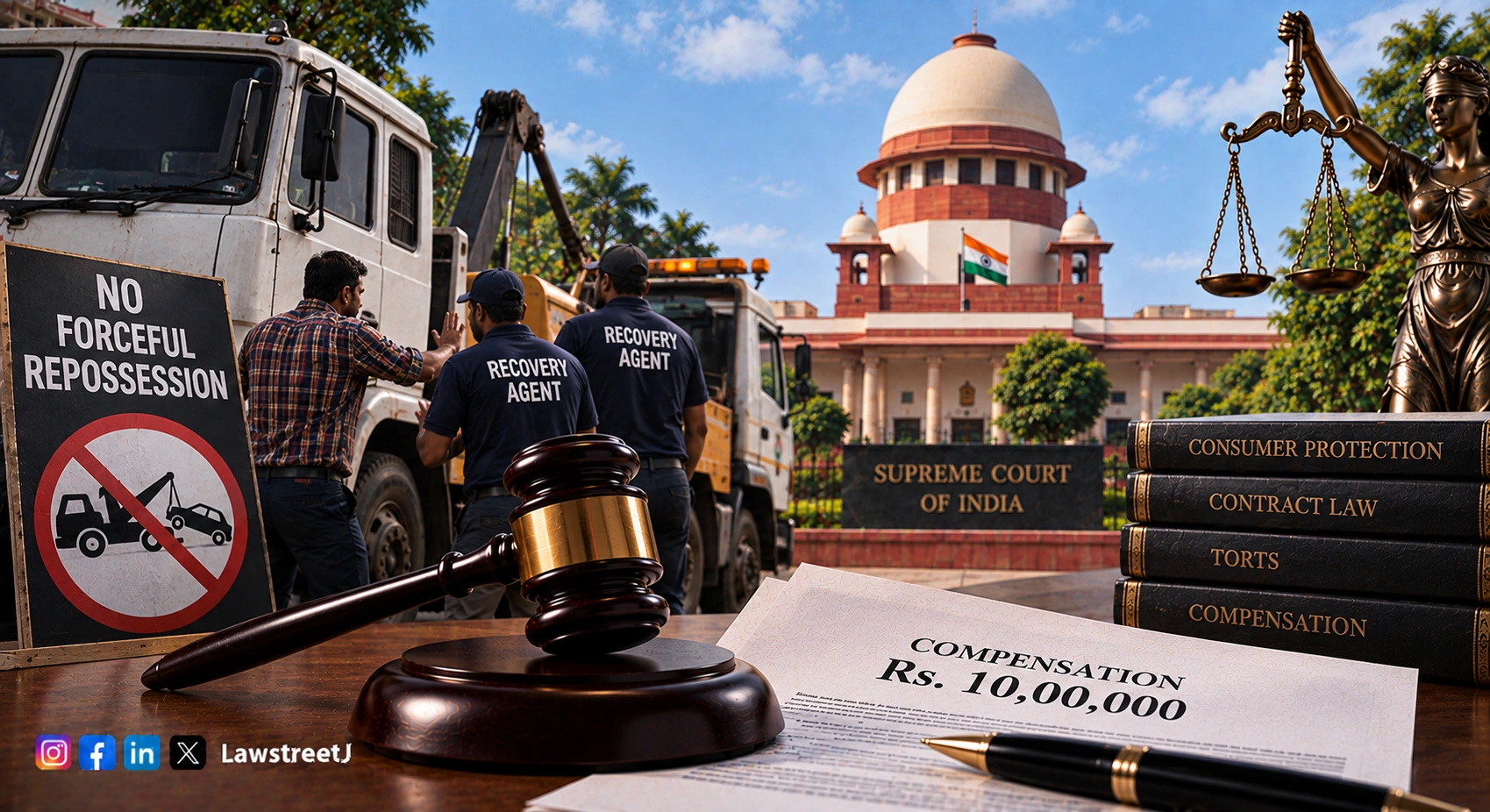
New Delhi: The Supreme Court has set aside an Allahabad High Court order and awarded Rs.10 lakh compensation, plus a refund of the sale proceeds with interest and costs, to a truck driver whose commercial vehicle was forcibly repossessed by a finance company's agents at 1 a.m. without notice, holding that the seizure violated RBI's Fair Practices Guidelines as well as the loan agreement's own notice clause, and directing the RBI to secure genuine compliance with its recovery guidelines by lenders.
Justice Alok Aradhe, delivering the judgment for a Bench also comprising Justice Pamidighantam Sri Narasimha, was hearing an appeal by Hari Dutta Sharma against an order dated 04.04.2025 of the Allahabad High Court dismissing his writ petition against the repossession and sale of his truck by Cholamandalam Investment and Finance Company Limited, from which he had taken a commercial vehicle loan in 2019, secured by hypothecation of the vehicle.
The appellant, who had defaulted on his instalments on more than one occasion, alleged that on 09.04.2023, while his vehicle stood parked after a delivery, four unidentified persons broke its steering lock at about 1:00 a.m. and drove it away without any notice to him. He lodged a police complaint and an FIR the same day, and later a complaint under Section 156(3) of the Code of Criminal Procedure, which was dismissed on the ground that the vehicle had been repossessed for default. He learnt only in September 2023, through a legal notice, that the Company had sold the vehicle on 31.08.2023 for Rs.4,50,000 and was seeking a further sum from him. The High Court dismissed his writ petition, holding that he had approached the court belatedly and had been a defaulter.
The Company defended the repossession as consistent with the loan agreement and the terms on which the vehicle was sold, while the appellant argued that the seizure violated Article 11 of the Loan Agreement, which required seven days' prior notice, and that a financier's right of self-help repossession cannot be exercised by force or deceit.
Tracing the RBI's Fair Practices Code guidelines issued since 2003 and its 2005 and 2006 circulars against 'undue harassment' and 'use of muscle power' in loan recovery, and the Court's own earlier decision in ICICI Bank Ltd. v. Prakash Kaur, which held that banks cannot employ 'goondas' to seize vehicles by force, the Court observed that a financier's contractual right of repossession, while legitimate, "must be construed with great circumspection; left unchecked, it is capable of being read as an unbridled licence to seize property by stealth, by force or in the dead of night."
On facts, the Court found that no seven-day notice under Article 11 had in fact been issued before the vehicle was taken, that the possession memorandum did not even bear the appellant's signature, and that the mode of seizure breaking open the steering lock at 1 a.m. bore every mark of the very conduct condemned in Prakash Kaur. It also faulted the High Court for dismissing the writ petition on the ground of delay without examining the merits, noting that the appellant had lodged an FIR the same day and continued to receive traffic challans for the vehicle long after it was supposedly sold.
Holding that the Company's action constituted a violation of Articles 14 and 21 of the Constitution, since the appellant, a man of modest means, had been deprived of his livelihood in an arbitrary and unfair manner, the Court set aside the High Court's order.
While declining to disturb the sale of the vehicle, already concluded in 2023, it directed the Company to close both of the appellant's loan accounts, refund the Rs.4,50,000 sale price with 6% interest from the date of sale, and pay Rs.10,00,000 as compensation for mental agony and loss of livelihood, along with costs of Rs.50,000.
The Court further directed the RBI to take effective steps to secure genuine compliance by NBFCs and banks with its recovery guidelines, observing that they had, until now, existed largely on paper.
Case Title: Hari Dutta Sharma vs. State of U.P. and Others, Civil Appeal arising out of SLP (C) Diary No.10952 of 2026, 2026 INSC 998