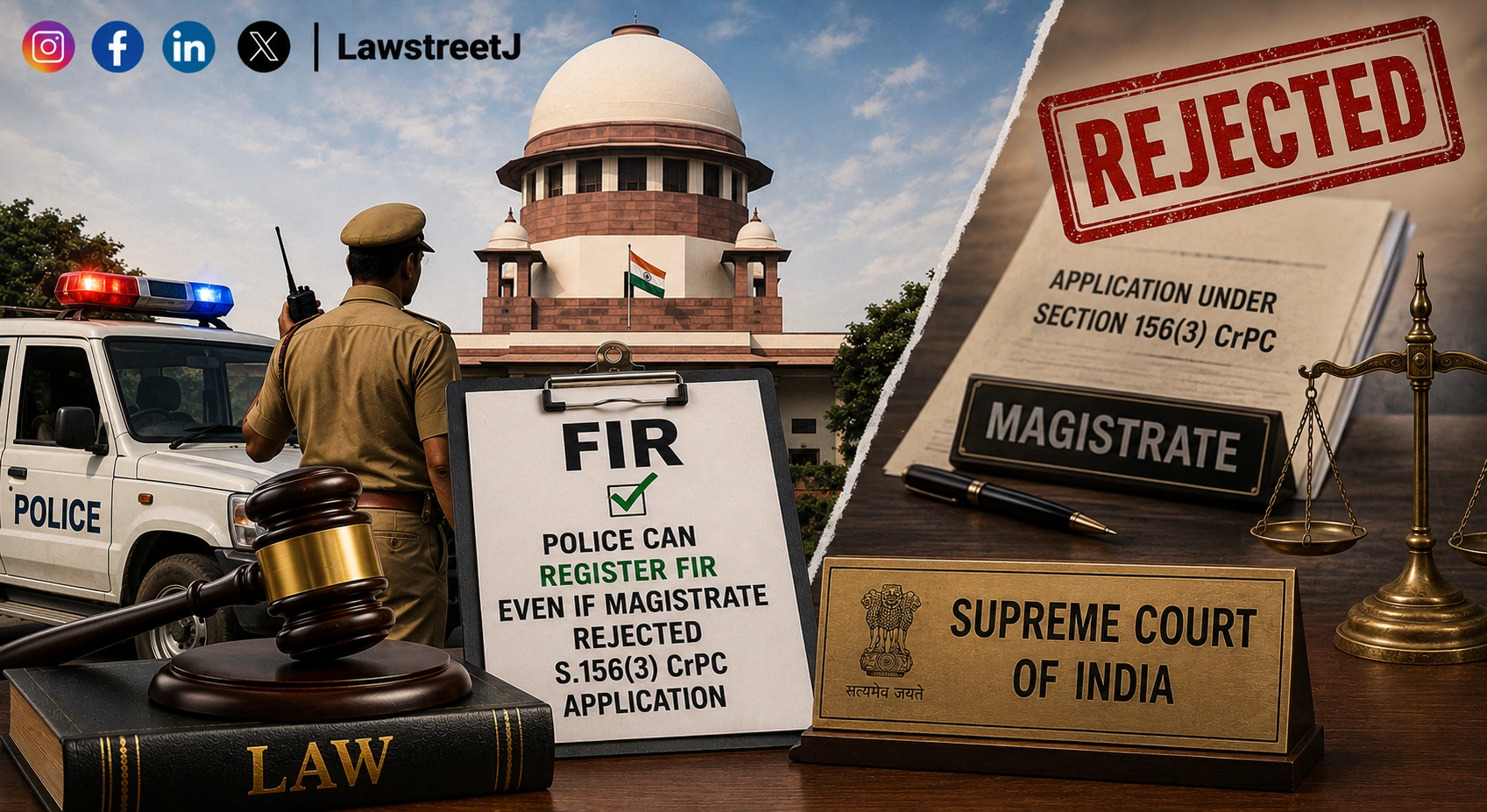
New Delhi: The Supreme Court has held that the rejection of an application under Section 156(3) of the Code of Criminal Procedure, 1973 (the provision corresponding to Section 175(3) of the Bharatiya Nagarik Suraksha Sanhita, 2023) does not bar the subsequent registration of a First Information Report founded on the same or substantially similar allegations, since such an order does not amount to a final adjudication on merits so as to attract the doctrine of res judicata.
A Bench of Justices Prashant Kumar Mishra and N.V. Anjaria was hearing an appeal filed by Pramod Kumar Shukla against an order of the Allahabad High Court, which had declined to quash FIR No.405/2024 registered against him for offences under Sections 406, 419, 420, 467, 468, 471, 504 and 506 of the Indian Penal Code, 1860.
The complainant had alleged that the appellant represented that he possessed influence in the Directorate of Education, Prayagraj, and could secure appointments for the complainant's son and grandson to the post of Clerk upon payment of ₹20,00,000/-, of which sums totalling ₹1,75,000/- were transferred to the appellant's bank account. No interview was ever conducted, and when repayment was demanded, the appellant allegedly abused and threatened the complainant and his family. Notably, the complainant had earlier moved an application under Section 156(3) of the CrPC before the Additional Chief Judicial Magistrate seeking a direction for registration of an FIR on substantially similar allegations, which was rejected on 11.09.2024 after the Magistrate found the Police report reflected a land transaction dispute rather than a payment for securing employment. The revision against that rejection was also dismissed.
Before the Supreme Court, the appellant contended that the FIR amounted to an impermissible second round of proceedings once the Section 156(3) application had been rejected on merits, and that the complainant's remedy lay only in a complaint under Section 200 of the CrPC, relying on Mohan Karthik and Others v. State of Tamil Nadu and Another. Reliance was also placed on State of Haryana v. Bhajan Lal and Neeharika Infrastructure Pvt. Ltd. v. State of Maharashtra to contend that no cognizable offence was disclosed and that the underlying transaction, being one for securing public employment through influence, was void under Section 23 of the Indian Contract Act, 1872. The State opposed the appeal, submitting that the FIR was founded on fresh material, including an audio recording and forged admit cards and results not placed before the Magistrate earlier, and that the appellant faced five other FIRs involving substantially similar allegations.
Tracing the statutory scheme under Sections 154, 156(3) and 190 of the CrPC, the Court explained, relying on Devarapalli Lakshminarayana Reddy v. V. Narayana Reddy and Sakiri Vasu v. State of U.P., that an order under Section 156(3) operates at the pre-cognizance stage and is confined to directing the police to exercise their statutory power of investigation under Section 156(1); it does not entail any adjudication of the merits of the allegations.
On the question of res judicata, the Court drew on its recent decision in S.C. Garg v. State of Uttar Pradesh, authored by Mishra, J., which reconciled the apparently divergent lines of authority on the point. Decisions such as Pritam Singh v. State of Punjab and Bhagat Ram v. State of Rajasthan, which applied res judicata in criminal proceedings, had arisen from an acquittal after a full trial, that is, a final adjudication on merits. By contrast, Devendra v. State of U.P. and Muskan Enterprises v. State of Punjab, which held res judicata inapplicable, concerned successive petitions under Section 482 of the CrPC where no adjudication on merits had taken place at all. Applying the same distinction, the Bench held that a Section 156(3) order falls in the latter category.
“An order passed under Section 156(3) of the Cr.PC is not one rendered upon an adjudication on the merits of the allegations against the proposed accused but is confined to regulating the commencement of investigation in accordance with the statutory scheme of the Code... such an order neither entails an adjudication on the merits of the allegations nor determines any right or liability of the proposed accused,”
the Court observed, holding that its rejection cannot bar a subsequent FIR on the same allegations.
The Court found direct support in its earlier order in Mahendri v. State of U.P., where an identical contention was rejected on the ground that declining a Section 156(3) prayer does not reflect on the veracity of allegations subsequently made in an FIR. The Bench also distinguished Mohan Karthik, clarifying that it concerned the maintainability of a second application under Section 156(3) itself, and had no bearing on the present controversy.
The Court further held, relying on the Constitution Bench decision in Lalita Kumari v. Government of Uttar Pradesh, that the police's obligation to register an FIR on information disclosing a cognizable offence flows independently from Section 154 of the CrPC and is not curtailed merely because an earlier application under Section 156(3) had been rejected on the material then available.
Upholding the High Court's view that the allegations, taken at face value, disclosed cognizable offences and that the appellant's defence regarding the true nature of the transactions was a matter for investigation, the Court also noted that the appellant faced five other FIRs on substantially similar allegations.
Finding no perversity in the High Court's findings, the Supreme Court dismissed the appeal.
Case Title: Pramod Kumar Shukla vs. State of Uttar Pradesh and Others, Criminal Appeal No. 3931 of 2026 (Arising out of S.L.P. (Criminal) No.12908 of 2025)