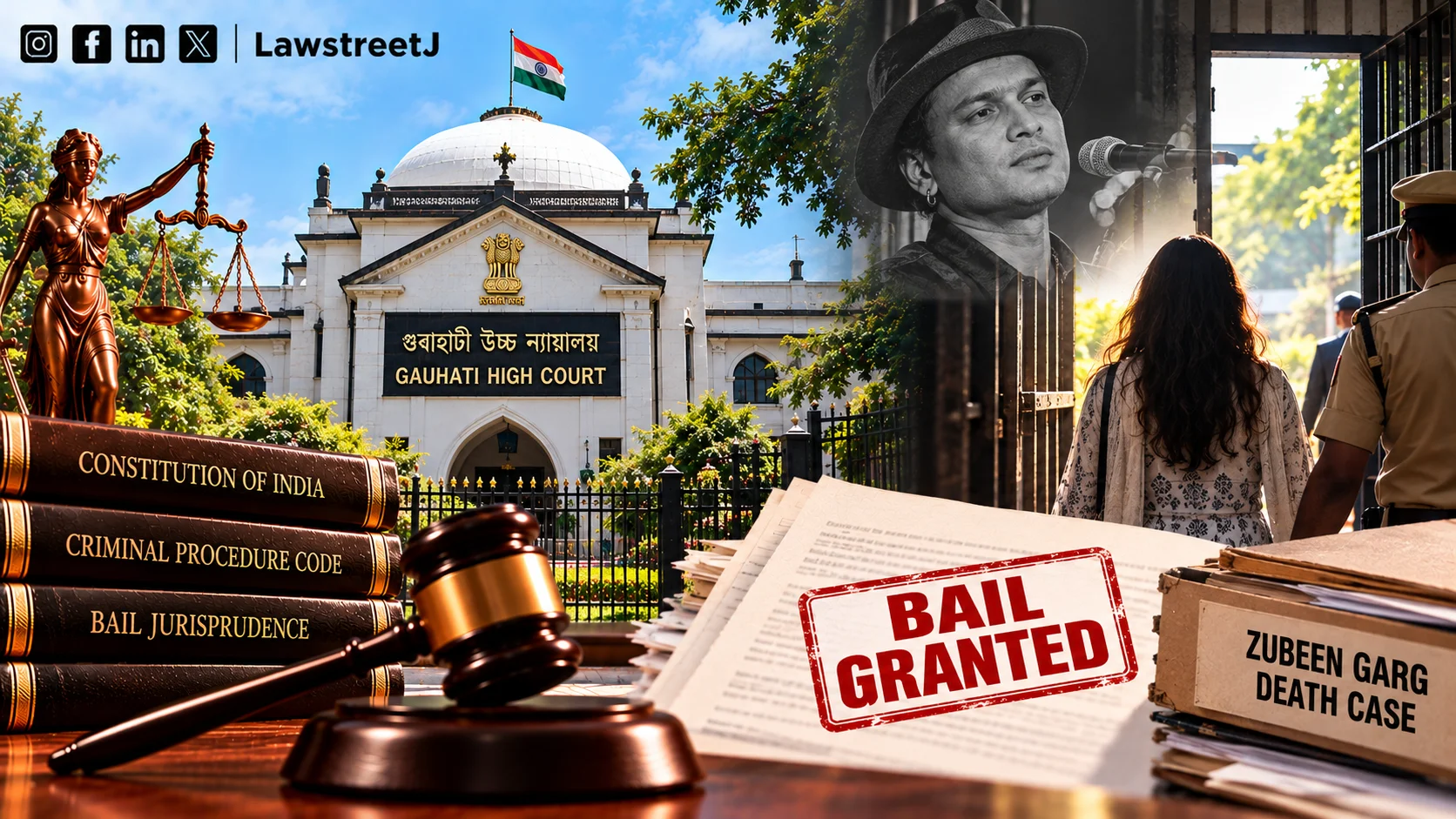
Guwahati: The Gauhati High Court has granted bail to Amritprava Mahanta, the fourth accused (A-4) in the case relating to the death of singer Zubeen Garg in Singapore on 19.09.2025, holding that the materials collected during investigation and the trial testimony recorded so far do not, prima facie, disclose any role attributed to her in the alleged conspiracy, and that the findings in the charge-sheet against her do not find support from those materials.
Justice Pranjal Das, in a judgment pronounced on 09.10.2026 after orders were reserved on 07.10.2026, allowed Bail Application No. 2212 of 2026 and directed that the petitioner be released on bail of Rs. 50,000 with two sureties of the like amount to the satisfaction of the trial court. The petitioner, who was arrested on 03.10.2025, had been in custody for about 369 days.
The Court noted that after news of the singer's death, a complaint was lodged at Morigaon police station alleging that Shyamkanu Mahanta and Siddartha Sharma, along with others, had murdered him, and that complaints were transferred to the Crime Investigation Department, where CID PS Case No. 18/2025 was registered under Sections 61(2), 105 and 106(1) of the Bharatiya Nyaya Sanhita. A Special Investigation Team filed a charge-sheet against seven accused. The petitioner was charged under Sections 3(6), 3(7), 3(8), 61(2), 103(1) and 238 BNS before a Special Fast-Track Court constituted by the High Court on 26.03.2026 for day-to-day trial. The charge-sheet lists 394 witnesses and 373 documents. The petitioner was not named in the first complaint, and her two earlier bail applications before the trial court, one before and one after framing of charge, had been rejected.
The prosecution's case is that A-1 to A-4 conspired to murder the singer, took him to Singapore for a cultural festival, fed him alcohol despite medical advice against it and his history of epilepsy, and took him on a yacht trip where he was encouraged to swim in the sea without a life jacket. He is stated to have suffered a seizure, ingested salt water and lost consciousness, and was declared dead at Singapore General Hospital at 5:13 PM Singapore time. The role attributed to the petitioner was to feed him alcohol, and the apparent motive was financial irregularities by A-1, his manager.
Senior Advocate A.K. Bhuyan, for the petitioner, argued that she has no criminal antecedents, that no witness states that she administered alcohol or conspired to kill, that the yacht crew's statements, the captain and Singapore police officials were not part of the investigation, that the whisky bottle allegedly in the room was not seized, and that sanction required for prosecuting an offence committed abroad by an Indian citizen had not been obtained. Special Public Prosecutor Z. Kamar submitted that she was near the yacht captain at the relevant time, had not objected to changes in room arrangements, and was tasked to make the victim drink as much as possible, that the forensic report showed death by drowning with a high level of alcohol but no poison in the viscera, and that, the conspiracy having been hatched in Assam, sanction was not required.
After reviewing the factors for bail laid down in State of U.P. v. Amarmani Tripathi, Kalyan Chandra Sarkar v. Rajesh Ranjan, Ram Govind Upadhyay v. Sudarshan Singh and Prasanta Kumar Sarkar v. Ashis Chatterjee, the Court noted that Section 483 of the Bharatiya Nagarik Suraksha Sanhita corresponds to Section 439 of the Code of Criminal Procedure, and that the Court was conscious that the trial had proceeded almost midway and the offences charged were heinous, but that the prima facie case had to be examined.
On the allegation of feeding alcohol, the Court found that none of the statements of about 250 witnesses recorded during investigation, including those before Judicial Magistrates, states that A-4 fed, served, poured, procured, offered or forced alcohol upon the victim. Of 121 prosecution witnesses examined at the time the records were received, 118 made no such statement, and three further witnesses examined later also did not. The three who referred to alcohol, PW-10, PW-12 and PW-29, had no personal knowledge and had filed FIRs on the basis of media reports, and PW-12 said he took the charge-sheet to be the "gospel truth". The chain of custody documents and the documents annexed to the charge-sheet also contained nothing to that effect. The Court observed that a police statement of witness Rupkamal Kalita, in which he said A-4 told him the victim had been given whisky before boarding the yacht, indicated a caution being conveyed by her, which is incompatible with the prosecution theory that her main task as a conspirator was to feed him alcohol. It also found no statement in the WhatsApp messages produced by the prosecution indicating that she fed him alcohol, without appreciating that document in detail.
The Court declined to consider the references in the petitioner's own police statement to the victim taking alcohol and to her sharing a drink with him, holding, on the strength of P. Krishna Mohan Reddy v. State of Andhra Pradesh, that an accused's statement to the police, whether confessional or exculpatory, cannot be used against her or a co-accused at the stage of bail.
The Court then examined the petitioner's alleged role in the Singapore trip, room changes, organising the yacht trip, making the victim swim and swim without a life jacket, and found no statement of any witness, whether recorded during investigation or in trial, and no document, attributing any of these to her. Referring to CBI v. K. Narayana Rao, Baldev Singh v. State of Punjab and Yogesh v. State of Maharashtra on the requirement of a meeting of minds, it said it was unable to find any material indicating any overt or covert act by A-4 in furtherance of the alleged conspiracy, and noted that no suspicion of such a conspiracy had been found before departure, around the time of the incident or afterwards. It observed that it was "perplexing" that she would share the apparent financial motive, since there were no allegations of financial wrongdoing against her, while leaving the question of motive to the trial court.
The Court also noted materials on her conduct after the incident: witness statements that she, along with others, rubbed the victim's hands and feet, that she said he needed his epilepsy tablet and searched his clothes for medicine, and that, according to PW-123, she put two fingers in his mouth when she thought he was biting his tongue and cried aloud on hearing of his death.
Holding that if the materials on record even fall short of making out a prima-facie case against the bail petitioner, the interest of justice would require that such a bail petitioner should be granted bail, the Court said it was unable to find a prima facie case of conspiracy and murder against A-4, while clarifying that this was only for the purpose of bail and that guilt was a matter for the ongoing trial. It added that the absence of foundational support for the charge-sheet's findings was itself a factor militating against continued under-trial detention. Citing State of Rajasthan v. Balchand, it reiterated that bail is the rule and that under-trial detention should not be used as punishment, observing that the credibility of the criminal justice system is damaged when it is.
The Court also referred to the medical protocol stipulated for the singer by doctors in Guwahati and Mumbai, which included abstaining from alcohol, not going near water, taking seizure medication regularly and undergoing assessments before foreign travel. It stated that, prima facie, several of these protocols appear to have been violated, but that whether any accused was responsible, and whether this would invite criminal liability, would be decided at trial.
The Court relied additionally on the proviso to Section 480(1) of the BNSS, which permits release of a woman accused even of offences punishable with death or life imprisonment, and on Satender Kumar Antil v. CBI, which held that such welfare provisions must be considered while exercising bail powers under the higher courts. It recorded seven reasons for granting bail: the nature of the materials against her, the absence of even a prima facie case, the lack of support for the charge-sheet's findings, the progress of the trial with 124 witnesses examined, the length of her detention since 03.10.2025, her being a woman, and the absence of criminal antecedents. It held that denying bail at this stage would be a travesty of justice.
On the public sentiment surrounding the case, the Court observed that a court has to be conscious of society's sense of justice, but cannot be captive to it, and that its duty is to go by legal justice derived from the materials and evidence on record.
The bail is subject to conditions that the petitioner cooperate with the remaining trial, not hamper or tamper with evidence, not influence witnesses, not inflict self-harm, take precautions for her own safety, and not go abroad without permission of the trial court, with a warning that violation may lead to cancellation. The Court clarified that its observations are only for adjudicating bail and do not express any opinion on the merits of the trial, to the prejudice of either the defence or the prosecution.
Appearances:
For the Petitioner: Mr. A.K. Bhuyan, Senior Advocate, with Ms. N. Choudhury and Mr. N.R. Sharma, Advocates.
For the Respondent (State of Assam): Mr. Z. Kamar, Senior Advocate and Special Public Prosecutor, with Mr. P. Dutta, Assistant Special Public Prosecutor.
Case Title: Amritprava Mahanta vs. The State of Assam, Bail Appln. No. 2212 of 2026


![Justice Nongmeikapam Kotiswar Singh appointed as acting Chief Justice of Gauhati High Court [Read Press Release]](/secure/uploads/2023/01/lj_9707_5c969d0f-570f-400a-ba8b-3b65cf825540.jpg)
![Collegium Recommends Chief Justices of Delhi, Rajasthan, and Gauhati High Courts for Elevation to Supreme Court [Read Order]](/secure/uploads/2023/11/lj_9736_933a94de-bdaf-43de-944b-b0e58e17edb5.jpg)
![Supreme Court Mandates Strict Scrutiny in Sexual Harassment Allegations at Work [Read Judgment]](/secure/uploads/2023/11/lj_3478_eef290f2-6acf-4296-9ee0-adf54f275609.jpg)