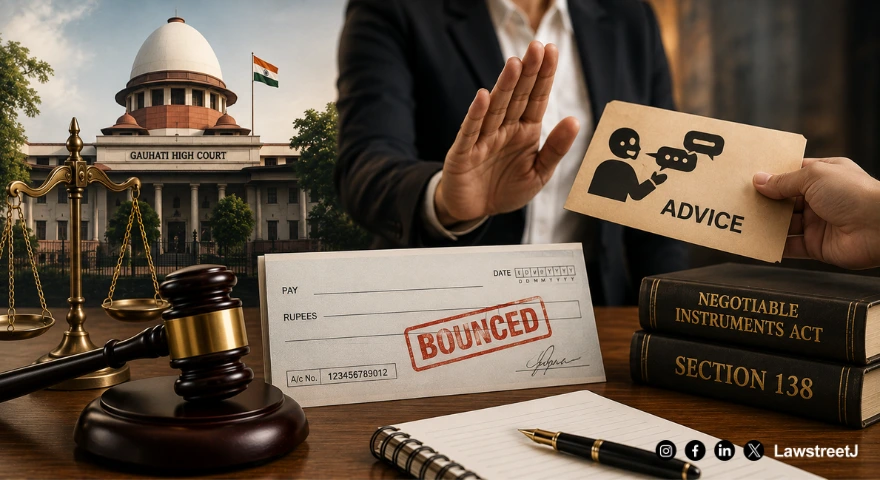
Guwahati: The Gauhati High Court has dismissed a criminal revision petition challenging a conviction under Section 138 of the Negotiable Instruments Act, holding that a notice which merely "advises" the drawer of a dishonoured cheque to make payment can still amount to a valid demand under the statute, so long as the notice, read as a whole, conveys the requirement to pay.
Justice Sanjeev Kumar Sharma was hearing a revision petition filed under Section 438/442 of the BNSS by Protima Dutta Kalita, challenging the judgment dated 14.07.2025 of the Sessions Judge, Golaghat, in Crl.A. No. 3/2023, which had upheld her conviction under Section 138 of the NI Act while modifying the sentence to six months' simple imprisonment and compensation of Rs. 2,60,000.
According to the facts, the petitioner and the respondent, who were known to each other, had a cordial relationship. The petitioner had approached the respondent seeking financial assistance of Rs. 1,30,000 for her son's marriage, verbally promising repayment. The respondent, after arranging the amount through her self-help group, paid the sum to the petitioner. On the respondent's repeated requests for repayment, the petitioner issued a cheque dated 16.12.2016 for Rs. 1,30,000, drawn on the State Bank of India, Dergaon Branch, and also executed a handwritten note acknowledging the debt, duly signed on revenue stamps. The cheque was dishonoured, and upon the petitioner's failure to pay despite notice, a complaint was filed. The learned CJM, Golaghat convicted the petitioner and sentenced her to one year's simple imprisonment along with compensation of Rs. 3,00,000, a decision that was partly modified in appeal.
Before the High Court, the petitioner urged two grounds. The first was that the complainant had not specified the exact date on which the loan amount was handed over to the petitioner. Rejecting this contention, the Court held that since the petitioner had not denied her signature on the cheque, the statutory presumption under Section 139 of the NI Act stood attracted, and the mere absence of a specific date on which the money changed hands would not, by itself, rebut that presumption. The Court further noted that the petitioner had failed, during cross-examination of the complainant and her witnesses, to discharge her burden of showing that the cheque was not issued towards a legally enforceable debt.
The second and more forcefully argued ground was that the notice issued by the respondent's counsel following dishonour of the cheque did not amount to a valid demand as required under proviso (b) to Section 138 of the NI Act, since the notice, dated 09.01.2017, only "advised" the petitioner to pay the cheque amount rather than "demanding" it.
Examining this contention, the Court held that the requirement under proviso (b) is that the payee must clearly communicate to the drawer the necessity of making good the cheque amount, and that this requirement to pay must be discernible from the notice read as a whole. The Court observed that words such as "advice" or "request" are merely polite forms of language, and must still be treated as a demand for the purposes of Section 138 if the notice, taken in its entirety, conveys the requirement to pay.
In support of this reasoning, the Court relied on the Supreme Court's decision in Central Bank of India & Anr. v. Saxons Farma & Ors., (1999) 8 SCC 221, where a similarly worded notice had been held sufficient to constitute a demand. The Court extracted the relevant portion of the Supreme Court's ruling:
"The object of notice is to give a chance to the drawer of the cheque to rectify his omission and also to protect honest drawer... The last line to the portion of notice extracted above reads as under: \"Kindly arrange to make the payment to avoid the unpleasant action of my client.\" In our opinion it is a clear demand as required under Clause (b) of Section 138."
Applying this principle, the Court noted that the notice in the present case, like the one considered in Saxons Farma, did not use the word "demand" in so many words but nonetheless spelt out the consequence of non-payment namely, that failure to pay would lead the complainant to approach a court of law under the NI Act. The Court held that this was sufficient to satisfy the requirement of proviso (b) to Section 138.
Holding that neither of the two grounds urged on behalf of the petitioner had any substance, the Court found the revision petition to be devoid of merit and dismissed it accordingly.
Appearances: Mr. B. Sinha and Mr. H. Islam appeared for the petitioner; Mr. C. Kalita, Mr. L.K. Borah and Mr. D.K. Borah appeared for the respondent.
Case Title: Protima Dutta Kalita v. Smti Rina Borgohain (Crl.Rev.P./412/2025)


![Justice Nongmeikapam Kotiswar Singh appointed as acting Chief Justice of Gauhati High Court [Read Press Release]](/secure/uploads/2023/01/lj_9707_5c969d0f-570f-400a-ba8b-3b65cf825540.jpg)
![Collegium Recommends Chief Justices of Delhi, Rajasthan, and Gauhati High Courts for Elevation to Supreme Court [Read Order]](/secure/uploads/2023/11/lj_9736_933a94de-bdaf-43de-944b-b0e58e17edb5.jpg)
![Supreme Court Mandates Strict Scrutiny in Sexual Harassment Allegations at Work [Read Judgment]](/secure/uploads/2023/11/lj_3478_eef290f2-6acf-4296-9ee0-adf54f275609.jpg)