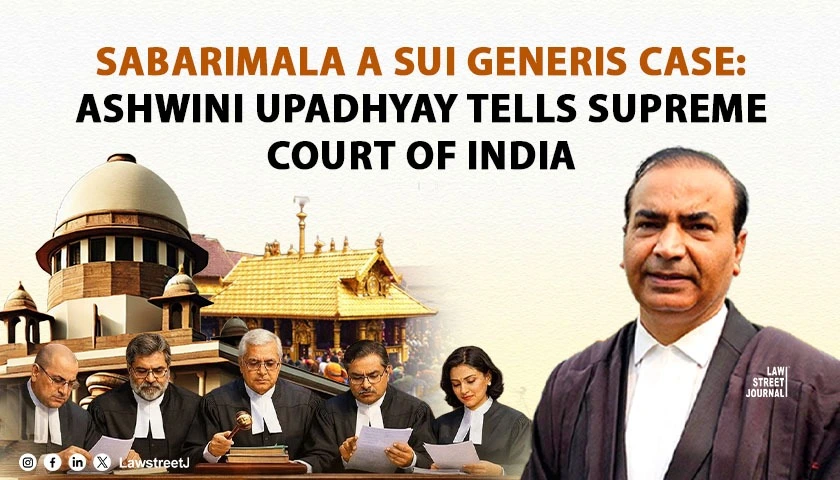
New Delhi: Written submissions have been filed before the Supreme Court of India by Advocate Ashwini Kumar Upadhyay in IA 5551 of 2020 in Review Petition (C) 3358 of 2018 in Writ Petition (C) No. 373 of 2026, in the matter of Kantaru Rajeevaru v. Indian Young Lawyers Association & Others, a seven-judge constitutional reference arising from the review of the Sabarimala five-judge judgment.
The submissions address, in three parts, the seven questions of law framed by the Constitution Bench, additional questions that arose during the hearing, and the sui generis nature of Sabarimala.
The submissions contend that Article 25 is a limited right, subject to restrictions relating to public order, morality, health, and other fundamental rights, given the sensitive nature of religious freedom. It is argued that the inclusion of the right to propagate religion—unique to the Indian Constitution—justifies these constraints. The submissions further assert that Article 26, being derived from Article 25, cannot have a wider scope and is similarly subject to other fundamental rights.
On the interplay between Articles 25 and 26, it is contended that individual rights under Article 25 are primary, and denominational rights under Article 26 arise only when individuals exercise their rights under Article 25. The submissions emphasise that fundamental rights are not isolated but form a seamless web, as described by constitutional scholar Granville Austin, and that Article 26 is therefore impliedly subject to all other provisions of Part III.
On the term “morality” in Articles 25 and 26, the submissions argue that it refers to public morality, not constitutional morality. Constitutional morality, it is contended, governs public servants and constitutional functionaries who take an oath and perform constitutional duties, and the two must not be conflated. On the phrase “sections of Hindus” in Article 25(2)(b), it is submitted that it refers to vertical divisions within Hinduism, such as Shaivism, Vaishnavism, and Shaktism, and not horizontal divisions based on gender.
It is further submitted that the right to move the Supreme Court under Article 32(1) for enforcement of fundamental rights is itself a fundamental right and cannot be curtailed. Religious practices that offend public conscience or threaten unity and integrity are not purely private matters and may be subject to public interest litigation, particularly since Articles 25 and 26 are subject to public order, health, and morality. The submissions reject the proposition that a person challenging a religious practice forfeits membership and locus standi, stating that such a view would foreclose the possibility of internal social reform.
On the exceptional character of Sabarimala, the submissions (at Para 33) argue that the temple possesses a unique and sui generis status. Drawing comparative examples, it is submitted that just as Mecca-Madina among mosques, the Church of Jerusalem among churches, the twelve Jyotirlingas among Shiva temples, the 51 Shakti Peeths among Goddess temples, the Char Dham among Hindu pilgrimage sites, certain Jain temples associated with the 24 Tirthankaras, key Buddhist sites such as Sarnath, Gaya, Lumbini, and Kushinagar, and historically significant Gurudwaras hold distinct sanctity, the Sabarimala Temple occupies a singular position among Lord Ayyappa temples. It is stated to be the only temple where devotees are required to observe a 40-day Brahmacharya period before undertaking the pilgrimage.
The submissions further argue that the restriction on the entry of women of a specific age group is not discriminatory but constitutes a permissible religious belief. It is asserted that beliefs cannot be assessed through scientific criteria. The submissions also state that in Hindu traditions, women are venerated across rituals and festivals, including Navratri, where female deities are worshipped. On the issue of exclusion, it is contended that the restriction pertains to a specific age group in the context of the deity’s attributes and the arduous nature of the pilgrimage, and therefore does not amount to discrimination under Article 15. It is also argued that certain temples impose entry restrictions on men.
The historical justification for the restriction is stated to be twofold: respect for the celibate nature of Lord Ayyappa (Naishtika Brahmachari), and the practical hardships historically associated with the pilgrimage. The submissions note that the temple is surrounded by hills, requires a 41-day observance, and involves a difficult forest trek with limited facilities. It is argued that the restriction was rooted in concerns for safety and well-being rather than discrimination.
Further, the submissions contend that Article 30 is an independent constitutional guarantee relating to cultural and educational rights, and not an extension of Articles 25 and 26. Placed alongside Article 29, it is structurally distinct from the right to freedom of religion and is not subject to limitations such as public order, morality, and health. The inclusion of linguistic minorities is cited to demonstrate its non-religious character.
Reliance is placed on Constituent Assembly debates to support this distinction, including the role of Sardar Vallabhbhai Patel, K.M. Munshi, and B. R. Ambedkar in treating religious freedom and minority educational rights as separate constitutional domains. The submissions also refer to the views of H.M. Seervai and Fali Nariman to argue that conflating these provisions would create constitutional inconsistency and violate Article 14.
On the distinction between Dharma and religion, the submissions argue that the term “religion” does not accurately translate the Sanskrit concept of Dharma. It is contended that Dharma, derived from the root dhr (to sustain), is based on duty, reason, and universal welfare, rather than adherence to a specific deity or doctrine. The submissions outline the Ashtadha Dharma and Dashavidha Dharma principles and link them to constitutional values reflected in the Preamble, Fundamental Rights, Directive Principles, and Fundamental Duties.
Case Title: Kantaru Rajeevaru v. Indian Young Lawyers Association & Others, IA 5551 of 2020 in Review Petition (C) 3358 of 2018 in Writ Petition (C) No. 373 of 2026