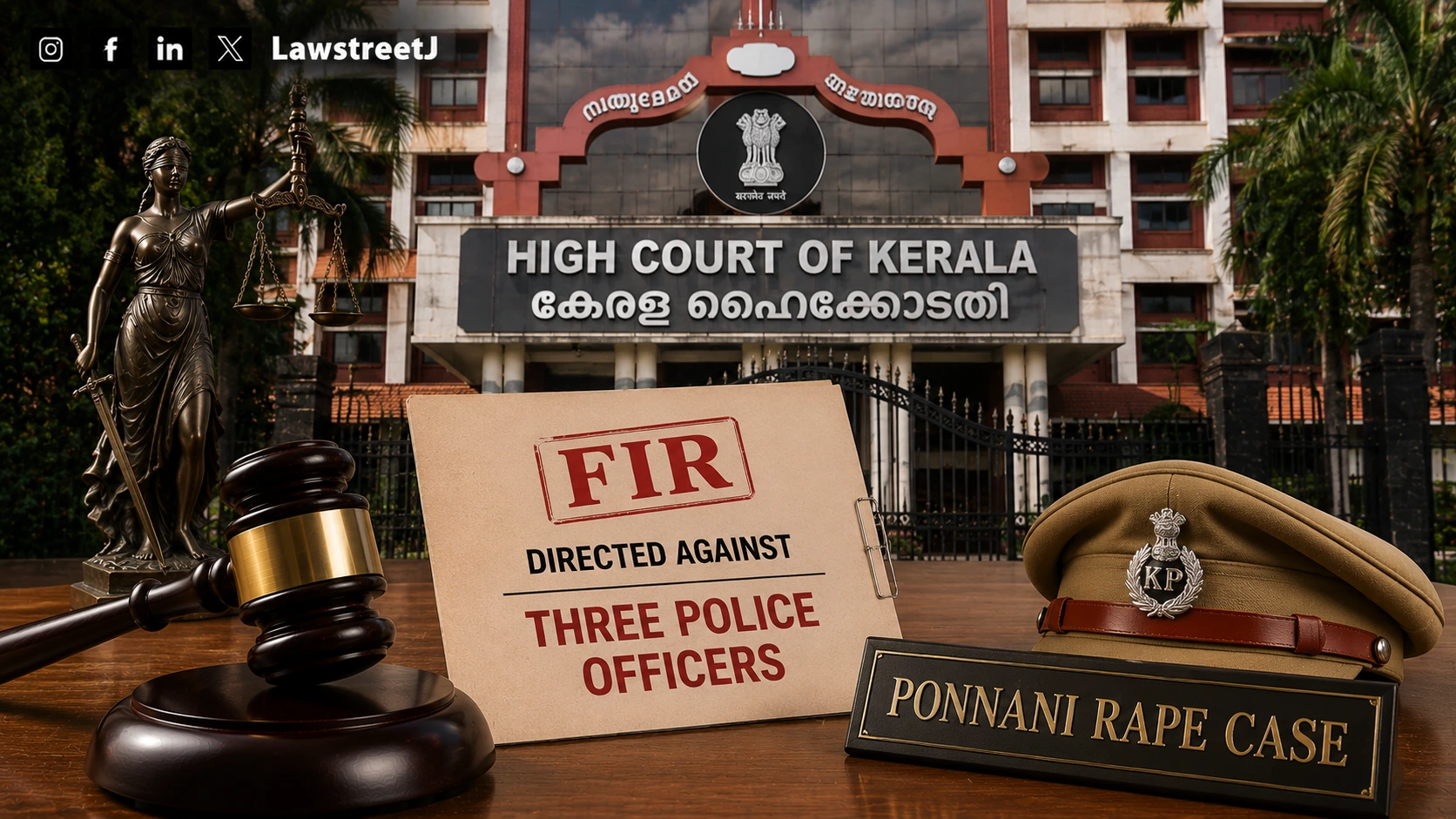
The Kerala High Court has dismissed a Criminal Miscellaneous Case filed by three police officers challenging an order of the Judicial First Class Magistrate Court, Ponnani, which forwarded a private complaint against them for investigation, holding that neither the procedural safeguards under Section 175(4) of the BNSS nor the requirement of a properly sworn affidavit under Section 333 of the BNSS stood violated.
Justice Jobin Sebastian was hearing a Crl.MC filed under against the order in CMP No. 3288 of 2024, by which the Magistrate had forwarded a private complaint filed by a woman for investigation under Section 175(3) of the Bharatiya Nagarik Suraksha Sanhita, 2023, against a Circle Inspector of Police, a Deputy Superintendent of Police and a Superintendent of Police.
The complainant had alleged that she was raped and sexually assaulted by the three officers on separate occasions between 2022 and 2024, after she had approached them seeking redressal of a dispute concerning the right over the house in which she resided. Her private complaint, filed under Section 210 of the BNSS, alleged offences including rape, unnatural offences, sexual harassment and criminal intimidation under the Indian Penal Code.
The case had a protracted procedural history. After the Magistrate initially called for a report from the officers' superior under Section 175(4) of the BNSS, the complainant approached the High Court, and a Single Judge held that compliance with Section 175(4) was not mandatory since the alleged acts could not be regarded as done in discharge of official duty. This order was set aside by a Division Bench in a writ appeal on the ground that interference under Article 226 was premature while the complaint was still pending before the Magistrate, and the matter was remitted for fresh consideration. The complainant's further appeal to the Supreme Court was dismissed, with the Court leaving it open to her to urge before the Magistrate that the acts alleged were not committed in discharge of official duty, while also directing that the Magistrate must satisfy himself that the application under Section 175(3) was accompanied by an affidavit sworn or affirmed in accordance with Section 333 of the BNSS. The Magistrate thereafter forwarded the complaint for investigation, giving rise to the present challenge.
The petitioners' senior counsel raised two principal contentions. First, it was argued that Section 175(4) of the BNSS was a mandatory procedural safeguard for public servants, and that since the allegations were against police officers, the Magistrate was bound to obtain and consider a report from their superior officer, along with their explanation, before ordering investigation under Section 175(3). Second, it was contended that the affidavit accompanying the complaint had been sworn before an advocate rather than before one of the authorities listed in Section 333 of the BNSS, and was therefore invalid, particularly in view of the Supreme Court's direction requiring compliance with that provision.
Rejecting the first contention, the court held that the safeguards under Section 175(4) apply only where the act complained of has arisen in the course of discharge of official duty, and that mere status as a public servant does not attract the provision. Examining the allegations at face value for this limited purpose, the court found that allegations of rape and sexual assault bear no reasonable nexus with the discharge of official police duties.
The court observed that the Magistrate had "specifically recorded that the allegations against the petitioners are of rape and sexual assault and that such acts can never be regarded as having been committed in the discharge of official duties," and that this finding warranted no interference, noting further that the Supreme Court had left the question of applicability of Section 175(4) open for the Magistrate's independent consideration.
On the second contention, the court referred to Section 333 of the BNSS and to Rule 40 of the Criminal Rules of Practice, Kerala, which permits affidavits for use before criminal courts to be sworn before a wider set of authorities, including an advocate. Holding that Rule 40 supplements rather than conflicts with Section 333, and that the legislative object of ensuring authenticity of allegations and deterring frivolous complaints stood fulfilled once an affidavit was sworn before a person authorised under the Rules, the court found that the affidavit's authentication by an advocate did not vitiate the Magistrate's order, especially since the petitioners had shown no prejudice.
Finding no perversity, illegality or jurisdictional error in the Magistrate's order, the court held that there was no ground warranting interference and dismissed the Criminal Miscellaneous Case.
Appearances:
For the Petitioners: Sri. S. Sreekumar, Senior Advocate; Sri. S. Rajeev, Sri. M.S. Aneer, Shri. Sarath K.P., Shri. Anilkumar C.R., Shri. K.S. Kiran Krishnan, Shri. T.P. Aravind, Shri. Akash Cherian Thomas, Shri. Azad Sunil, Shri. Maheswar Padickal, Smt. Akshara S., Smt. Nivedita Rajeev and Smt. Dipa V., Advocates.
For the State (R1): Sri. T. Asaf Ali, Director General of Prosecution; Sri. C. Rasheed, Advocate.
For the Second Respondent: Shri. Muhammed Firdouz A.V., Shri. Gentle C.D. and Shri. M.P. Shameem Ahamed, Advocates.
Case Title: Vinod Valiyattoor & Ors. vs. State of Kerala & Anr., Crl.MC No. 5826 of 2026



![Kerala HC Quashes 498A Dowry Harassment Case Against Live-In Partner, Citing Lack of Relative Status [Read Order]](/secure/uploads/2023/08/lj_5693_1057c042-1e57-4e27-8c9e-25af0ec38ec4.jpg)
![Watching porn on mobile: Kerala HC highlights importance of mother cooked meals, outdoor sports [Read Order]](/secure/uploads/2023/09/lj_9155_Parental_supervision_of_mobile_phone_usage.jpg)
![Lakshadweep MP Mohammed Faizal Disqualified from Lok Sabha After Conviction Suspension Plea Rejected by Kerala High Court [Read Notice]](/secure/uploads/2023/10/lj_9640_87b5fd97-0e05-4ff8-9a99-3be1e4446192.jpg)