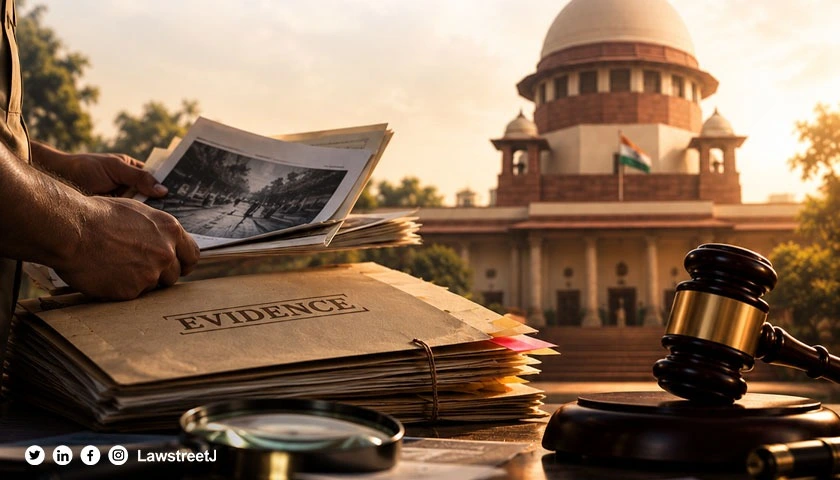
New Delhi: The Supreme Court has set aside an order of the Patna High Court that had quashed cognizance taken under Sections 302 and 201 of the Indian Penal Code against a man in a case where the appellant's son drowned to death, holding that the High Court acted in a very casual manner, ignored the compelling circumstances noted in the revisional order of the Sessions Judge, and misread the FIR and the post-mortem findings, and reiterating that a Magistrate may take cognizance of an offence despite a police closure report.
A Bench of Justice J.B. Pardiwala and Justice K. Vinod Chandran delivered the order on October 09, 2026, in an appeal by Mrityunjay Kumar Chaudhary, described in the order as a grieving father, against the State of Bihar and the accused, arising out of SLP (Crl) No. 18490 of 2026. The appeal challenged the High Court's order dated 05.05.2026 in Cr. Misc. No. 36193/2022.
The accused's counsel submitted at the outset that the appeal had become infructuous as cognizance had been taken by the Judicial Magistrate First Class, IV, Darbhanga. The appellant's counsel pointed out that the High Court's operative portion had set aside both the revisional order of the 7th Additional Sessions Judge, Darbhanga, and the Magistrate's order accepting the police final report and directing the protest petition to be registered as a complaint case, so that no cognizance subsisted and no protest complaint was pending. The court accepted that position.
According to the first information statement, the appellant's son was taken by the accused from his house for a walk, after which one Ashok Chaudhary informed the family that the boy was found drowning near the State Boring and could not be saved despite his efforts. The father rushed to the site and arranged boatmen, whose search failed as the boy had been swept away in the currents. After investigation, the police filed a final report, and by an order dated 29.10.2021 the Magistrate accepted it and directed the protest petition to be numbered as a complaint. The 7th Additional Sessions Judge, in revision, directed the Magistrate to reconsider the final report, pointing to compelling circumstances that could commend cognizance, and the Magistrate, on re-examination, took cognizance.
Extracting paragraph 16 of Brajesh Kumar alias Birjesh Kumar Singh v. State of Bihar, the court recalled that, on a closure report, the Magistrate has three options, namely to accept it and close the proceedings, to take cognizance on the material in the report, or to direct further investigation, as held in Ram Naresh Prasad v. State of Jharkhand, H.S. Bains v. State (U.T. of Chandigarh) and Ramswaroop Soni v. State of M.P., and that the primacy of the court to take or deny cognizance under Section 190(1)(b) of the Code of Criminal Procedure is discernible from the Code itself.
The court held that the High Court's assumption that the post-mortem report, which recorded death due to asphyxia and ventricular fibrillation as a result of drowning, showed nothing sinister was wrong, since even a person pushed into water deliberately would show nothing different in a post-mortem, which has to be tested on the attendant circumstances. It noted that the accused had taken the deceased from his house and was last seen with him, that two witnesses spoke of seeing him flee from the scene, and that he should proffer an explanation, which made a trial expedient to unravel the mystery.
The court also held that the High Court's finding that the FIR did not disclose the information received about the drowning was flawed, since the FIR clearly stated that the information was passed on through Ashok Chaudhary, and that the High Court had not looked at the Sessions Judge's order despite noticing it, which listed compelling circumstances and dealt in detail with the statements recorded under Section 161. It said that such statements cannot be relied on at the trial but can be gone into at the stage of cognizance, as that is the material produced by the police along with the final report.
The court set aside the High Court's order and remanded the matter for expediting the trial. The accused must appear before the Magistrate within two weeks, who shall carry out the committal proceedings in accordance with law, failing which he is to be taken into custody and produced before the Magistrate, and on appearance or production he shall be released on bail on conditions the court deems fit, subject to co-operation in the trial. The court made it clear that its view, and those of the Sessions Judge and the Magistrate in affirming cognizance, shall not, in any manner, regulate or govern the trial. The appeal was allowed.
Appearances:
For the Appellant: Mr. Sparsh Chaudhary, Advocate; Ms. Akansha, Advocate-on-Record; Mr. Naman Raj Singh and Dr. Amardeep Gaur, Advocates.
For the Respondents: Mr. Amit Chaudhary, Additional Standing Counsel; Ms. Aagam Kaur, Advocate-on-Record; and Ms. Nisha Bhaskar, Mr. Kartikey, Ms. Shrijeta Pratik, Mr. Anuj Prakaash, Mr. Niraj Dubey, Ms. Sohini Bardhan and Mr. Pradum Kumar, Advocates.
Case Title: Mrityunjay Kumar Chaudhary vs. State of Bihar & Anr., Criminal Appeal arising out of SLP (Crl) No. 18490 of 2026