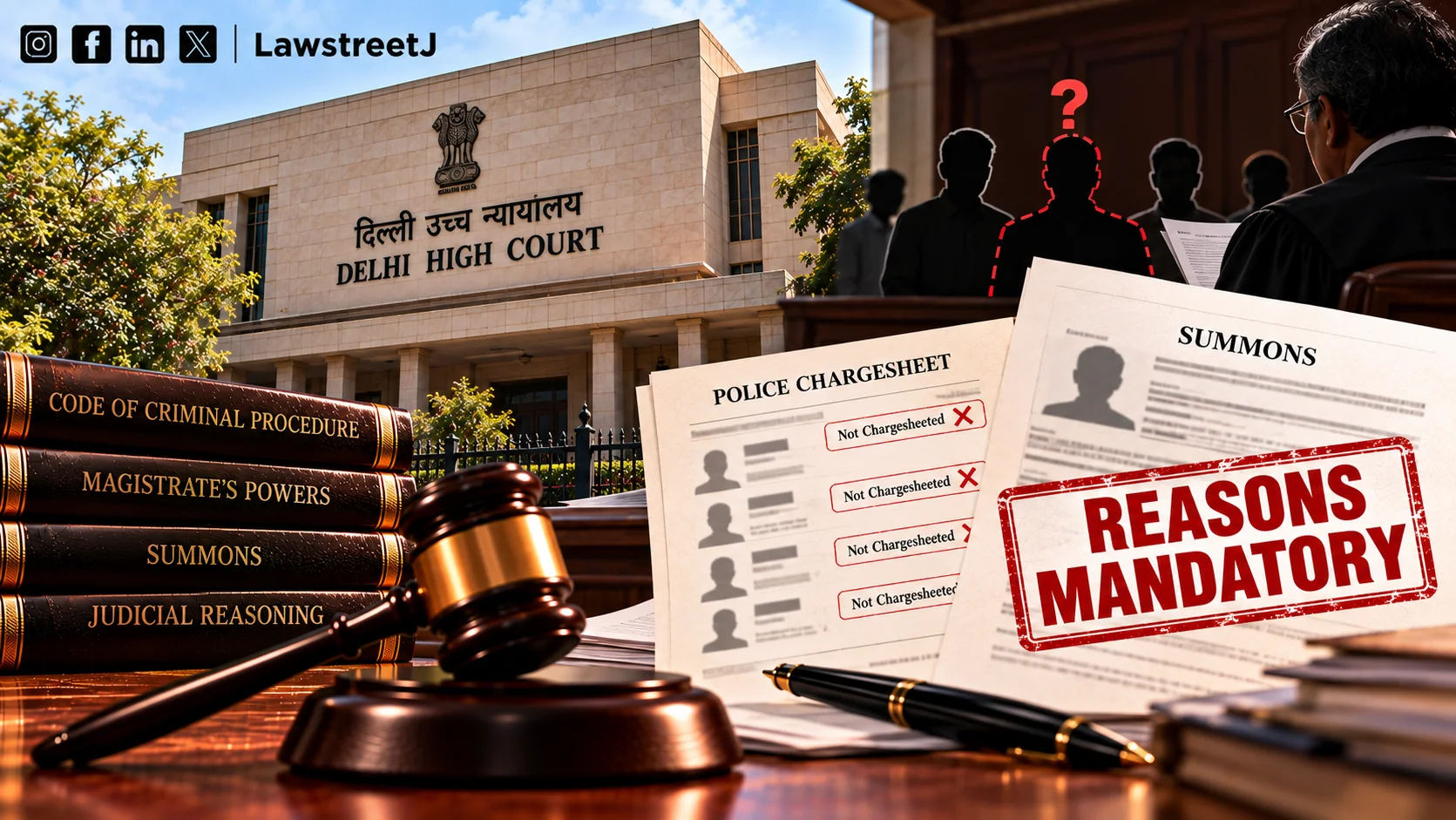
New Delhi: The Delhi High Court has set aside a Magistrate's order summoning a former non-executive director of Raheja Developers Ltd., whom the investigating agency had placed in Column 12 of the charge-sheet, holding that a Magistrate who summons a person not sent up for trial must record the material relied upon, and remitting the question of issuing process for fresh consideration.
Justice Madhu Jain, in a judgment pronounced on 12.10.2026 in CRL.M.C. 2148/2025, Zubair Ahmed v. State Govt. of NCT of Delhi and Anr., partly allowed a petition under Section 528 of the Bharatiya Nagarik Suraksha Sanhita, 2023. It challenged the order dated 07.02.2025 of the Chief Judicial Magistrate, South District, Saket Courts, in Criminal Case No. 308/2022, arising from FIR No. 603/2018, by which cognizance was taken of offences under Sections 406, 420 and 120B of the IPC and the petitioner was summoned.
The petitioner was a non-executive director of the company from 20.08.2009, and resigned by a letter dated 18.08.2015, with the Registrar of Companies recording his cessation on 21.08.2015. The complainants, Rajat Dayal and his wife, had booked a flat in the company's project in Gurugram in 2014, followed by an Agreement to Sell and an MoU providing for refund with a premium on cancellation. Alleging construction delay and non-repayment after cancellation in 2017, they approached the police, naming the company, its directors and certain officials, but not the petitioner. An FIR followed on 05.10.2018 on a Magistrate's direction under Section 156(3) CrPC.
The Economic Offences Wing examined his role. The charge-sheet sought prosecution of Navin M Raheja, Yogesh Raheja and the company, while the petitioner was placed in Column 12, the agency recording that he received only sitting fees, was not involved in day-to-day affairs and faced no incriminating evidence. Later, the complainant filed a synopsis alleging that he regularly attended Board meetings and knew of the conspiracy. The Magistrate summoned all persons in Columns 11 and 12.
Senior Advocate Siddharth Aggarwal, for the petitioner, argued that the settlement relied on by the complainant was between the complainants and the company, that the grievances arose in 2017–2018 after he had left, and that prosecuting him merely as an erstwhile director would fasten vicarious liability. He submitted that the summoning order reproduced the synopsis as though it formed part of the charge-sheet, reflecting non-application of mind, and distinguished Sangita Arora v. State (NCT of Delhi) as involving a director with a shareholding of about 34 per cent and signed documents.
The complainant argued that the conspiracy began with the 2014–2015 transactions, when the petitioner was a director, that the Magistrate is not bound by the investigating agency's opinion, relying on Jagdish Ram v. State of Rajasthan, and that examining the role of a non-executive director at this stage would amount to a mini-trial. It also objected that the petitioner had not availed the revisional remedy under Section 397 CrPC.
The Court identified the issue as whether the order showed the judicial mind required by Sections 190 and 204 CrPC (corresponding to Sections 210 and 227 of the BNSS). Relying on Sunil Bharti Mittal v. CBI and the Delhi High Court's decision in Radesh Singh v. State, it held that a Magistrate may summon even a person placed in Column 12, but must pass a speaking order that discloses sufficient grounds for proceeding, since the investigating agency found no material at the threshold.
Examining the material, the Court found that the allegations recorded in the impugned order, that the petitioner regularly attended Board meetings, was aware of the conspiracy and knowingly followed directions, did not emanate from the charge-sheet and were substantially a reproduction of the complainant's synopsis. The order's statement that a "bare perusal of the charge-sheet" showed active participation was not borne out by it. The Bench said that where the agency has found no incriminating material, "the order must at least identify the material relied upon" and briefly indicate why it furnishes sufficient ground, and held the order non-speaking as far as the petitioner was concerned.
The Court declined to examine the sufficiency of the material itself, saying this would substitute its satisfaction for that of the Magistrate. Following the course adopted in Shiv Jatia v. Gian Chand Malick, Sanjit Bakshi v. State and Radesh Singh, it set the order aside to the limited extent of the summons against the petitioner and remitted the matter. It also rejected the revision objection, holding in line with Prabhu Chawla v. State of Rajasthan that revision does not bar inherent jurisdiction, and that the interference was confined to the defect in the order.
The trial court has been directed to reconsider afresh on the complete record, including the charge-sheet, the synopsis and the material relied on in support, and pass a reasoned order. The Court clarified that it had not examined whether the material is sufficient, that the criminal case and FIR were not quashed, and that proceedings against the other accused continue unaffected. Interim orders stand vacated.
Appearances:
For the Petitioner: Mr. Siddharth Aggarwal, Senior Advocate, with Ms. Smriti Sinha, Ms. Aleena, Ms. Vismita Diwan, Mr. Japman Singh and Mr. Divyash Sharma, Advocates.
For the State: Ms. Meenakshi Dahiya, APP, with Mr. Aditya Vikram Singh, Advocate, and Insp. Ramkesh, P.S. EOW.
For Respondent No. 2 (Complainant): Mr. Madhav Sareen, Ms. Raunak Wahi, Ms. Vanshika Jha, Ms. Pradhi Sahni and Mr. Raghvendra Pratap Singh, Advocates.
Case Title: Zubair Ahmed vs. State Govt. of NCT of Delhi and Anr., CRL.M.C. 2148/2025


![Delhi High Court Sets Aside Arbitral Tribunal's Award Against NHAI in Highway Project Delay Case [Read Judgment]](/secure/uploads/2023/07/lj_9605_23374c2e-392c-4491-a2fe-f2f12fc5272f.jpg)
![Delhi Court Rejects Stay Request in Defamation Case Against Rajasthan CM Ashok Gehlot [Read Order]](/secure/uploads/2023/08/lj_5208_80de1ddc-d76a-4f7f-b180-408e3ae14fb4.jpg)
.jpeg)