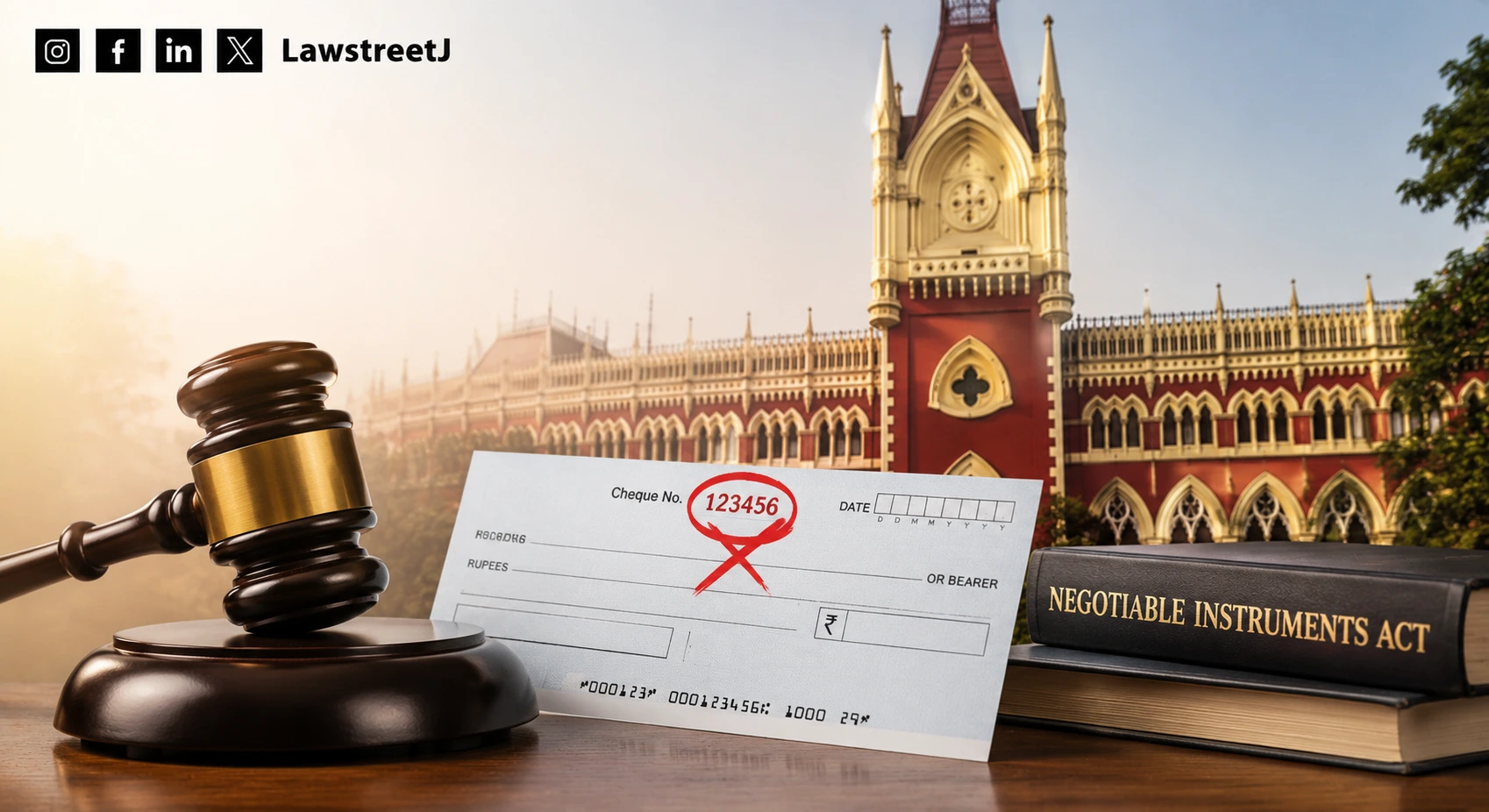
Kolkata: The Calcutta High Court has held that a criminal trial under Section 138 of the Negotiable Instruments Act, 1881, cannot be sustained where the accused was made to answer an entirely different cheque transaction at the stage of recording his plea under Section 251 of the Code of Criminal Procedure, 1973.
Justice Uday Kumar, while holding that such a defect strikes at the root of a fair trial, set aside the six-month sentence of imprisonment imposed on the accused, Sudipta Ghosh, while maintaining the direction to pay Rs.3 lakh as compensation, since the amount had already been deposited.
The complainant, Chandana Pal, had extended a friendly loan of Rs.1,50,000 to the petitioner, a practicing Chartered Accountant, in May 2003. Towards repayment, the petitioner issued a cheque dated 12th March 2006 for the same amount, which was dishonoured on presentation for insufficient funds. Upon his failure to clear the liability despite a statutory demand notice, the complainant filed a complaint under Section 138 of the Act, resulting in his conviction by the Metropolitan Magistrate, 16th Court, Calcutta, in 2019, and the confirmation of that conviction in appeal by the Additional District and Sessions Judge, 1st Fast Track Court, in 2022.
Before the High Court, counsel for the petitioner pointed to the original plea sheet dated 29th March 2008, which recorded that the Magistrate had examined the petitioner for the dishonour of an entirely different instrument, Cheque No.901536 dated 27th March 2006 for Rs.5,00,000, rather than the cheque actually forming the subject matter of the complaint. Relying on this Court's decisions in Dilip Kumar Das v. State of West Bengal and Natendra Nath Giri v. State of West Bengal, it was argued that this amounted to an incurable procedural illegality under Section 251 of the Code, causing grave prejudice to the accused.
Rejecting the State's submission that the discrepancy was a mere curable irregularity under Section 465 of the Code, the Court held that the petitioner had been called upon to defend a five-lakh-rupee transaction but was ultimately tried and convicted for a one-and-a-half-lakh-rupee transaction, a defect going to the root of the trial.
“There is a vast difference between correcting a minor clerical slip and confronting an accused with a completely fabricated financial liability.”
On the question of financial capacity, the Court reiterated that once the signature on a cheque is admitted, a presumption arises under Sections 118 and 139 of the Act of 1881 that it was issued for a legally enforceable debt, as held in Rangappa v. Sri Mohan, but that this presumption is rebuttable. Noting the complainant's admission in cross-examination that she was unemployed and had received the loan amount from her father, and the prosecution's failure to examine the father, the Court held that this created an evidentiary gap under the framework laid down by the Supreme Court in K. Prakashan v. P.K. Surenderan, further compounded by the trial court's failure to put this circumstance to the petitioner during his examination under Section 313 CrPC.
The Court, however, rejected the petitioner's arguments on limitation and service of notice, holding that the issuance of a signed cheque within three years of the loan constituted a valid acknowledgment of debt under Section 18 of the Limitation Act, 1963, and that service of the demand notice at the petitioner's verified office address was validly presumed under Section 27 of the General Clauses Act, 1897, relying on C.C. Alavi Haji v. Palapetty Muhammed.
While a procedural breakdown at the Section 251 stage would ordinarily warrant setting aside the conviction and remanding the matter for a fresh trial, the Court noted that the litigation had commenced twenty years ago in 2006, and that the petitioner had already deposited the full compensation of Rs.3 lakh, double the cheque amount, pursuant to an interim order of the Court dated 15th September 2022. Invoking the Supreme Court's ruling in Kalamani Tex v. P. Balasubramanian, the Court held that full restitution rendered a fresh trial and further incarceration unnecessary.
“When an accused complies with judicial directives by depositing double the cheque amount as compensation, the financial injury to the complainant is fully redressed, and an active term of imprisonment becomes unnecessary.”
The Court accordingly allowed the revisional application in part, setting aside the sentence of six months' simple imprisonment while affirming the compensation of Rs.3 lakh under Section 357(3) CrPC, directing that the amount already deposited be treated as full satisfaction of the order and permitting the complainant to withdraw it without further conditions. The petitioner was discharged from his bail bonds, and the criminal proceedings against him were closed.
Appearances: Mr. Debabrata Acharyya and Mr. Sital Samanta, Advocates appeared for the petitioner, while Mr. Debarshi Brahma, Mr. Sourav Mondal, Mr. A. Bhuiya, Mr. S. Maity, Mr. S. Banik and Mr. R. Mondal, Advocates appeared for the opposite party no.2.
Case Title: Sudipta Ghosh vs. State of West Bengal & Anr.



![Calcutta High Court conducts late-evening hearing, orders release of lawyer arrested inside court [Read Order]](/secure/uploads/2023/12/lj_4146_Court_lawyers_arrest.jpg)
![Indian Courts this Week: Law Street Journal's Weekly Round-Up of SC & HCs [Jan 1 - Jan 6]](/secure/uploads/2024/01/lj_9050_WhatsApp_Image_2024-01-06_at_12.07.10_PM.jpeg)