

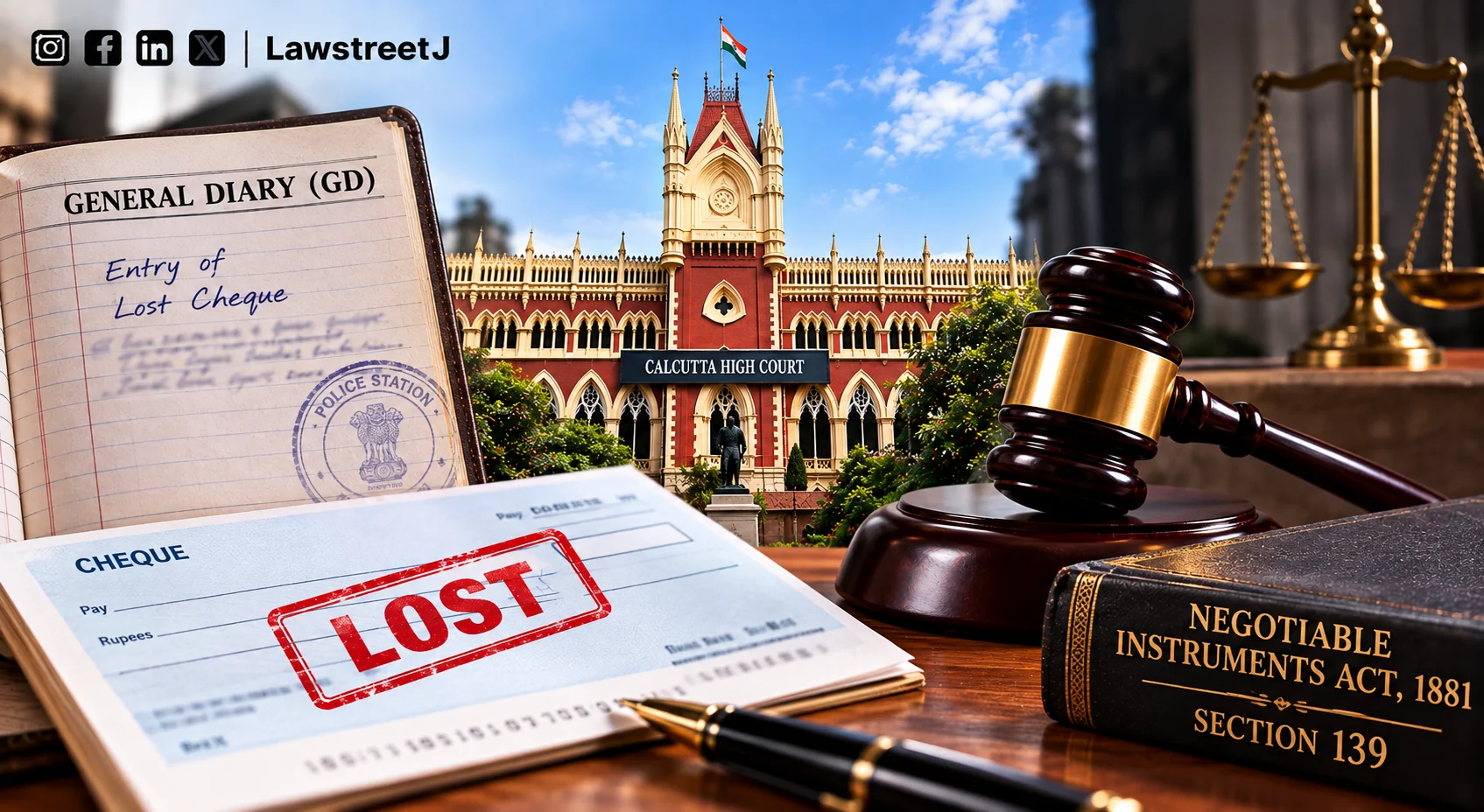
Kolkata: The Calcutta High Court has dismissed a criminal revision challenging concurrent convictions under Section 138 of the Negotiable Instruments Act, 1881, holding that a General Diary entry reporting a lost cheque, unsupported by independent evidence, cannot displace the statutory presumptions once the drawer's signature is admitted, while exempting the petitioner from the seven-day jail term and upholding compensation of Rs. 35,000.
Justice Uday Kumar was hearing CRR 1371 of 2024, filed by Tuhin Gangopadhyay under Section 401 read with Section 482 of the Code of Criminal Procedure, 1973, against the judgment dated 22.02.2024 of the Additional Sessions Judge, 1st Court, Suri, Birbhum, in Criminal Appeal No. 28 of 2021. The appellate court had affirmed the conviction recorded on 22.09.2021 by the Judicial Magistrate, 3rd Court, Suri, while reducing the jail term from three months to seven days and raising the compensation from Rs. 30,000 to Rs. 35,000.
The complainant alleged that the petitioner borrowed Rs. 30,000 on 01.08.2015 for his cloth business, "Madhukari Textile", and issued a cheque dated 06.11.2015 drawn on the State Bank of India, Suri Main Branch. The cheque was dishonoured, a demand notice was issued on 04.12.2015 and received on 07.12.2015, and no payment followed. The petitioner pleaded that he had lost his money bag containing a blank signed cheque on 06.11.2015, lodged G.D. Entry No. 334 at Suri Police Station and instructed his bank to stop payment.
The petitioner argued that the courts below misplaced the burden of proof, that the G.D. entry and the bank deputy manager's testimony rebutted the presumptions under Sections 118 and 139, that the complainant proved neither a legally enforceable debt nor financial capacity, with no written agreement and no reflection in his income tax returns, and that the proprietary firm was not arraigned. He relied on Rajaram v. Maruthachalam, Rajco Steel Enterprises v. Kavita Saraff and Dilip Hariramani v. Bank of Baroda.
The complainant's counsel, Mr. Sujoy Sarkar, objected at the threshold that the petitioner lacked clean hands, since his revision affidavit described him as an "unemployed person belonging to a poor family" although he claimed to run a cloth business during the trial. On merits, he argued that a G.D. entry is no proof of loss and that revisional courts cannot reappreciate evidence, relying on the Supreme Court's recent decision in Kuntegowda v. Thurubaiah.
The Court first overruled the preliminary objection. While reaffirming that a litigant invoking revisional jurisdiction must come with clean hands, it held that the inconsistency was a generalisation of socio-economic distress and not a material suppression going to the root of the case. It said that substantive justice should not be defeated by hyper-technical objections in a challenge to a sentence of imprisonment.
On the "lost cheque" defence, the Court held that under Section 139 the court must presume that the cheque was issued in discharge of a debt or liability once the signature is admitted. A bare G.D. entry, uncorroborated by police investigators, public notice or immediate action against the complainant after the demand notice, remained an ex post facto creation of evidence. The petitioner also failed to explain how a blank signed cheque reached the complainant. Rajco Steel was distinguished, since there the foundational transaction had been disproved.
On the absence of a written agreement and income tax return entries, the Court held that these may weigh heavily in large, unexplained transactions, but that this cannot become an inflexible rule invalidating every modest hand loan, such as the Rs. 30,000 involved here. It added that the accused had not raised a probable foundation of the complainant's financial incapacity at the earliest opportunity, namely in the reply to the demand notice. Rajaram was distinguished as a case of massive unexplained cash transactions.
The plea that the firm should have been arraigned, raised for the first time before the High Court, was rejected as legally misconceived. The Court held that "A proprietary concern is not a distinct legal entity separate from its proprietor", so the liability of a proprietorship is the proprietor's personal and unlimited liability, and non-arraignment of the trade name is not a fatal defect.
On the scope of revision, the Court stressed that "a Revisional Court does not function as a second appellate court." Interference is warranted only where findings are perverse, based on a misreading of evidence or vitiated by a manifest error of law. Finding no perversity in the concurrent findings, it answered all five questions against the petitioner.
The Court dismissed the revision on merits and affirmed the convictions. However, for the ends of justice, it modified the sentence to exempt the petitioner from the seven days of simple imprisonment, while upholding the compensation of Rs. 35,000 and the default sentence. Full credit must be given for any sums already deposited during the trial, appeal or revision. The Trial Court was directed to disburse the compensation to the complainant on realisation and, in default, to invoke Sections 421 and 431 of the Code of Criminal Procedure. There was no order as to costs.
Appearances:
For the Petitioner: Ms. Sima Ghosh and Mr. Sayantan Rakshit, Advocates.
For Opposite Party No. 2: Mr. Sujoy Sarkar, Advocate.
Case Title: Tuhin Gangopadhyay vs. State of West Bengal and Anr., CRR 1371 of 2024