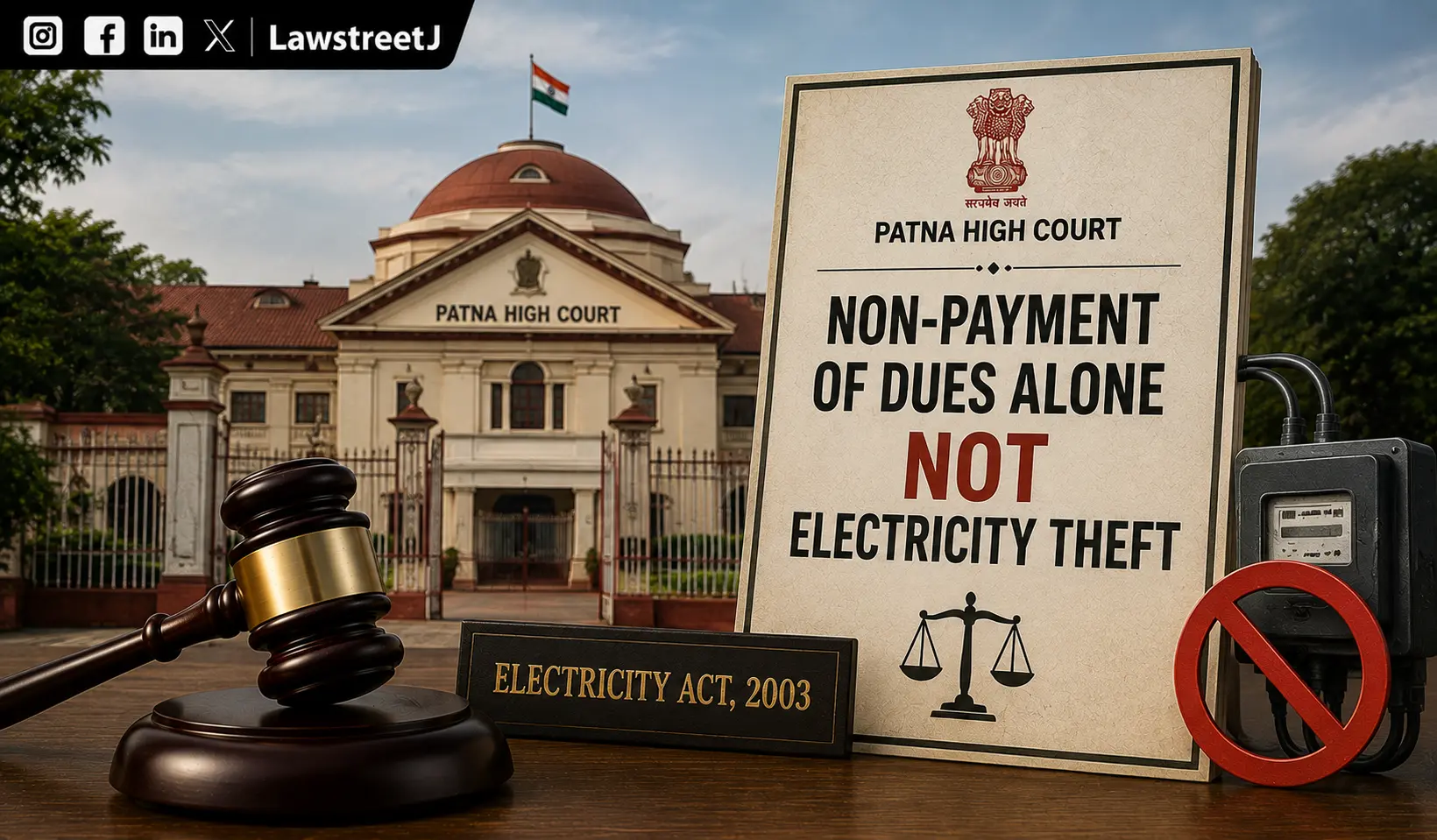
Patna: The Patna High Court has quashed an FIR registered against a domestic power consumer under Section 135 of the Electricity Act, 2003, holding that mere non-payment of electricity dues does not amount to theft of electricity where there is no material on record to show that the connection was actually disconnected or that the meter was tampered with.
Justice Jitendra Kumar was hearing a writ petition filed by Md. Shahid Imam seeking quashing of Nawadah Town P.S. Case No. 363 of 2022, registered against him for the offence punishable under Section 135 of the Bihar Electricity Act, 2003. As per the written report, officials of the Electricity Department, on raid, found the petitioner consuming electricity in his domestic premises despite disconnection of the connection on 04.01.2021 over an outstanding due of Rs.5,39,126, and without payment of the due amount or obtaining an R.C. receipt. SBPDCL claimed to have suffered a loss of Rs.1,96,811 on account of the alleged unauthorised consumption, as per the inspection/seizure report annexed with the written report.
Counsel for the petitioner submitted that the petitioner had been falsely implicated. While admitting that electricity charges remained outstanding, he contended that the domestic connection was never actually disconnected, and that the inspection notes annexed with the FIR did not record any tampering of the meter, despite a specific column provided for the purpose. It was argued that the petitioner had never consumed electricity dishonestly, that his meter was running as usual, and that he was willing to pay the dues in accordance with law so that, at best, only a civil liability arose, and no case was made out under Section 135.
Counsel for SBPDCL, Mr. Sanjay Kumar Giri, defended the FIR, submitting that electricity had been consumed dishonestly despite disconnection of the connection over the outstanding dues. He pointed out that as per the inspection report, the meter was running and showed a reading of 59425 Kwh at the time of disconnection on 04.01.2021, as against a reading of 71412 Kwh on the date of the raid, 19.04.2022.
The Court noted that Section 135 of the Electricity Act, 2003 deals with theft of electricity and requires dishonest intention, whereas Section 126 provides for assessment of electricity charges payable on account of unauthorised use of electricity, without any element of mens rea. Referring to the Supreme Court's decision in Southern Electricity Supply Co. of Orissa Ltd. Vs. Sri Seetaram Rice Mill, (2012) 2 SCC 108, the Court reproduced the distinction drawn between the two provisions, including the observation that dishonesty is a state of mind that has to be shown to exist before a person can be punished under Section 135, whereas intention is not the foundation for an assessment order under Section 126. The Court also referred to the Chhattisgarh High Court's decision in Chhattisgarh State Power Distribution Co. Ltd. Vs. Dinesh Chandra, (2026 SCC OnLine Chh 10813), which reiterated the same distinction and the meaning of "dishonestly" under Section 24 of the Penal Code, 1860.
Applying this distinction to the facts, the Court held that the claim of disconnection was not supported by the material on record, as neither the FIR nor the inspection notes annexed with the written report contained any reference to tampering of the meter or to the connection having actually been cut and sealed. The meter, on the contrary, was found running normally, with its reading having risen in step with consumption between the date of alleged disconnection and the date of the raid.
It clearly shows that the Petitioner was not consuming electricity with dishonest intention, in fact, he was using it bonafidely. The only thing against the Petitioner is that he had not paid the electricity charge due against him to the SBPDCL.
The Court concluded that while the petitioner may face civil liability for the outstanding dues, no criminal liability under Section 135 was made out on the alleged facts and circumstances, and accordingly allowed the writ petition and quashed the FIR. It clarified that SBPDCL remains at liberty to recover the electricity charges in accordance with law, including by invoking Section 126 of the Electricity Act if the conditions precedent for such assessment are fulfilled.
Appearances:
For the Petitioner: Mr. Arun Kumar, Advocate.
For the State: Mr. Sheo Shankar Prasad, SC-8.
For the Respondents: Mr. Sanjay Kumar Giri, Advocate; Mr. Mritunjay Harsh, Advocate.
Case Title: Md. Shahid Imam vs. The State of Bihar & Ors., Criminal Writ Jurisdiction Case No.645 of 2022


![Immediately stop caste-based survey: Patna High Court to Bihar Government [Read Order]](/secure/uploads/2023/05/lj_2614_70fde4fe-1b94-4360-a3d2-e162d6022c46.jpg)


![Supreme Court refuses pre arrest bail to IPS officer accused of creating fake WhatsApp account of HC's CJ [Read Order]](/secure/uploads/2023/11/lj_1575_Fake_WhatsApp_account_of_Patna_HC_Chief.jpg)