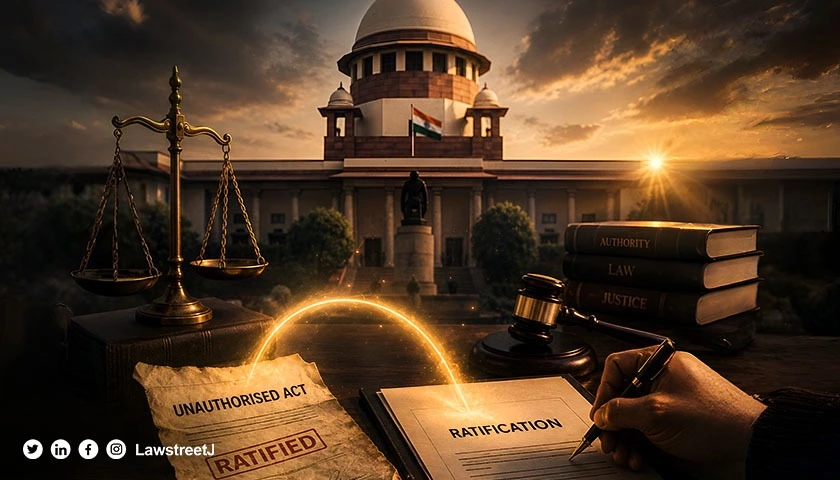
New Delhi: The Supreme Court has held that once a competent authority ratifies an act earlier performed without proper authority, the ratification relates back to the date of the original act, validating it as though authority had existed from the outset.
A Bench of Justices Pamidighantam Sri Narasimha and Alok Aradhe rendered the ruling while deciding two connected appeals arising from proceedings before the Delhi and Kerala High Courts, both concerning an employee's attempt to withdraw a tendered resignation after it had already been accepted and acted upon.
The respondent, B.S. Rawat, had joined Delhi Technological University (DTU) as Assistant Registrar (Legal) in 2010. In May 2016, he tendered his resignation and, at his own request, sought an advanced effective date along with a waiver of the notice period. His resignation was accepted with effect from 31.05.2016 by the then Vice-Chancellor, who at the time held only additional charge of the post.
Rawat was relieved, and his no-dues certificate, last pay certificate and experience certificate were issued and accepted by him without demur. It was only four months later, on 22.09.2016, that he wrote seeking withdrawal of his resignation, contending that it had never been validly accepted since the officer who accepted it was not the competent authority under Section 23(2)(ix) of the Delhi Technological University Act, 2009, that power vesting instead in the Board of Management (BOM).
The BOM, at its meeting on 26.09.2016, ratified the earlier acceptance, and Rawat's request for withdrawal was subsequently rejected. While the Delhi High Court's Single Judge directed his reinstatement with full back wages, the Division Bench affirmed reinstatement but denied back wages on account of his having taken up gainful employment in the interim.
Examining the doctrine of ratification, the Court explained that it "denotes the confirmation or adoption, by a person or body possessing the requisite authority, of an act earlier done on its behalf without such authority, or done irregularly, so that the act is treated as valid from its inception." Tracing its origin to the maxim ratihabitio mandato aequiparatur, a subsequent ratification is equivalent to a prior command, the Bench held that a ratified act is deemed valid from the date of the original unauthorised act, and not merely from the date of ratification.
The judgment culled out several governing principles: ratification cures the absence of prior authority and operates retrospectively; only the authority legally empowered to perform the act can ratify it; express approval by way of a resolution suffices, without any need for a fresh order; but the doctrine cures only defects of authority, and cannot validate an act that is inherently void or prohibited by law.
The Court also invoked the principle against approbation and reprobation, holding that a resignation may become a consummated and irrevocable transaction where both sides have, by their conduct, treated it as final and altered their positions accordingly, even if the initial acceptance suffered from a want of authority. Relying on the House of Lords decision in Reichel v. Bishop of Oxford, as noted in this Court's earlier ruling in Union of India v. Gopal Chandra Misra, the Bench observed that a resigner who has done all that lay in his power to complete the transaction cannot later be permitted to upset it merely because formal acceptance came from an improperly authorised officer.
Applying this to the facts, the Court found that Rawat himself had initiated and expedited the process, sought an advanced relieving date, accepted all consequential benefits, and thereafter used the experience certificate issued by DTU to secure fresh employment with the National Institute of Technology, Calicut (NITC) as Deputy Registrar.
The Bench held that he "cannot have his cake and eat it too" claiming the benefits of a completed exit when convenient, while later treating the exit as a nullity when it suited him to return. Since the BOM's ratification related back to 25.05.2016, there was, in point of law, no resignation left in existence for Rawat to withdraw by his letter of 22.09.2016. The Delhi High Court's direction of reinstatement was accordingly set aside.
In the connected matter, Rawat had challenged the Kerala High Court's dismissal of his claim for reinstatement at NITC, where his resignation, tendered in November 2018, was accepted by the competent authority on 22.11.2018 and communicated on 04.12.2018, though he was relieved only on 11.01.2019 upon completion of the notice period. Days before communication of acceptance, upon securing selection on deputation with the East Delhi Municipal Corporation, Rawat sought to withdraw his resignation, a request rejected by a reasoned order. The Court held that under the proviso to Statute 30 of the NIT First Statutes, 2009, a resignation takes effect on the date of its acceptance by the appointing authority, irrespective of communication or the running of the notice period; the notice period governs only the date of actual relieving.
It further held that the Office Memorandum dated 11.02.1988, while ordinarily permitting withdrawal of an accepted resignation before relieving, expressly preserves the competent authority's discretion to refuse such withdrawal for recorded reasons, a discretion the Court found had been properly exercised given Rawat's own admission, in his resignation letter, that he was "not interested to work anymore" at the Institute, and the timing of his withdrawal request immediately upon securing alternate employment.
Accordingly, the Court allowed DTU's appeal and set aside the direction of reinstatement, dismissed Rawat's appeal for back wages as infructuous, and dismissed his special leave petition against the Kerala High Court's judgment, with no order as to costs.
Case Title: Delhi Technological University vs. B.S. Rawat