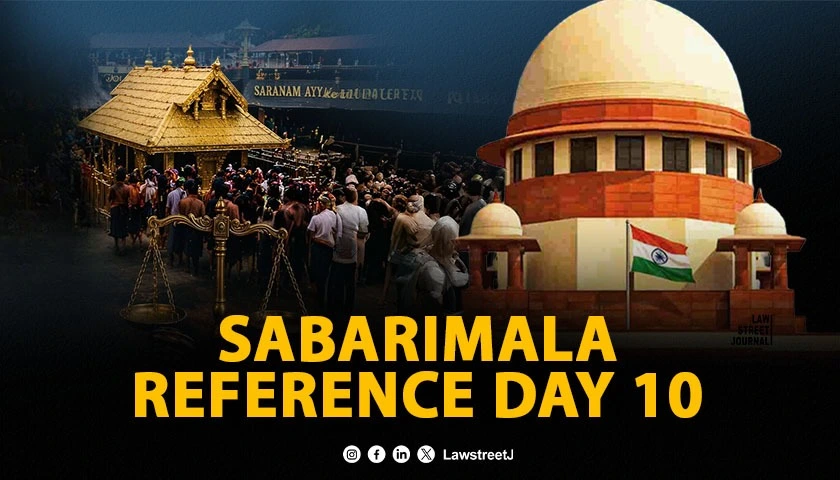
New Delhi: The nine-judge Constitution Bench of the Supreme Court, on April 29, 2026, continued hearing the Sabarimala reference in Indian Young Lawyers Association v. State of Kerala, with Senior Advocate Indira Jaising advancing arguments on behalf of the petitioners. The respondents had not commenced their arguments as of the close of the day’s proceedings.
This was Day 10 of the reference. The Bench is led by the Chief Justice Surya Kant and comprises Justices B.V. Nagarathna, M.M. Sundresh, Ahsanuddin Amanullah, Aravind Kumar, A.G. Masih, P.B. Varale, R. Mahadevan, and Joymalya Bagchi.
Senior Advocate Indira Jaising commenced her arguments by submitting that the reading of a constitutional text is different from the reading of a statute, and sought to illustrate what it means to read a constitutional text. She stated that she would consolidate all arguments into one, addressing all issues except locus standi, which she indicated would be addressed separately.
Jaising informed the Bench that she is representing two women petitioners, one of whom belongs to a Scheduled Caste community. She raised the question of whether denying entry to a Scheduled Caste woman amounts to a violation of Article 17 of the Constitution, and whether the right under Article 17 is applicable only to men.
She submitted that excluding a woman between the ages of 10 and 50 from the temple causes a substantial injury to her rights under Article 25(1), and noted that following the 2018 judgment, the two women she represents had gone to the Sabarimala Temple for darshan and subsequently filed a petition before the Court. She stated that one of the petitioners had gone to the temple with her mother, acting according to her conscience, and was mob-lynched.
On Constitutional Interpretation:
Jaising submitted that the Constitution is a living document to be interpreted in the light of justice, liberty, dignity, equality, and fraternity, and that dignity cannot exist without privacy. She argued that a purely textual reading of the Constitution is insufficient, citing the Supreme Court’s judgment in NALSA, which she submitted held that the Constitution must be interpreted to achieve its higher essence.
She further argued that the legislature cannot always be relied upon for reform as it is time-consuming, and that the Court should adopt an approach of interpreting the Constitution as a living instrument. She submitted that even when the Court was asked the scope of public policy under Section 23 of the Contract Act, it held that public policy must evolve in consonance with the Constitution.
Jaising submitted that the Constitution is not without a philosophy, and that in a society shaped by wealth and power, the search for equality has been a continuous one. She argued that the Constitution was built on a clean slate, removing all limitations such as caste.
On the question of constitutional morality, she submitted that no court has struck down anything solely on the basis of constitutional morality, and that it has been used to determine the scope of Articles 14, 25, and 26. She added that the Court is not being asked to take constitutional morality beyond the Constitution itself, and noted that India has a single secular, hierarchical judicial system, and not ecclesiastical courts, making it redundant to suggest that the Court cannot look into religion.
On Essential Religious Practices and Denominational Rights:
Jaising submitted that all six referred questions reduce to one: what is protected and what is not, and that the conscience of the Bench is the Constitution. She argued that the essential religious practices test was evolved by the Court because genuineness is a subjective test, whereas essential practice is not.
She submitted that her case is that denominational rights are subordinate to individual rights, and that she is not seeking to interfere with the rituals of temples, but questioning whether anybody can be kept out for any reason. She cited the judgments in Seshamal and Adi Shaiva as answering this question.
She argued that for a body to qualify as a religious denomination, there must be a doctrinal difference, and that being a temple alone does not make an institution a denomination. She submitted that the Ramakrishna Mission was declared a denomination because it has an organisation, structure, corporate personality, and a doctrinal difference.
She further submitted that every religion reforms itself from within, and that the history of Hinduism is the history of reform movements, adding that religion has the capacity to regenerate itself if it is to remain relevant. She argued that the word “social reform” in the Constitution exists for this reason.
Jaising submitted that Article 13 provides that if a custom violates fundamental rights, it will not continue, and that this is where the judgment in Devaru and the essential religious practices doctrine become relevant. She argued that the right to equality is higher than any norm, and that everything else—custom, practice, and morals—must be subject to the grundnorm.
She stated that she is not contesting the Court’s protection of ritualistic ceremonies and its position that such ceremonies are beyond social reform, but that her arguments are confined to the rights of individual believers. She cited Article 32 as the basis for the maintainability of the petitions, pointing to T.M.A. Pai as an instance where the Court reopened a settled judgment.
She asked whether Article 26’s guarantee of autonomy to religious denominations can be used to keep women out of a temple while leaving their right to worship unaddressed, and submitted that a religious denomination can and must be held responsible for respecting the rights and dignity of women.
Bench Exchanges:
Justice Amanullah questioned whether customs have crystallised into essential practices and whether customs and essential practices can be treated separately, stating that history cannot be forgotten. He asked whether the Court should determine which view prevails when there is a minority within a religion.
Jaising responded that the religion itself answers that question, and that discovering the content of a religion is a question of fact, noting that the British called theologians to court to assist in such determinations.
Justice Amanullah observed that if one wishes to discard an individual’s right to faith by subjecting it to a majority belief, then the Court would need to be assisted as to how not to do so. He also asked whether only a devotee can enter a temple, to which Jaising responded that she believes anybody can enter the house of God.
Jaising submitted that there has to be a framework for a Hindu to enter a public place of worship, to which Justice Amanullah responded that in a public place of worship, the worship component will overpower the argument.
Justice Nagarathna questioned whether the person claiming the right is a devotee, noting that the petitioner is not even living in South India. She also asked whether the Court can sit in judgment on a matter of conscience. Jaising responded that no one can be called to account for their conscience, but that she is questioning a practice and not a conscience.
Justice Nagarathna also stated that the Constitution was not drafted on a clean slate and that the past must be considered. Jaising submitted that the Constitution is built on a clean slate precisely because it removes all limitations such as caste.
Justice Bagchi noted that the restriction is not on women as a category but specifically on women between the ages of 10 and 50, and observed that it is not a question of judicial review but of deference. Justice Bagchi also observed that a religious denomination need not look to constitutional text to determine how to manage its own affairs.
Justice Sundresh observed that when the State invokes Article 25(2)(b), it deals with a religious practice on its face, but that the State and the Court are concerned only with social welfare and social order, and that while there may be an impact on religious practice, the concern remains with social welfare alone. Jaising agreed, stating that this is her argument exactly.
Justice Nagarathna noted that whatever the Bench decides will be decided in juxtaposition with the law it declares.
Jaising also submitted that if the Court is willing to reopen settled judgments under Article 32, the petitioners would also file an Article 32 petition, adding that people who stand by the law tend to suffer.
In a remark recorded during proceedings, Jaising stated that Senior Advocate A.M. Singhvi had offered her an award for not interrupting even under grave and sudden provocations during the hearing, and that she intends to claim it after the hearing concludes.
The matter is expected to continue with Jaising’s arguments, after which the respondents will commence their submissions.
Case Details:
- Court: Supreme Court of India, Nine-Judge Constitution Bench
- Case: Indian Young Lawyers Association v. State of Kerala
- Bench: Chief Justice Surya Kant; Justices B.V. Nagarathna, M.M. Sundresh, Ahsanuddin Amanullah, Aravind Kumar, A.G. Masih, P.B. Varale, R. Mahadevan, and Joymalya Bagchi
- Date of Hearing: April 29, 2026 (Day 10)
- Counsel Appearing on Day 10: Senior Advocate Indira Jaising for the petitioners
- Status: Petitioners’ arguments ongoing; respondents yet to commence