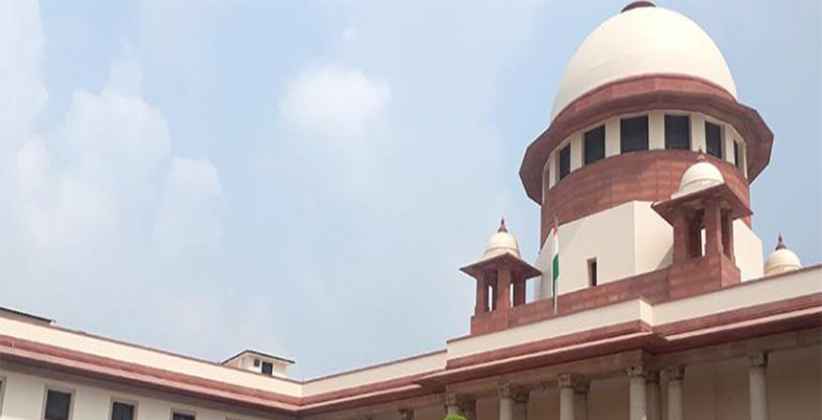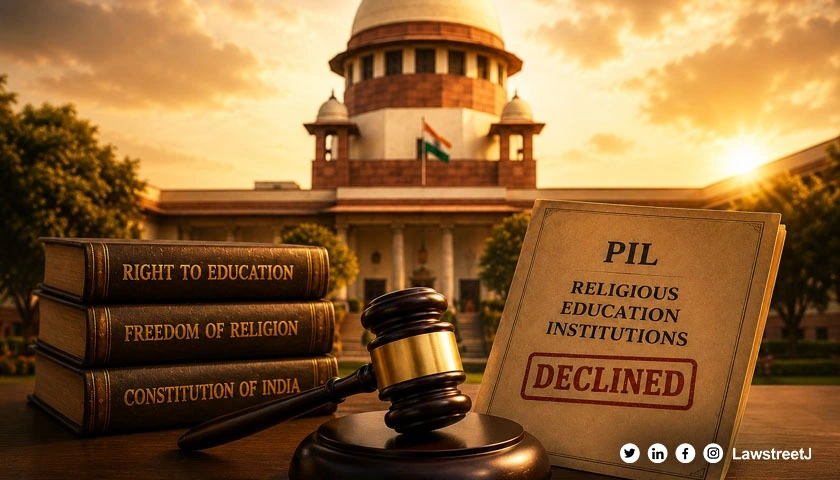
New Delhi: On Monday, the Supreme Court of India declined to hear a Public Interest Litigation (PIL) seeking mandatory registration, recognition, and regular monitoring of all institutions imparting secular education or religious instruction to children up to 14 years.
A Division Bench of Justices Aravind Kumar and Vipul M. Pancholi advised the petitioner, advocate Ashwini Kumar Upadhyay, to enforce a previously obtained order through contempt proceedings rather than repeatedly filing fresh writ petitions on the same cause.
Upadhyay, appearing in person, argued that thousands of unregistered, semi-religious minority educational institutions operate across India's border districts without state supervision. The plea contended that this lack of oversight poses a grave threat to national security, unity, and child safety, violating the fundamental right to quality education under Article 21A. It further claimed that gullible young children could easily be brainwashed or radicalised under the guise of religious instruction in these unmonitored environments.
However, the Bench immediately questioned the maintainability of the petition. Pointing out that this was the third writ petition filed by Upadhyay on the same issue, the Bench noted that the court had already directed the authorities to consider his representation within two months in a previous order. Upadhyay submitted that despite this directive, the authorities failed to decide on his representation even after three months, leaving him no option but to file a fresh plea.
The Bench was unimpressed and cautioned that successive writ petitions for the same relief are not maintainable. Justice Aravind Kumar observed that a fresh petition would be dismissed in limine, advising Upadhyay to file a contempt petition instead. The judges emphasized that seeking contempt was the correct path to enforce the order he had already secured, warning him not to "hit a self-goal" or "spoil a good case" through repetitive filings.
However, the petitioner attempted to argue and justify the larger questions raised in his PIL including the interplay between Articles 26 and 30 of the Constitution. The petition sought a declaration that Article 30 only protects minority institutions imparting secular or professional education and does not extend to religious instruction. It argued that institutions providing religious education should instead be governed under Article 26, which regulates religious and charitable establishments.
The Bench made it clear that these constitutional issues were irrelevant to the maintainability of the present petition. Justice Kumar reiterated that because a writ of mandamus had already been issued in Upadhyay's favour, the appropriate course was enforcement via contempt.
In light of the court's disinclination to proceed, Upadhyay sought permission to withdraw the petition. The Court dismissed the petition as withdrawn, granting liberty to take appropriate steps.
Case title: Ashwini Kumar Upadhyay v. Union of India and Ors. [W.P.(C) No. 868/2026]