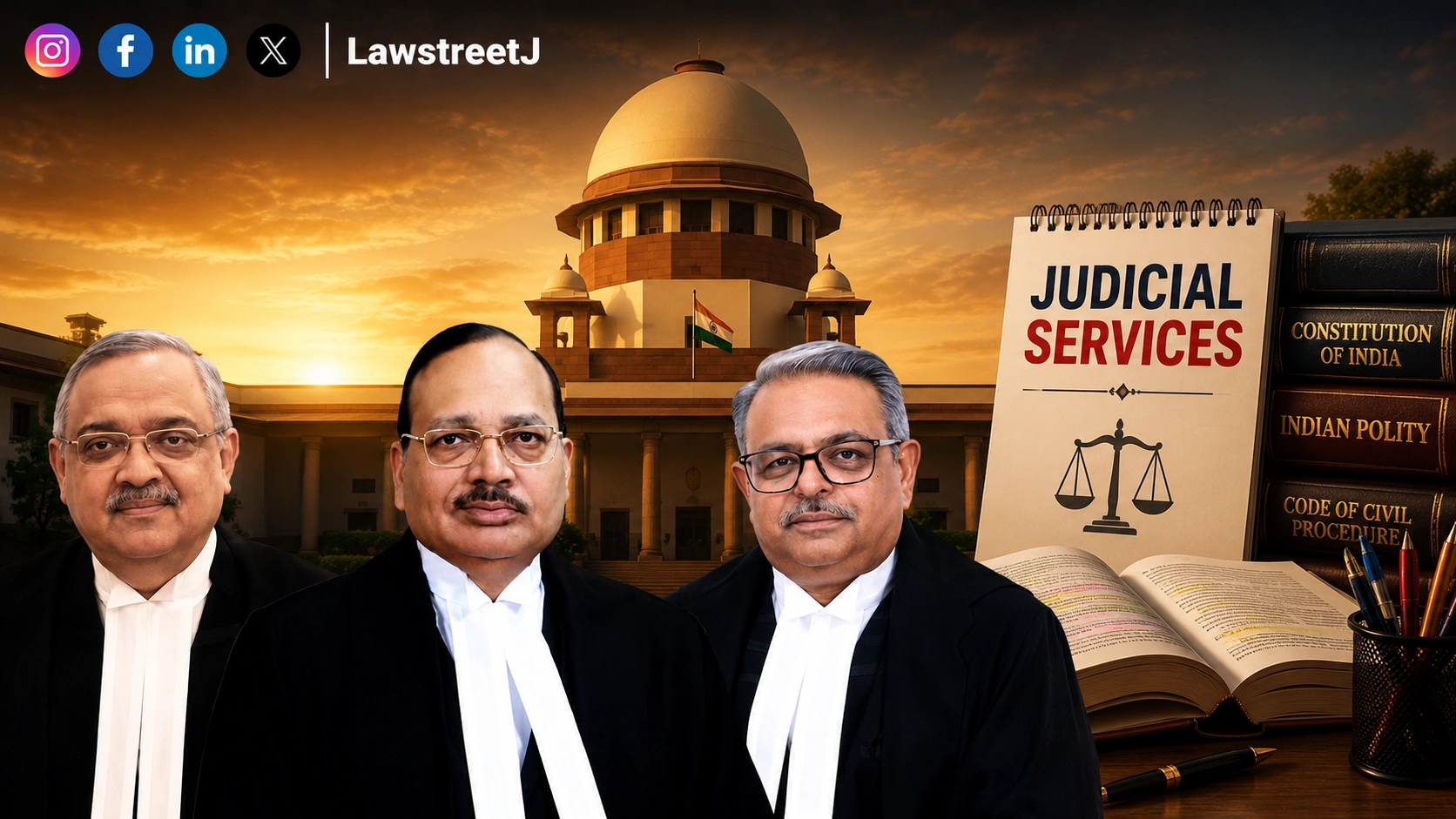
New Delhi: The Supreme Court on Friday modified its May 2025 judgment mandating three years of legal practice for direct recruitment to the post of Civil Judge (Junior Division), reducing the mandatory Bar practice requirement to one year.
The three-judge Bench comprising Chief Justice of India Surya Kant and Justices Augustine George Masih and K. Vinod Chandran pronounced its judgment on a batch of review petitions challenging the earlier ruling.
The Court directed that recruitment notifications issued on or after April 1, 2027 shall require candidates to possess at least one year of verified active practice at the Bar. As a transitional measure, however, law graduates have been permitted to appear in judicial service examinations without fulfilling the three-year practice requirement until March 31, 2027.
The Court has simultaneously introduced a structured practical-training framework for successful candidates. Those selected for judicial service will undergo one year of intensive training at the State Judicial Academy, followed by six months of law clerkship under a District and Sessions Judge or a member of the Higher Judicial Service, and another six months of law clerkship under a sitting judge of the concerned High Court.
Justice K. Vinod Chandran has dissented from the majority judgment.
Background
The issue of mandatory prior legal practice for candidates seeking direct recruitment to the post of Civil Judge (Junior Division) came before the Supreme Court in the context of the qualifications prescribed for entry-level judicial service.
For several years, fresh law graduates were eligible to appear for judicial service examinations without being required to first complete a prescribed period of practice at the Bar. This position changed with the Supreme Court's judgment in All India Judges' Association & Ors. v. Union of India & Ors., delivered on May 20, 2025, in which the Court directed that candidates seeking appointment as Civil Judges (Junior Division) through direct recruitment must have at least three years of practice at the Bar.
The Court's direction was based on the importance of practical exposure to litigation and court proceedings before a candidate assumes judicial office. The underlying consideration was that a judicial officer should have first-hand familiarity with the functioning of courts, the role of advocates and the practical aspects of conducting judicial proceedings.
The judgment subsequently led to several review petitions before the Supreme Court. The petitioners sought reconsideration of the three-year practice requirement and questioned whether prior experience at the Bar should be made a mandatory eligibility condition for entry-level judicial service.
Among the principal arguments raised in the review proceedings was that practical skills required for judicial office could be developed through structured and intensive judicial training after selection. The petitioners also highlighted the impact of the requirement on young law graduates, who would now have to spend three years in legal practice before becoming eligible to compete for entry-level judicial service.
The proceedings also brought into focus the possible impact of the requirement on women candidates. Concerns were raised about whether a uniform three-year practice requirement could create additional practical difficulties for women entering the legal profession and consequently affect their participation in judicial recruitment.
The position of persons with disabilities was also placed before the Court. A separate plea sought relaxation of the three-year practice requirement for persons with disabilities, raising questions concerning the application of the requirement to candidates who may face particular structural or practical difficulties in establishing a conventional litigation practice.
The review proceedings further raised questions concerning what would constitute qualifying legal practice. The Court considered issues relating to different forms of legal experience and whether experience gained in capacities other than conventional courtroom advocacy could be taken into account for satisfying the prescribed requirement.
The implementation of the three-year requirement also had an immediate impact on ongoing judicial recruitment. While the review petitions remained pending, the Supreme Court extended the deadlines for applications to Civil Judge examinations, ensuring that candidates were not prejudiced by the uncertainty surrounding the requirement.
The Supreme Court thereafter heard the review petitions at length. Arguments were advanced both in support of retaining the three-year practice requirement and in favour of reconsidering or suitably modifying it. The Court also considered possible measures concerning women candidates, persons with disabilities and the recognition of different forms of legal experience.
On July 28, 2026, a bench comprising Chief Justice of India Surya Kant, Justice Augustine George Masih and Justice K. Vinod Chandran reserved judgment after hearing the review petitioners, intervenors and the amicus curiae.
Case Title: Bhumika Trust v. Union of India & connected matters